
This DigiTip is a short explainer for busy teachers on understanding bias in generative AI. This clip shows how AI tools can reflect stereotypes, missing perspectives and one-sided views because they are trained on human-created data.
Teachers will learn simple ways to spot defaults, ask for broader perspectives, check whose voices are missing, and use critical thinking instead of accepting AI’s first answer.
Generative AI can feel pretty impressive. It’s quick. It sounds confident. And sometimes, it even feels objective.
But here’s the truth… It’s not neutral.
AI is trained on content created by humans. Text, images, websites, books, articles, videos, posts… all the stuff we’ve been putting out into the world for years.
And because humans create that content, human bias can creep in too.
Sometimes it’s obvious. Sometimes it’s subtle. And sometimes it sounds so reasonable that we don’t even notice it.
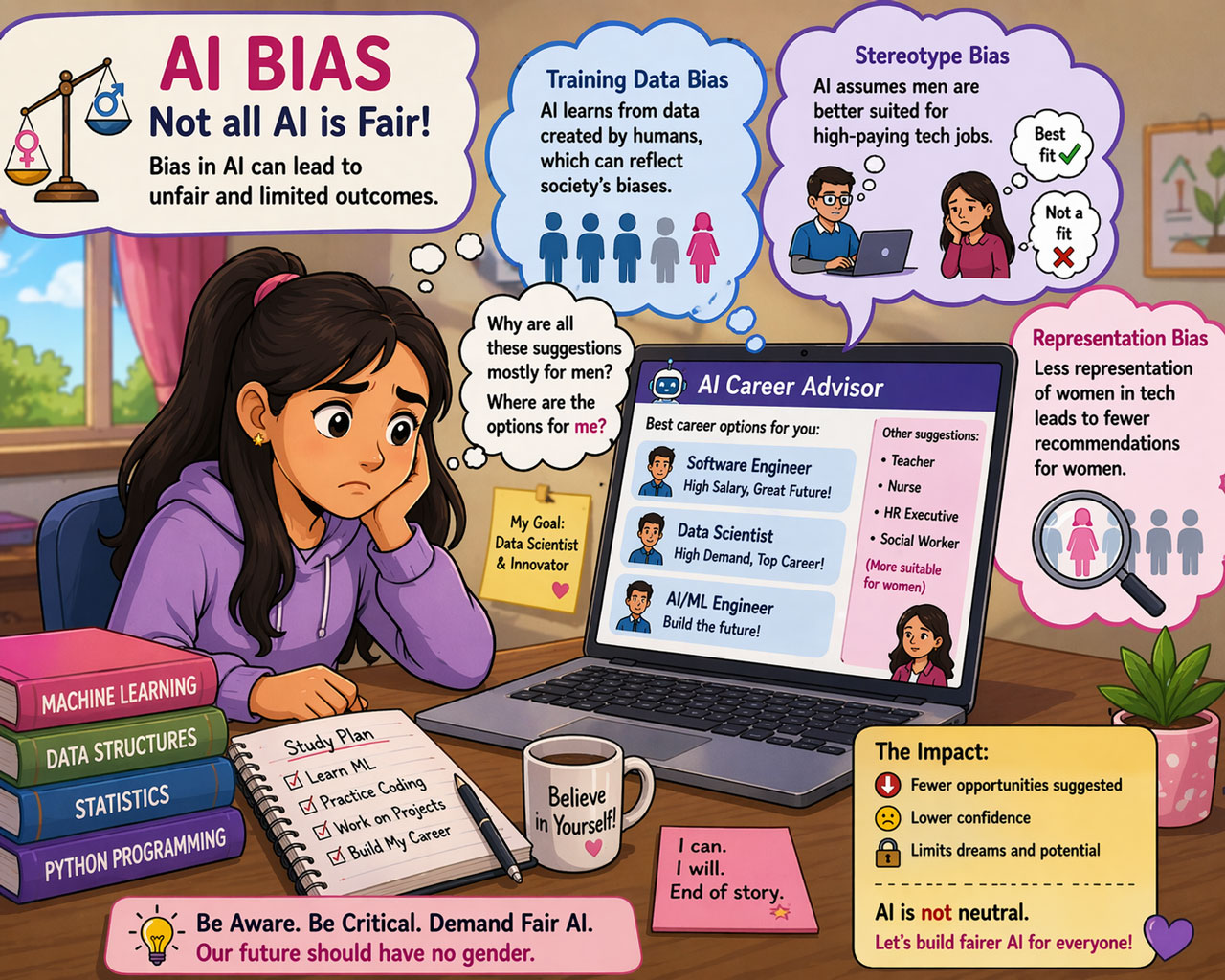
Bias in AI can show up as stereotypes, missing perspectives, or answers that feel a bit too one-sided. For example, let’s ask ChatGPT to create an image of a doctor.
What do we often get? A man in a white coat.
Now let’s ask Claude to create an image of a nurse. Quite often, we get a white woman.
That’s not random.
AI learns from patterns. And if the patterns it has seen over and over again connect “doctor” with men and “nurse” with women, that can shape what it produces.
It doesn’t usually happen because someone sat there and programmed the AI to be unfair. It’s more like the AI is a sponge. It soaks up what it has been dunked in.
And the water isn’t always clean.
The internet isn’t perfectly fair. History books aren’t always balanced. Some cultures, communities, languages, and perspectives have far more online content than others. So, AI can end up knowing a lot about some parts of the world and very little about others.
That’s where we need to be switched on.
You can’t just turn bias off, but you can get better at spotting it.
Start by noticing the default. When AI gives you a person, a story, an example, or an image, ask yourself: what did it assume?
Did it make the hero male?
Did it place the story in a Western-style city?
Did it leave out voices from other cultures or communities?
Once you notice the default, you can challenge it.
Ask the AI to try again.
Try prompts like:
“Can you show this from another perspective?”
“Can you give me examples from different cultures?”
“What would this look like if the main character were a girl?”
“Whose point of view is missing here?”
Most of the time, the AI will adjust. It just didn’t do it the first time.
And that’s the important part.
AI doesn’t decide what’s fair. AI doesn’t decide what’s balanced. You do.
So don’t just accept the first answer. Question it. Push it. Improve it.
In an AI-powered world, critical thinking matters more than ever. Because AI reflects the world as it is.
But with the right prompts, the right questions, and the right mindset, we can help shape what it could be.
 Dr Tim Kitchen