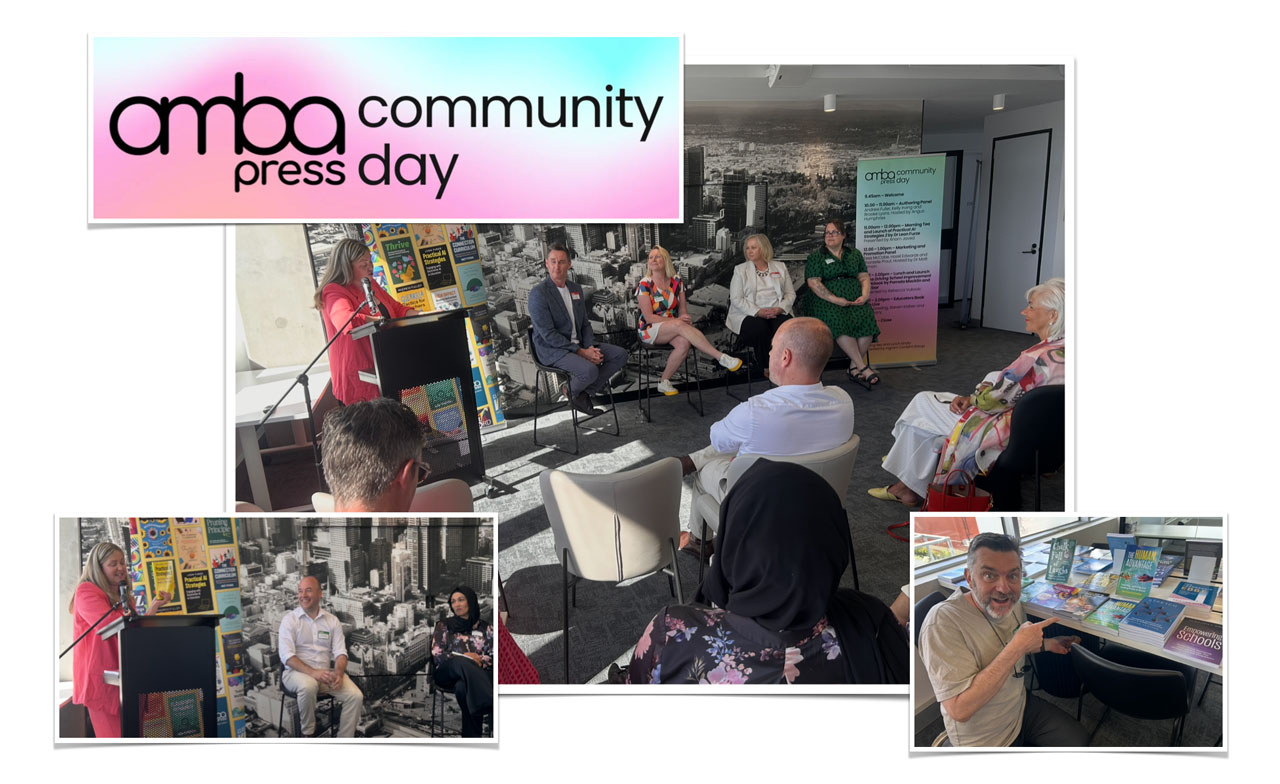
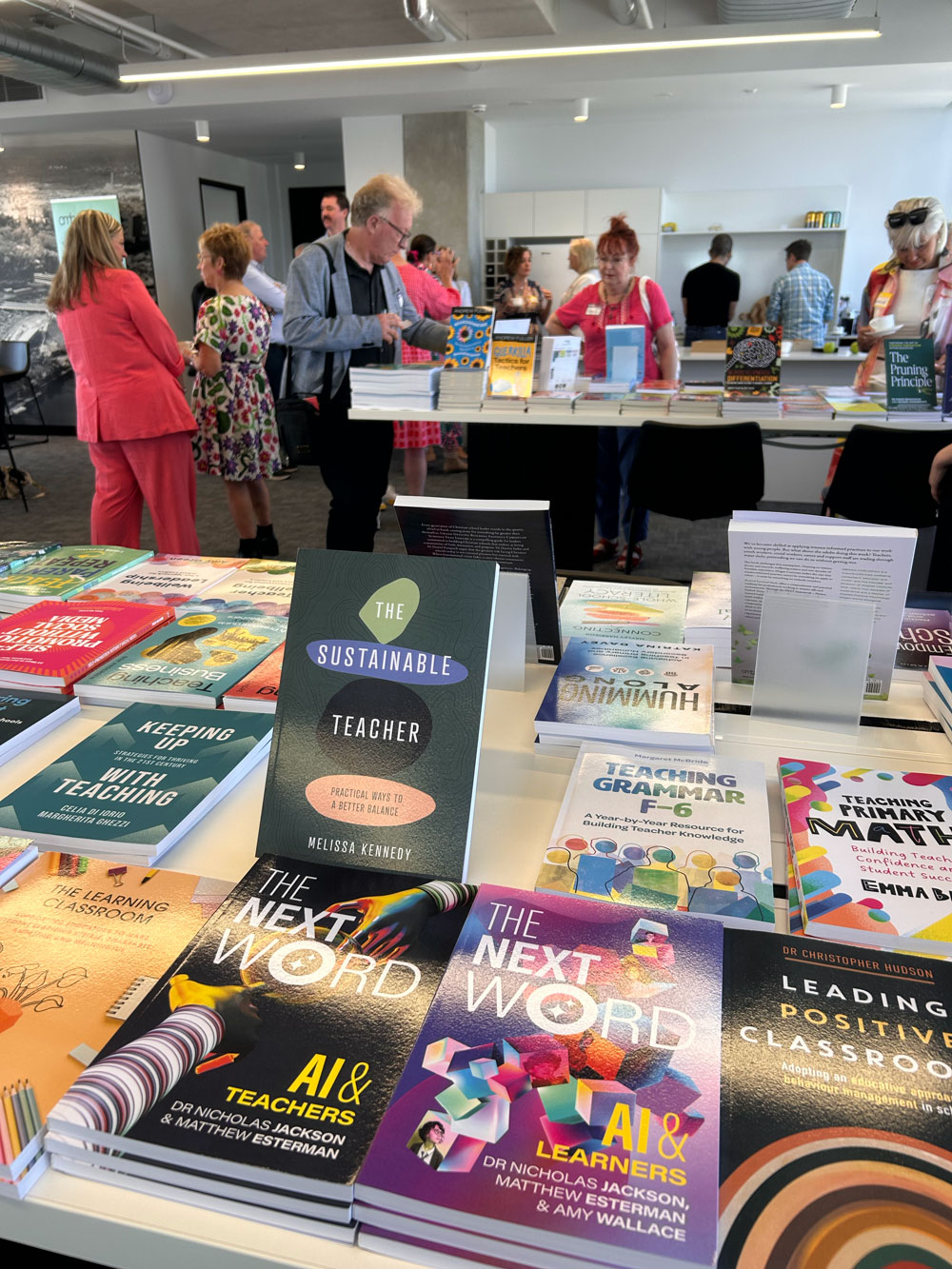
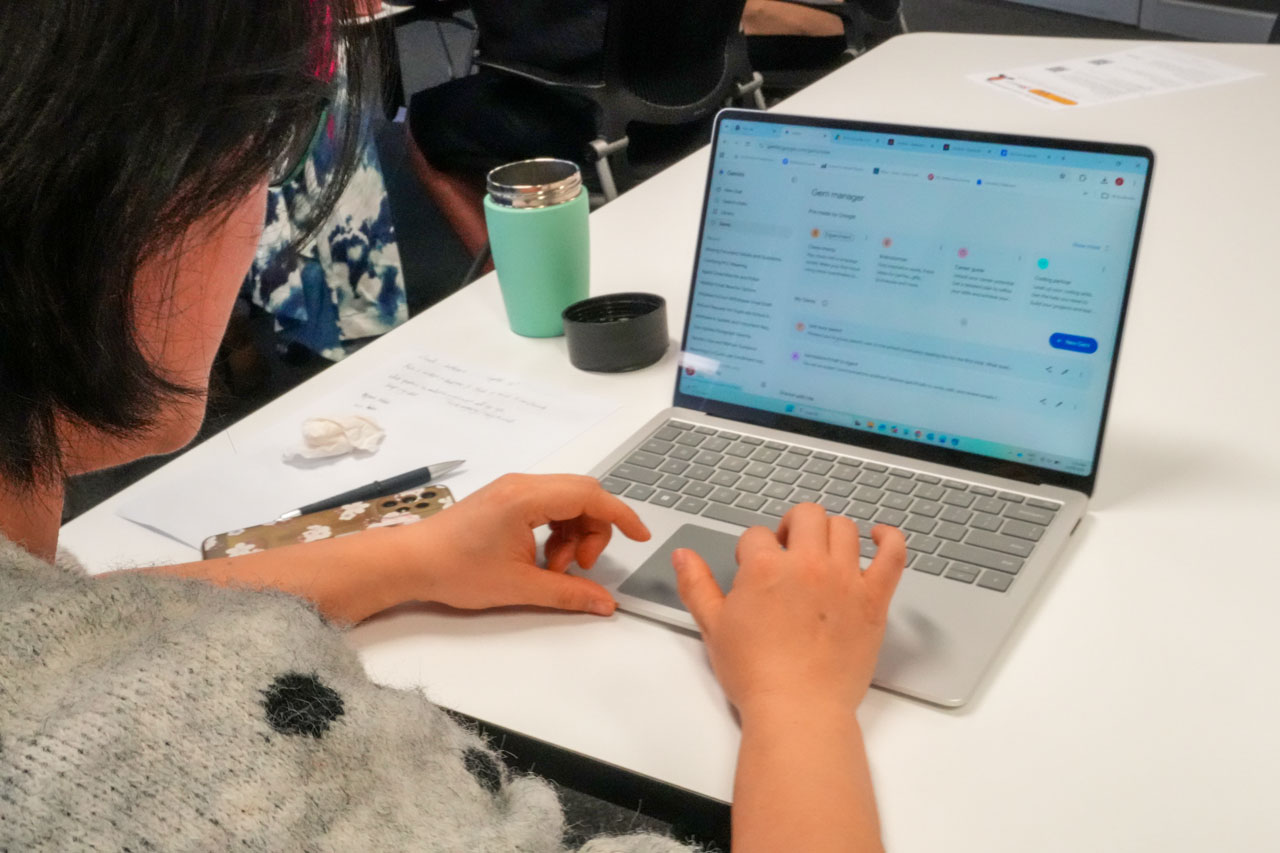
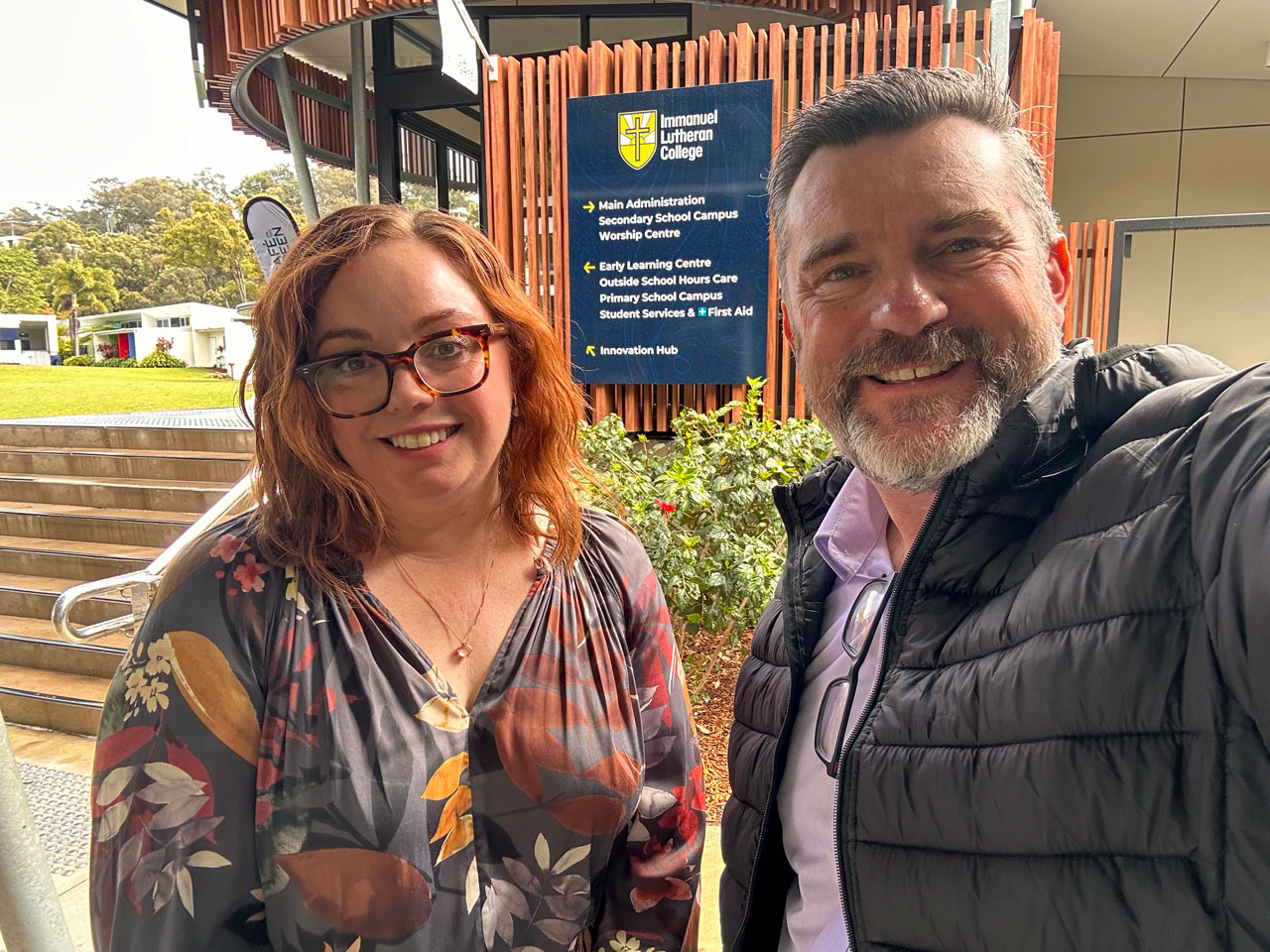
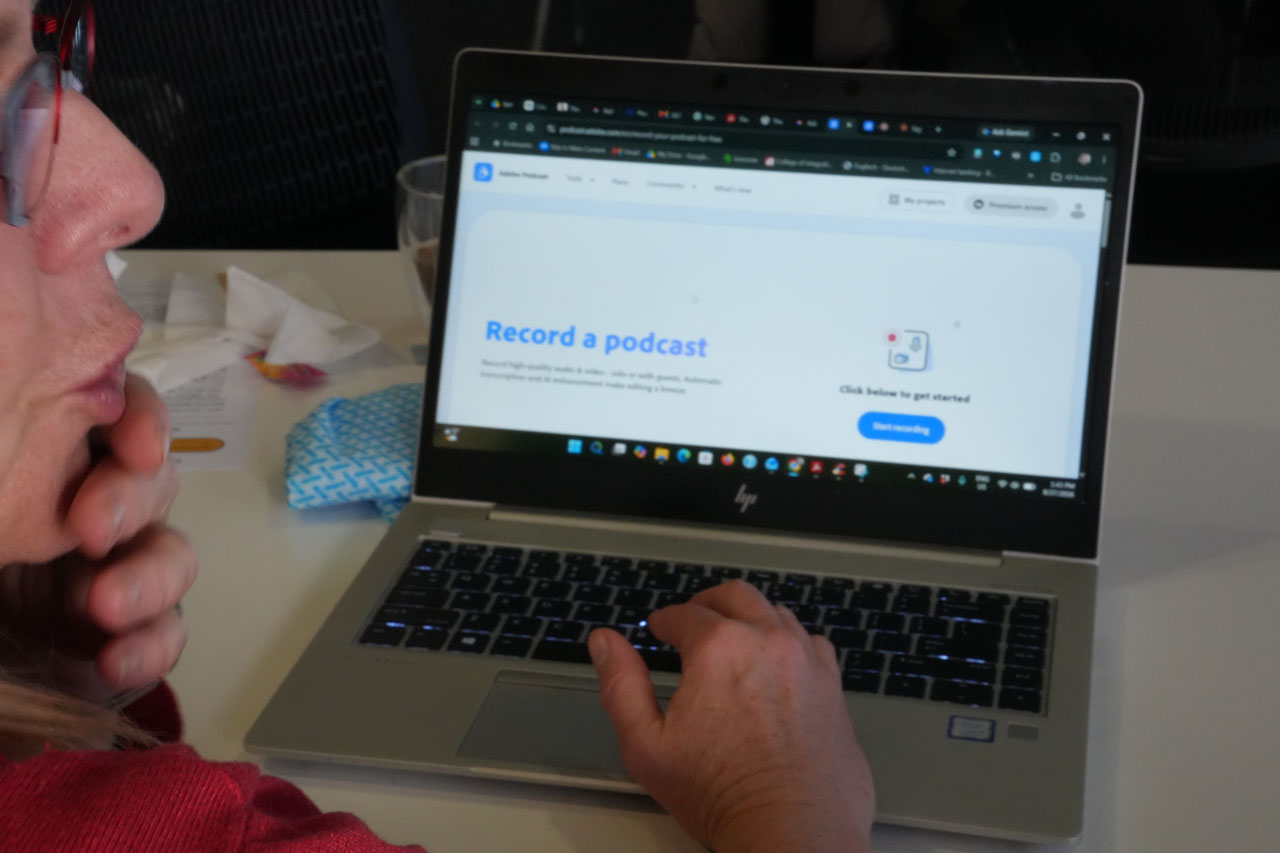
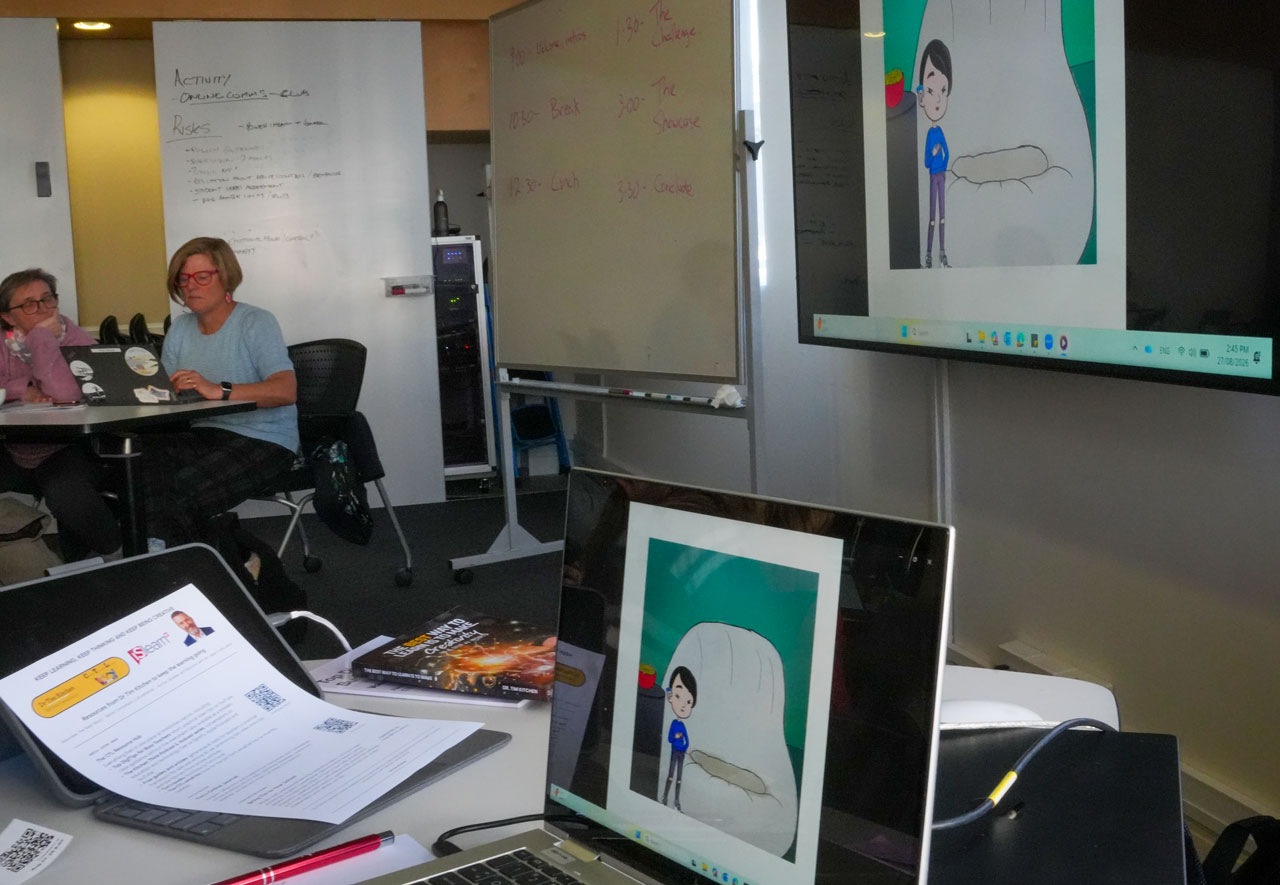
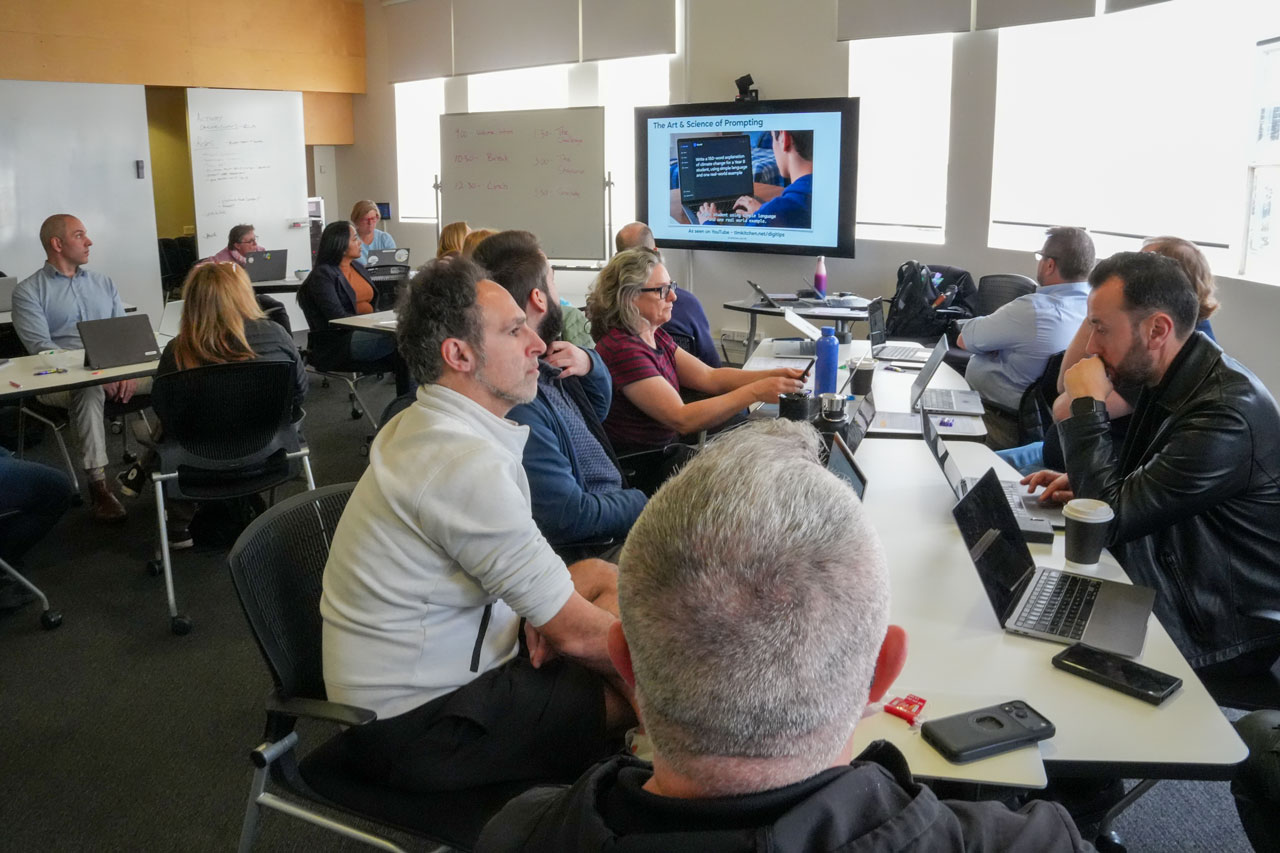
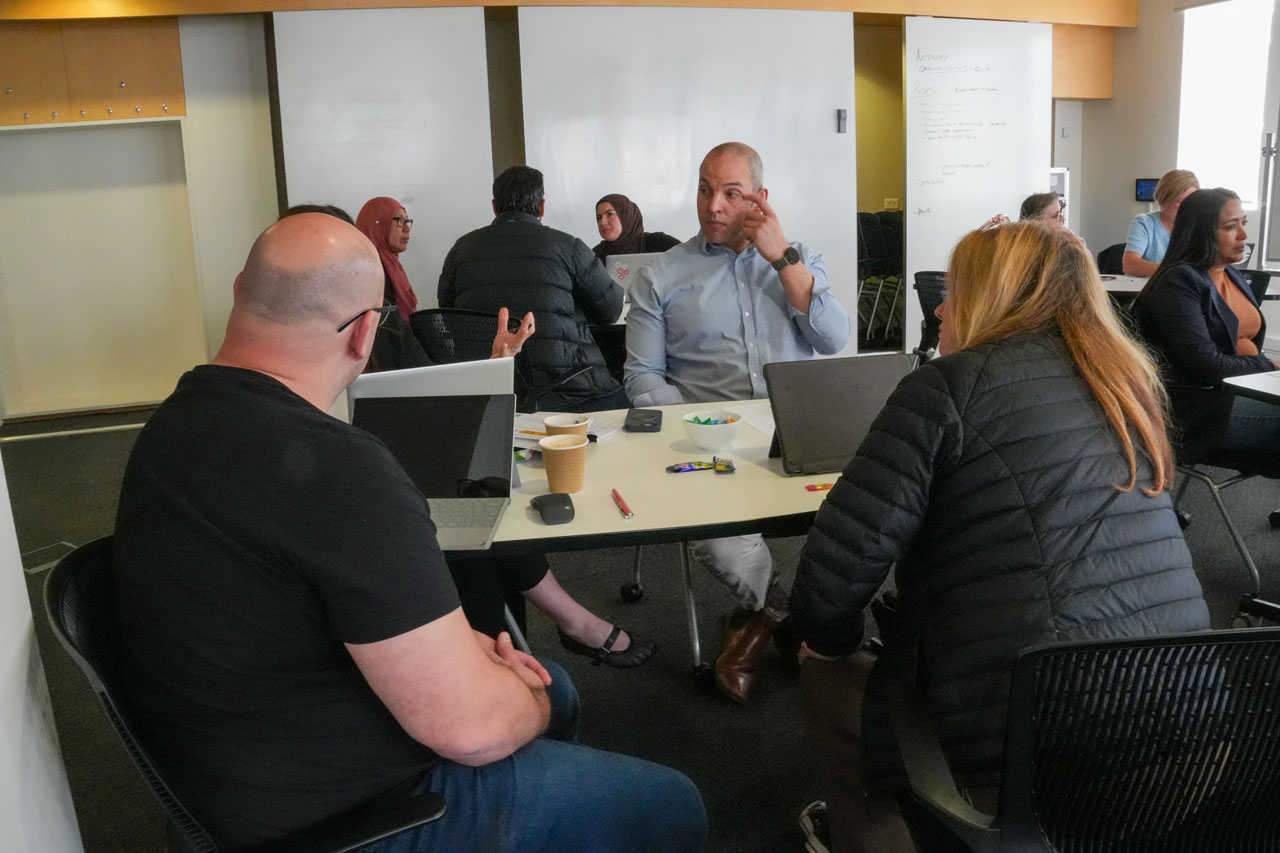
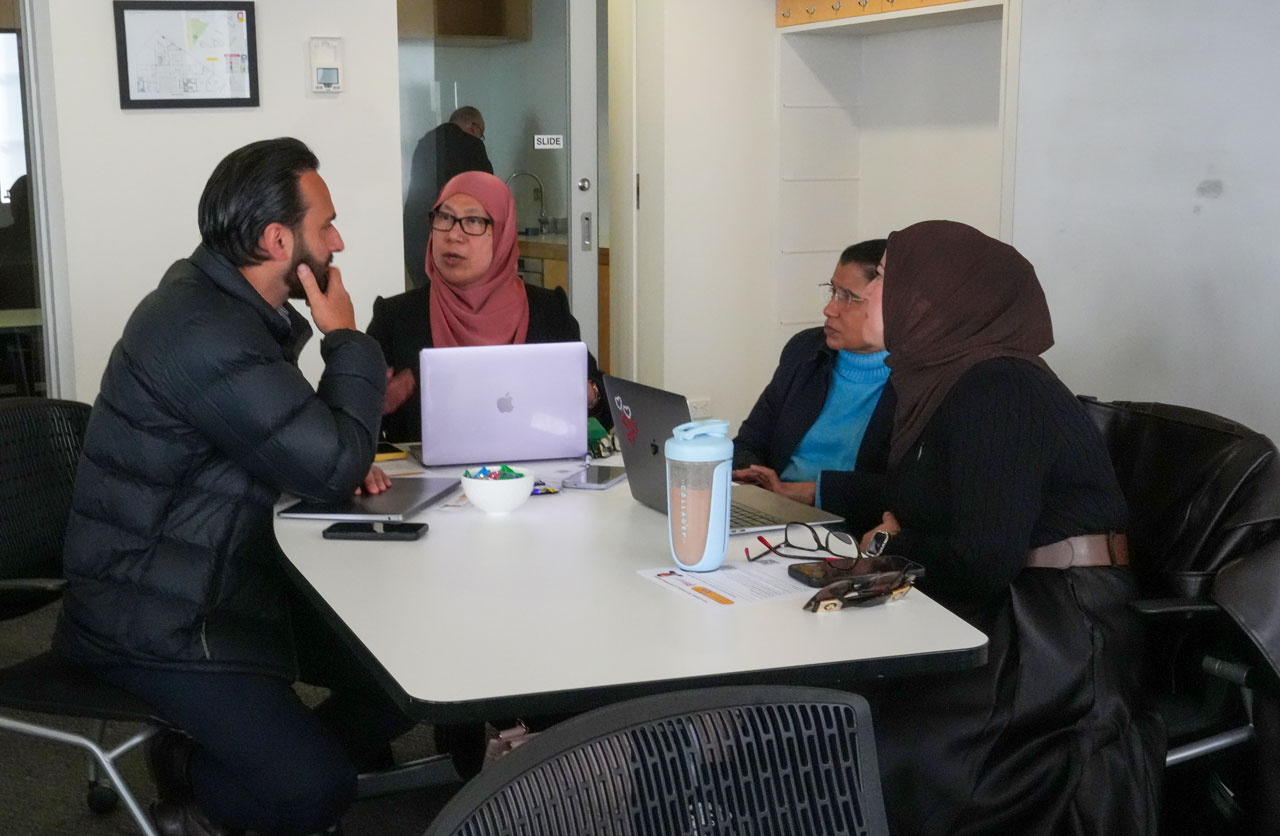
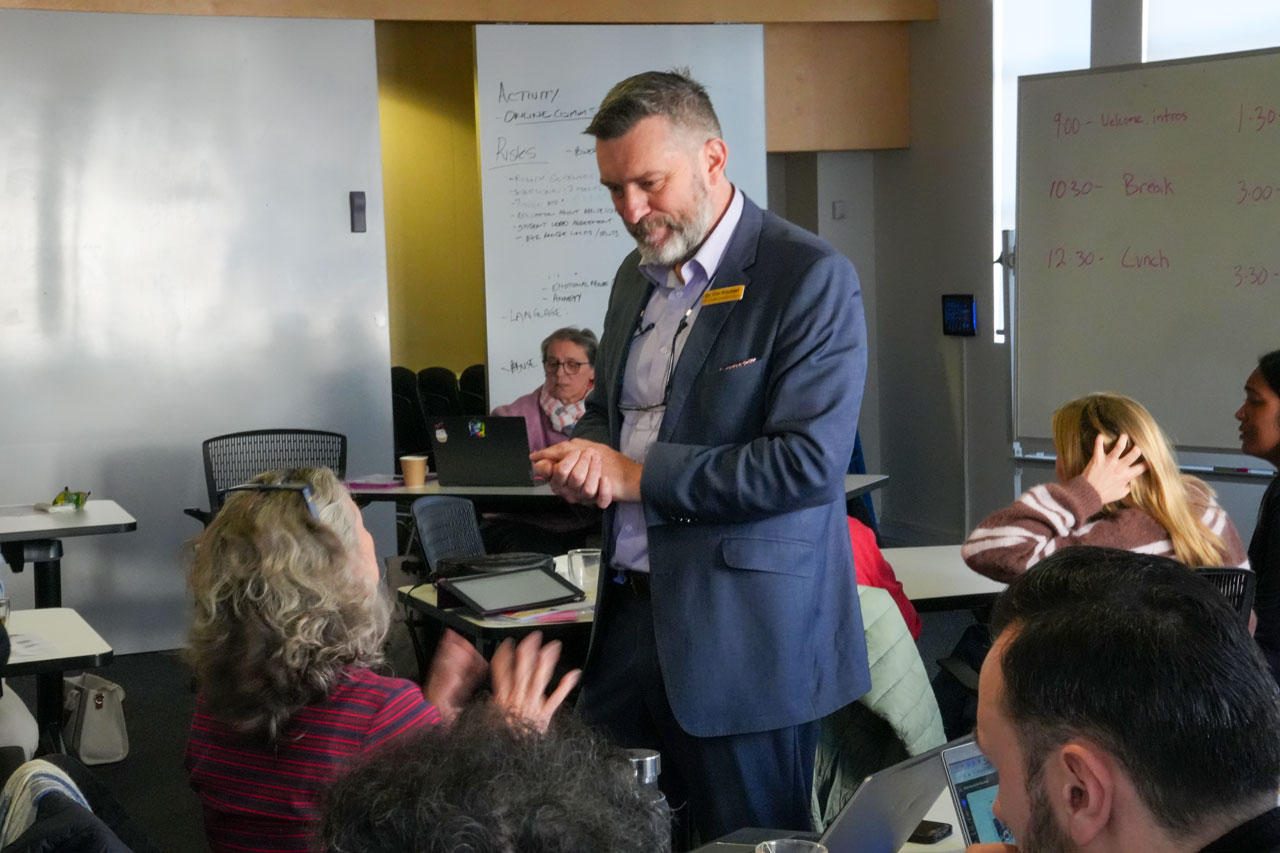
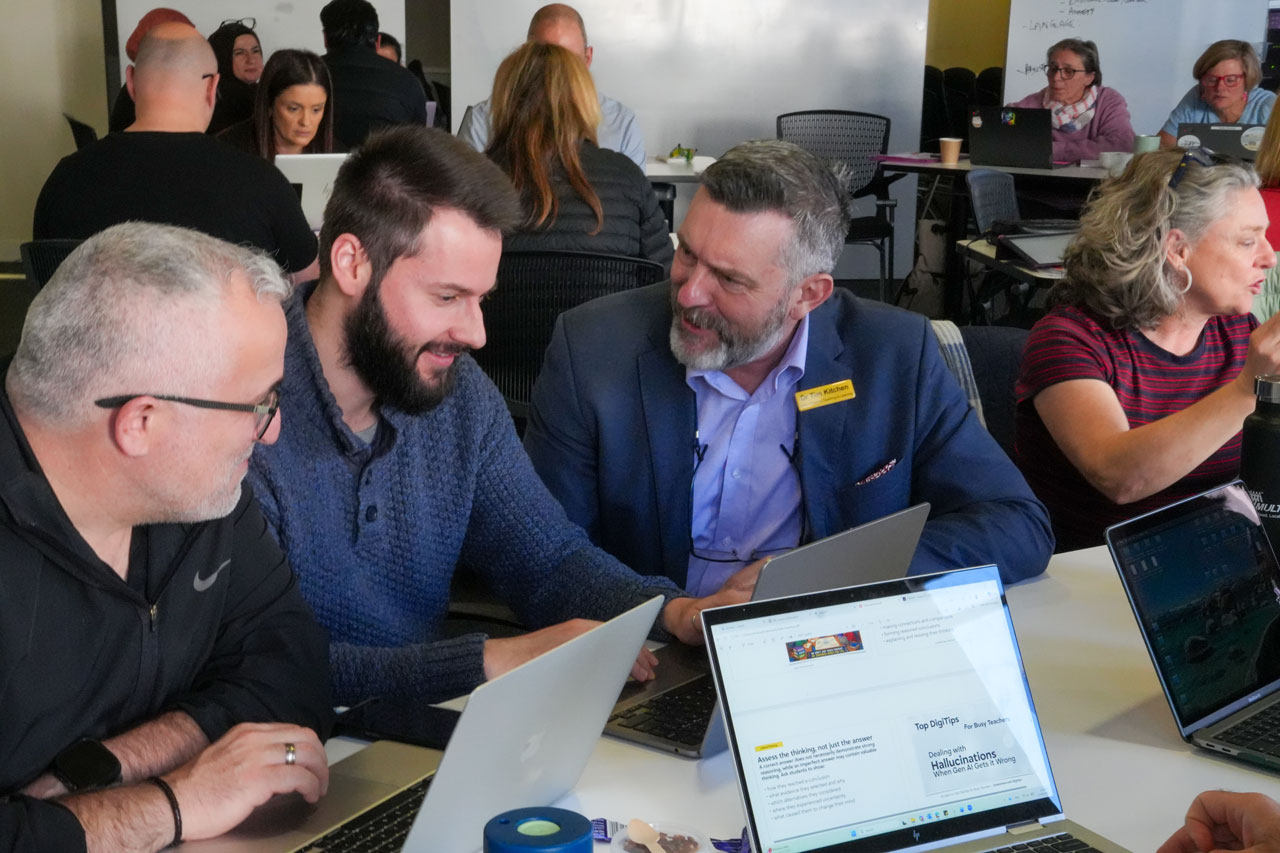
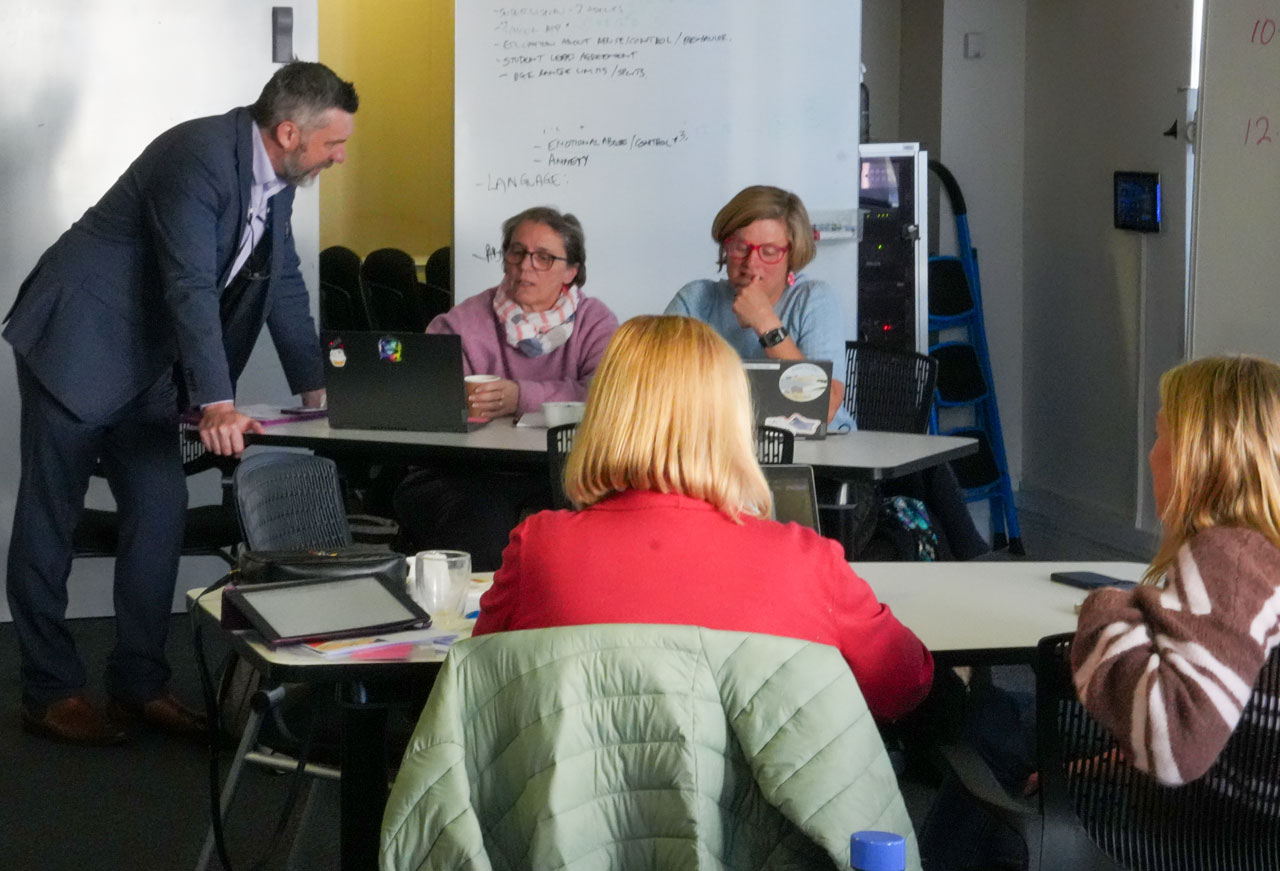
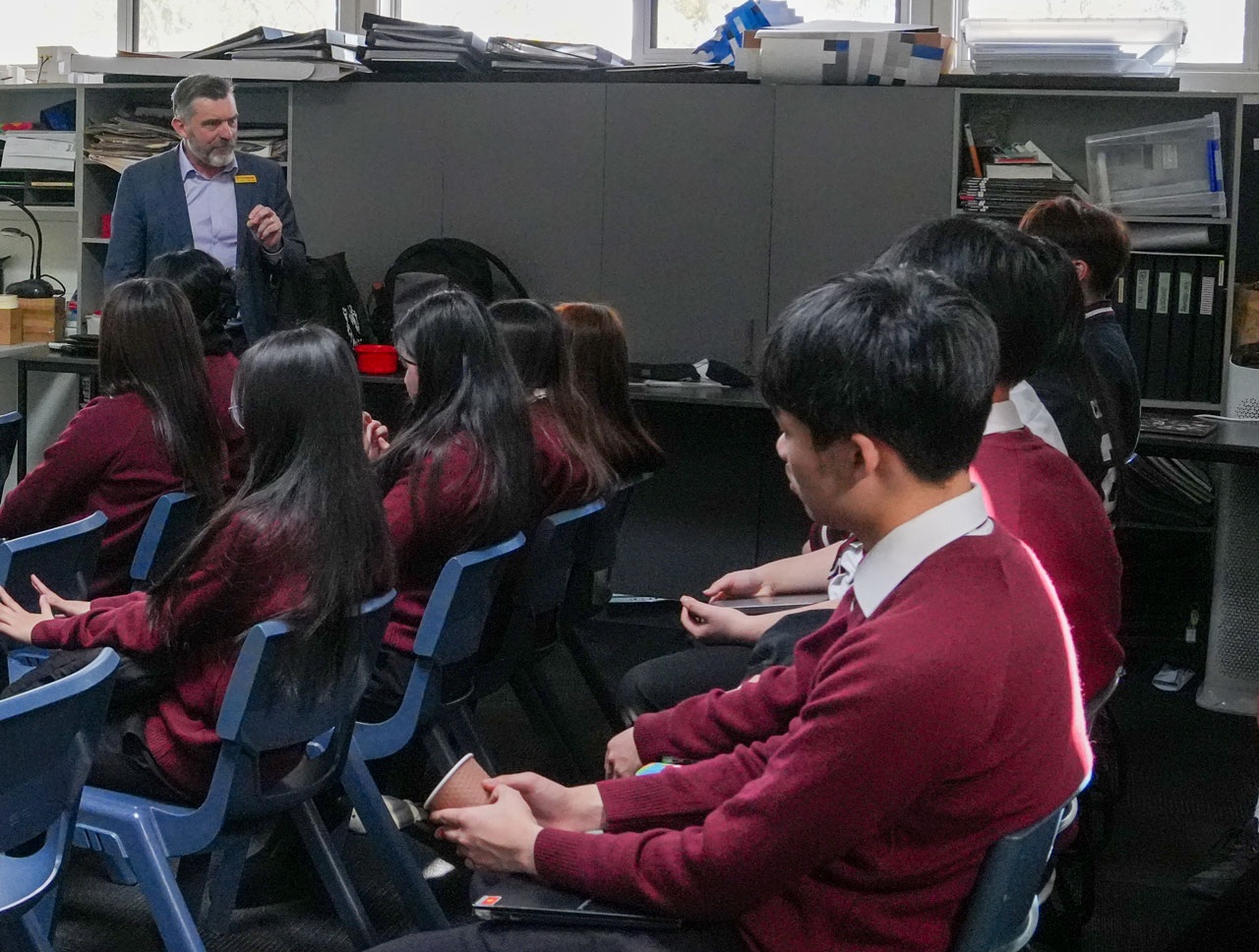
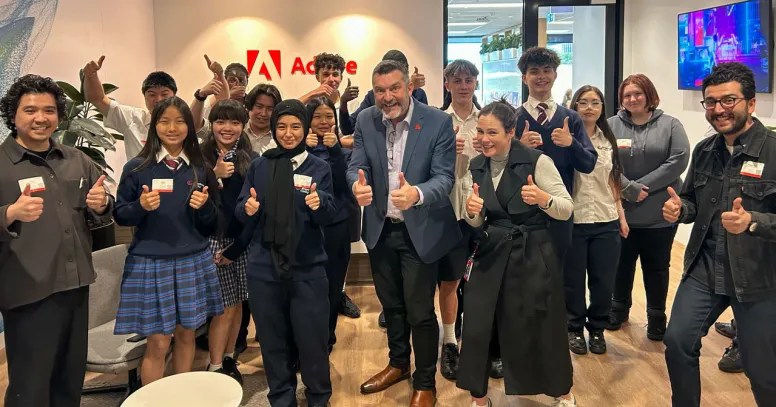
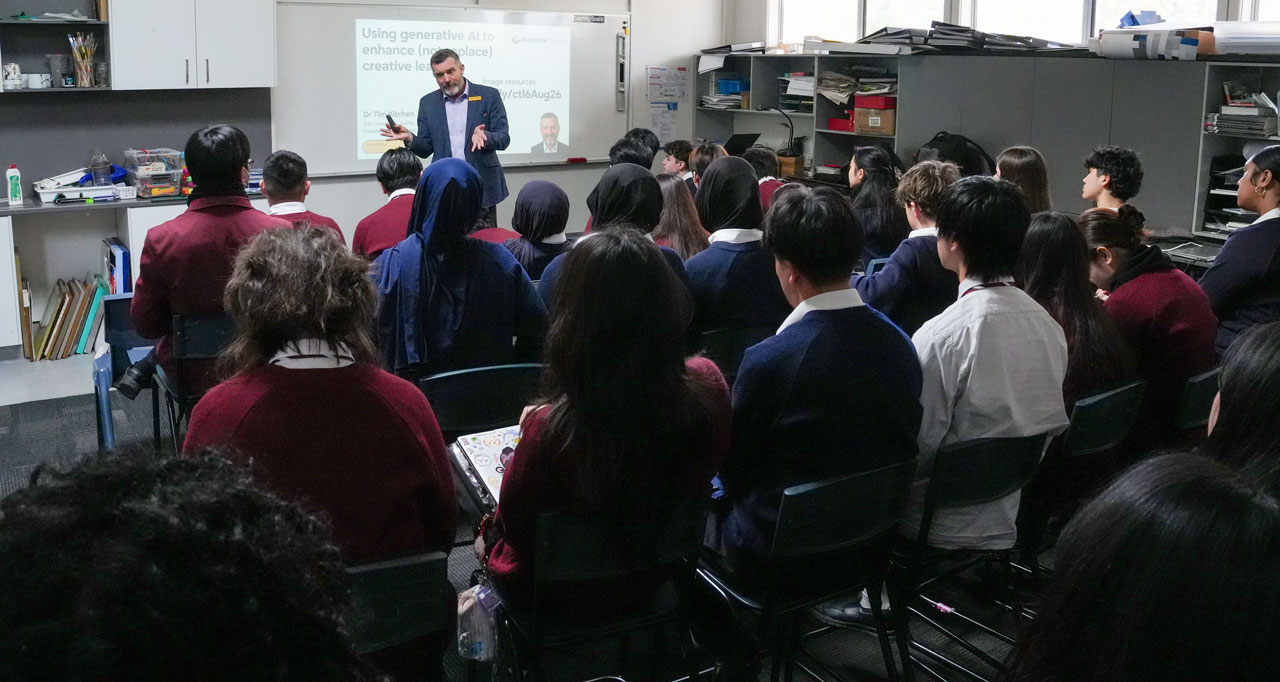
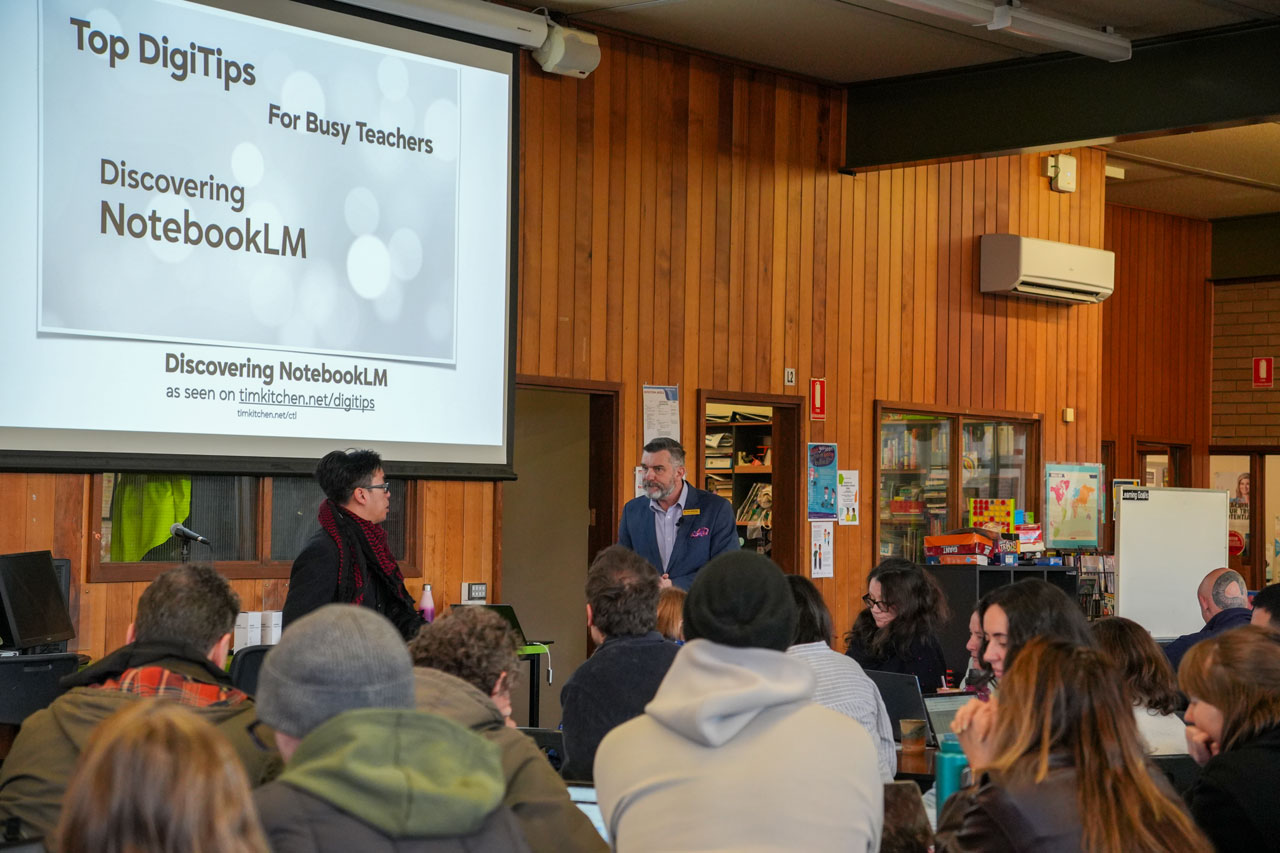
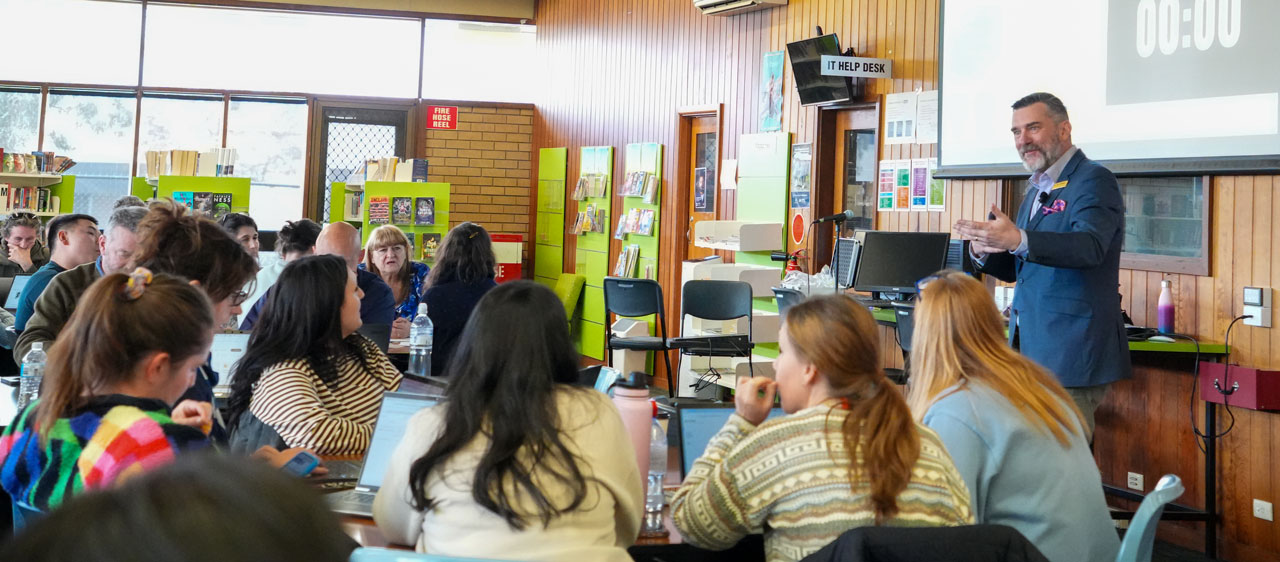
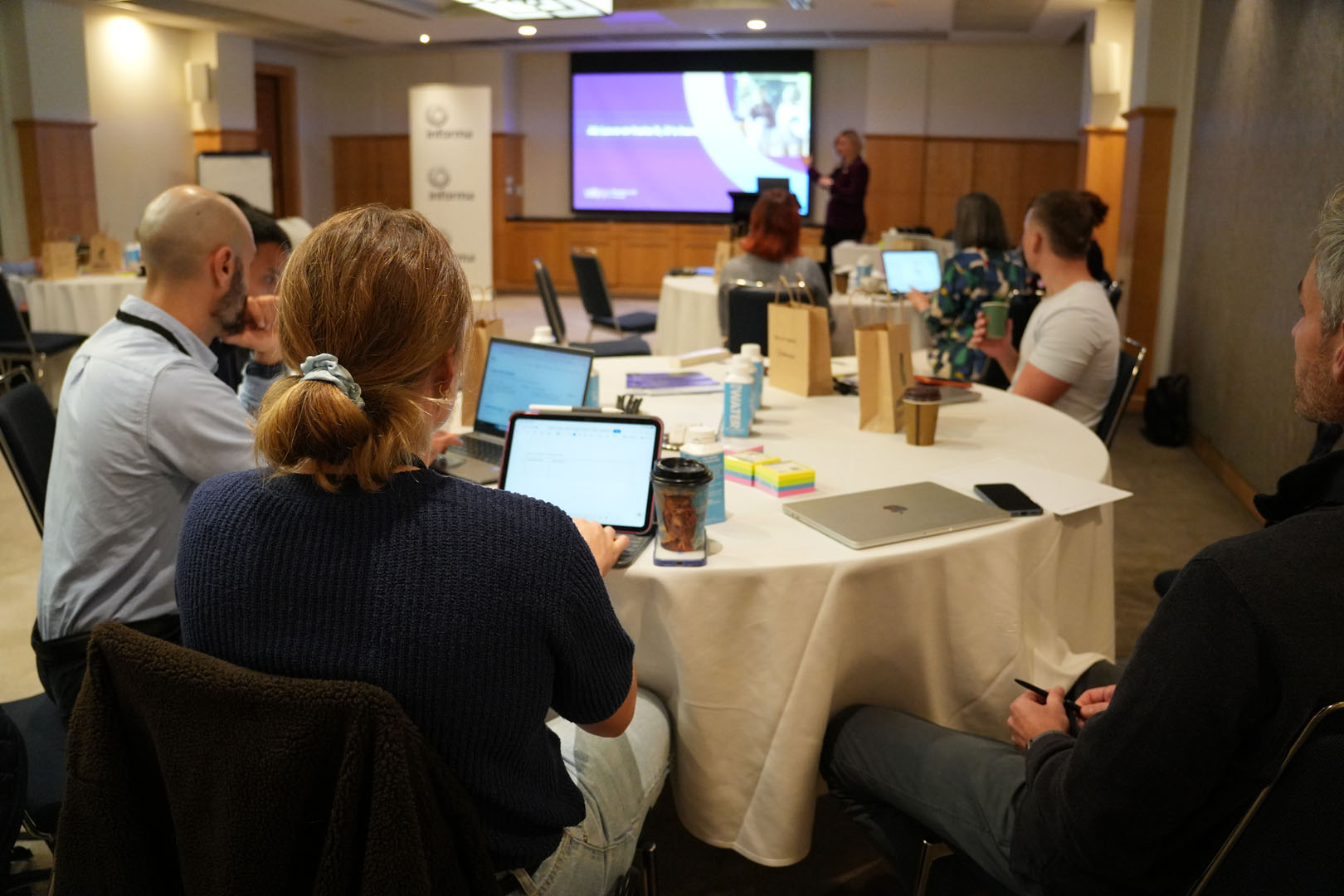
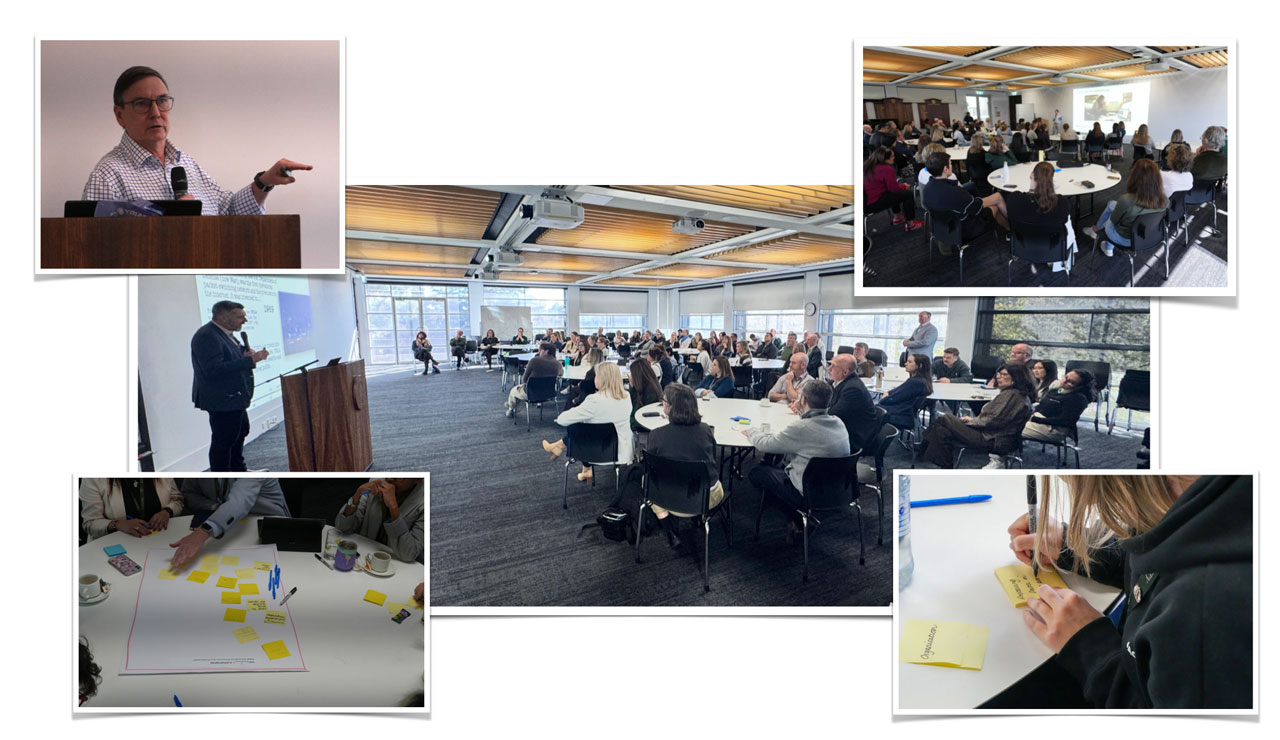
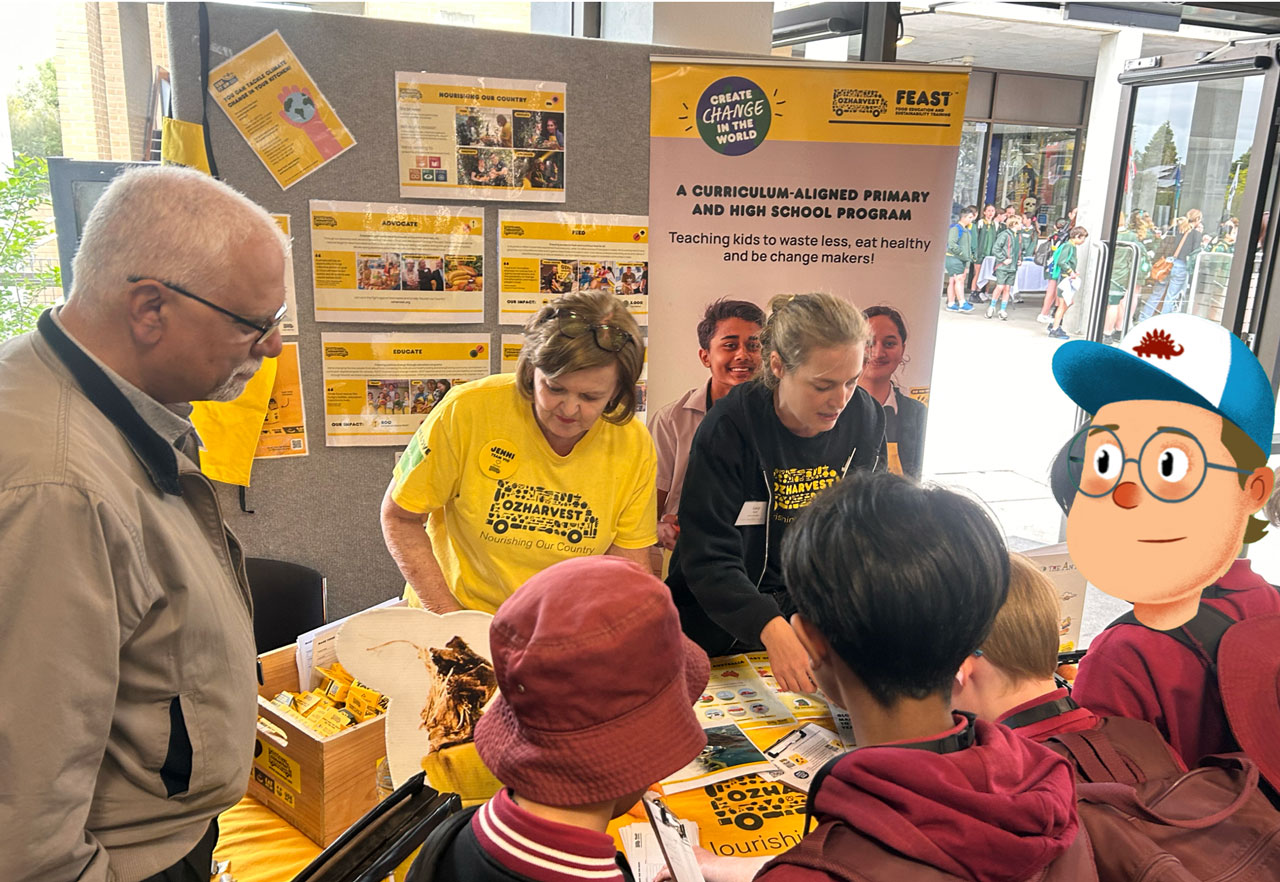
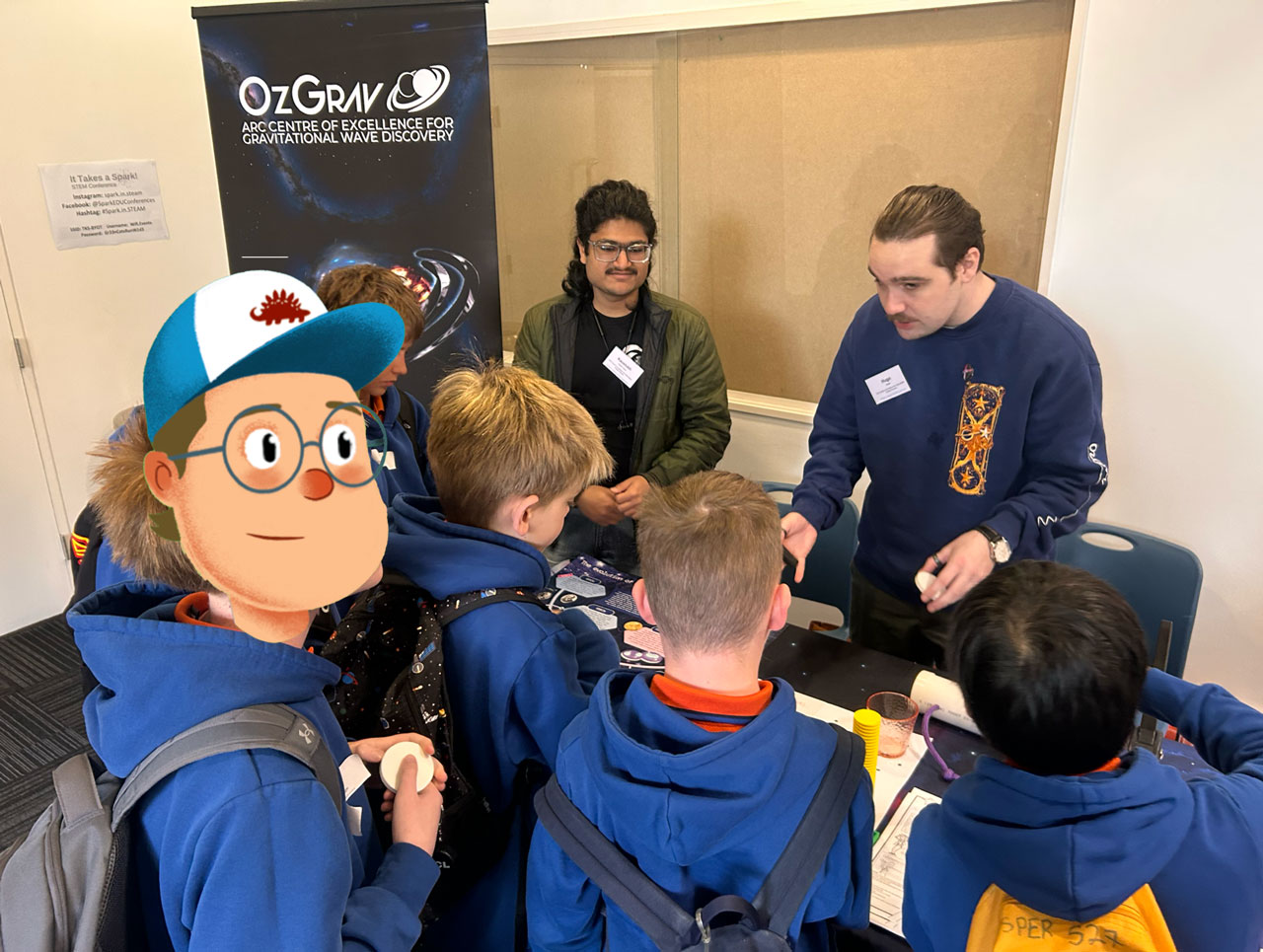
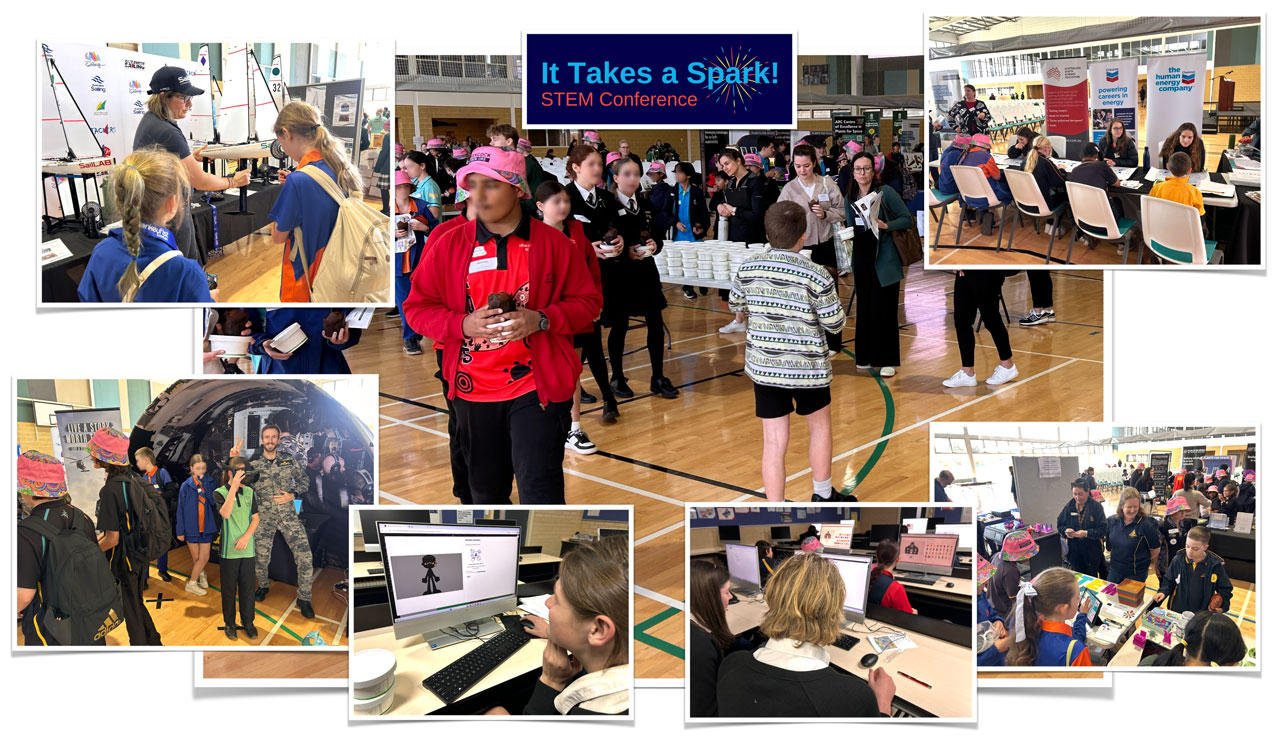
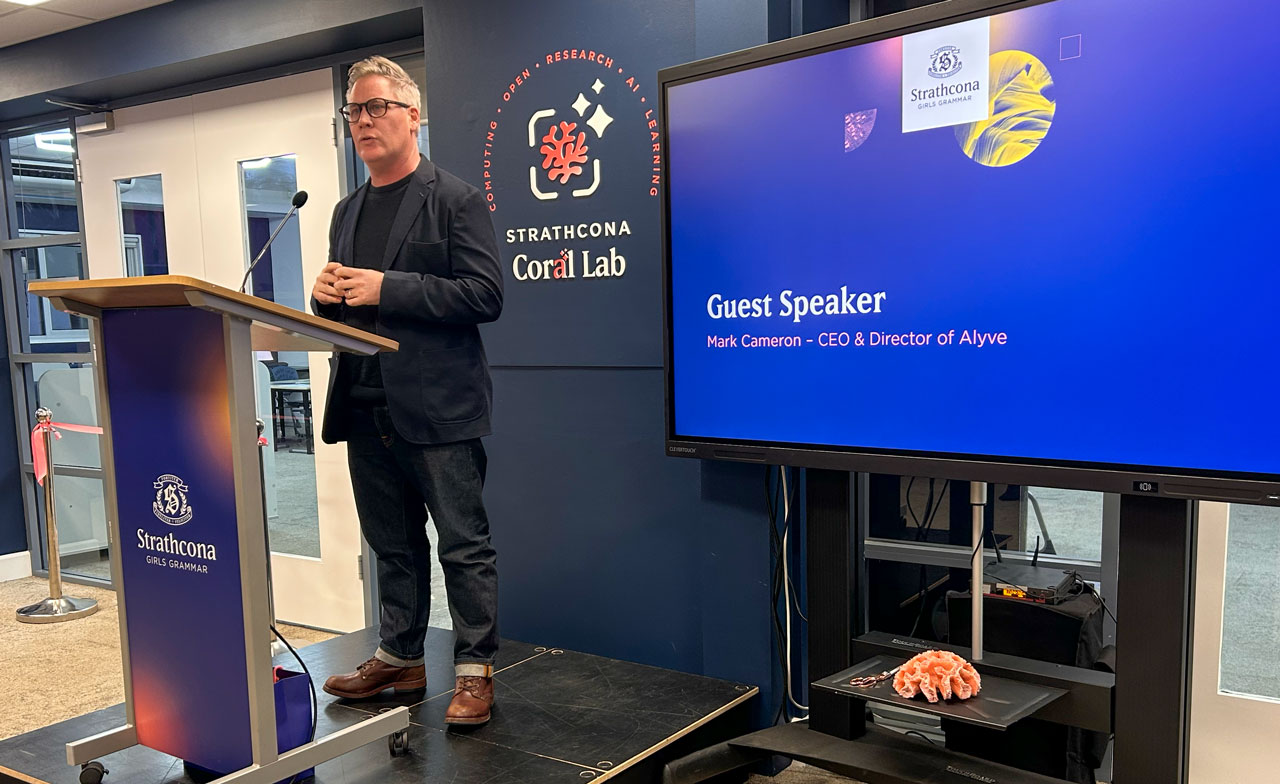
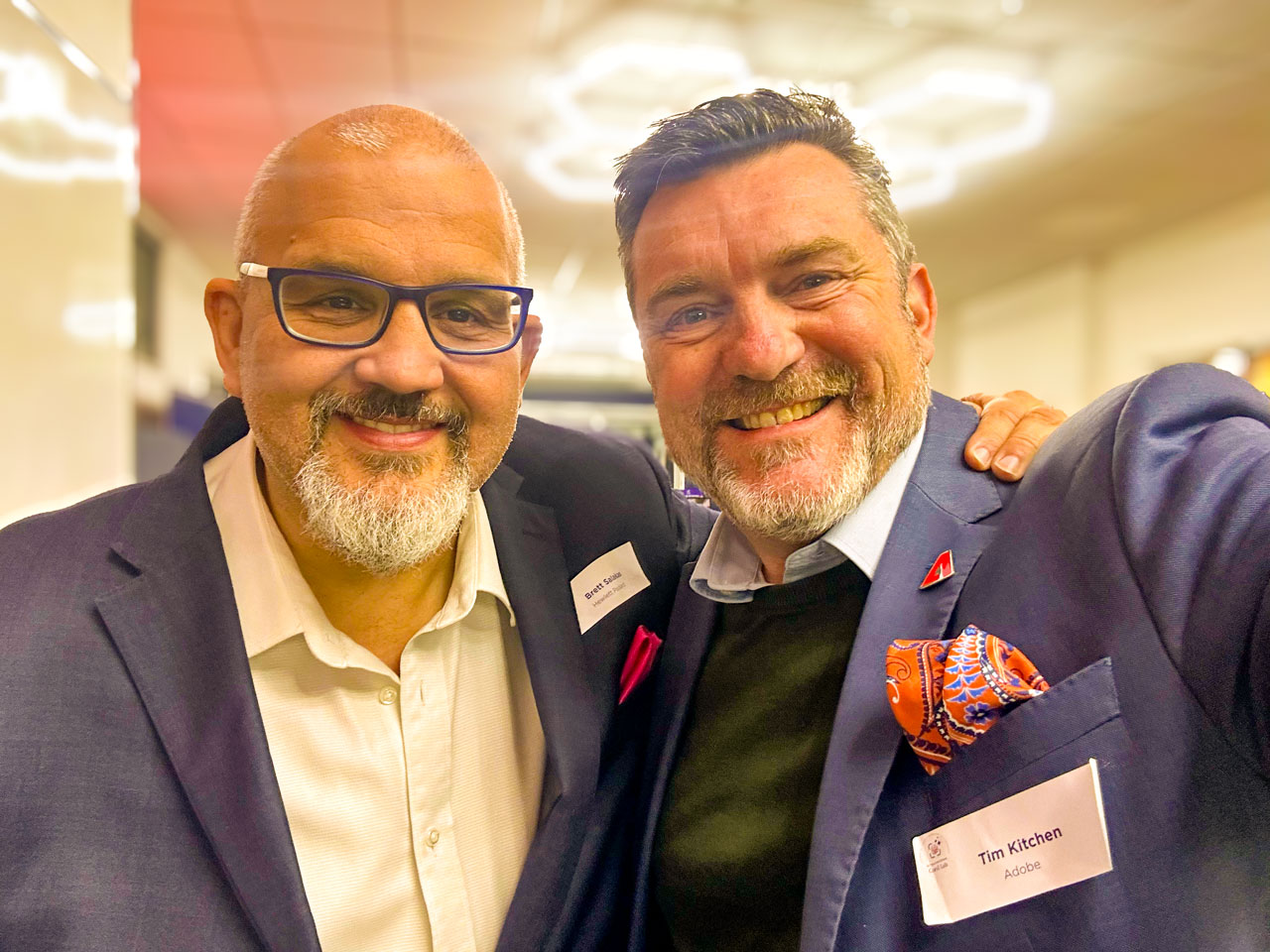
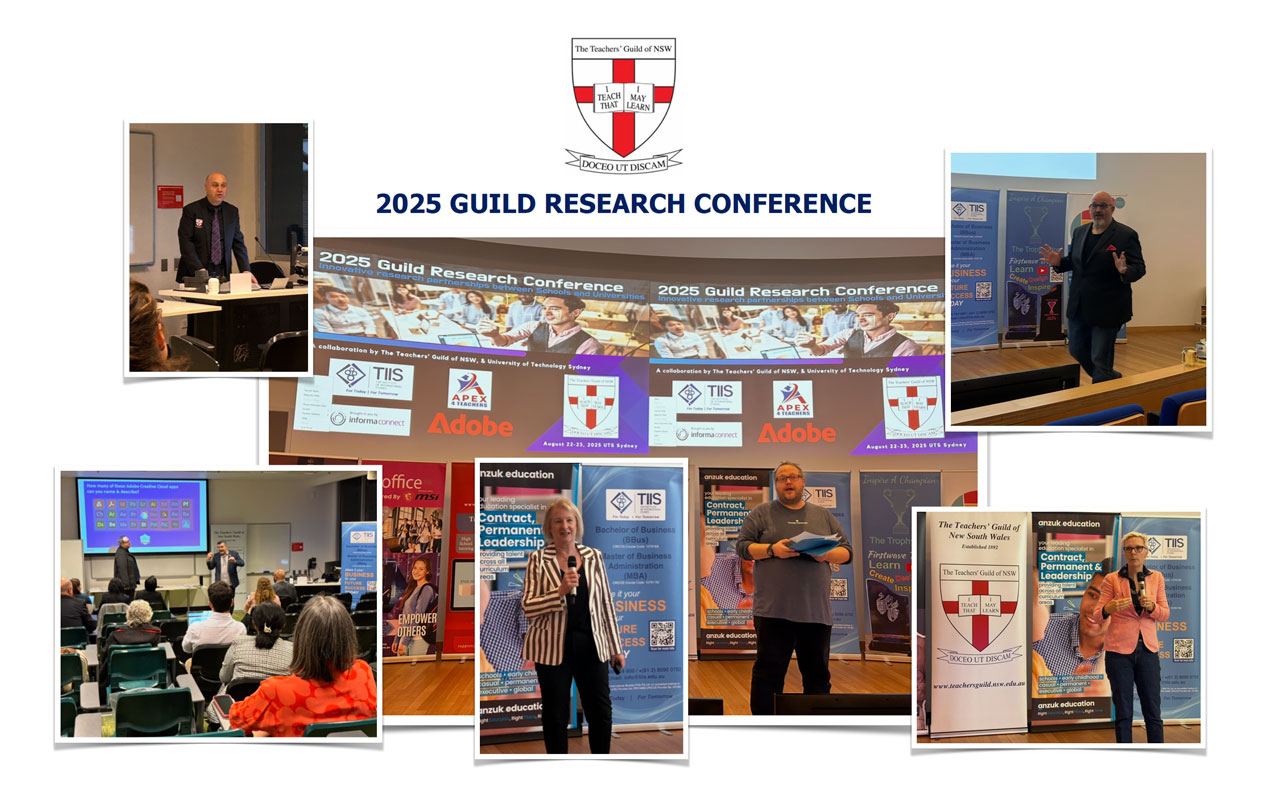
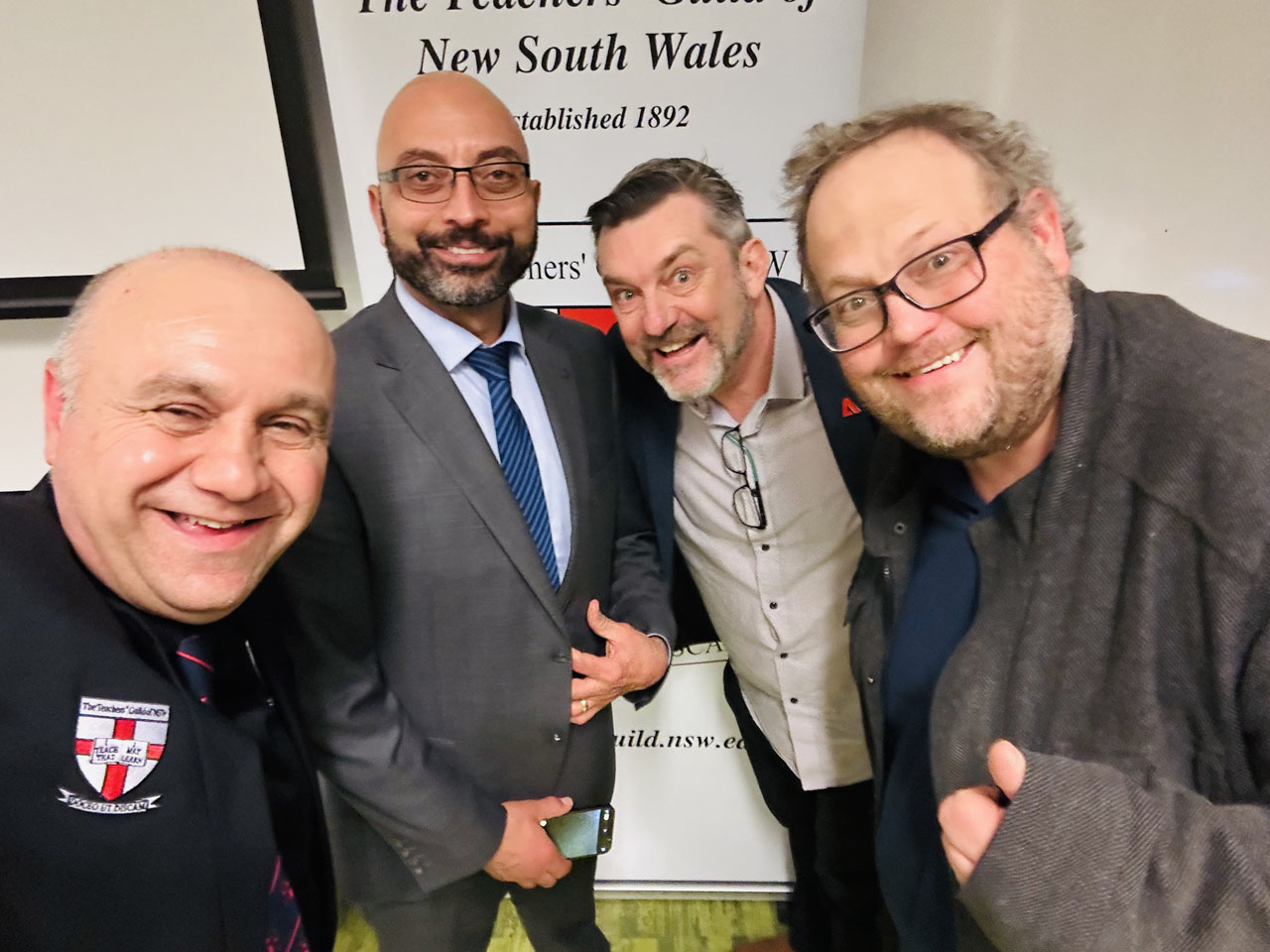
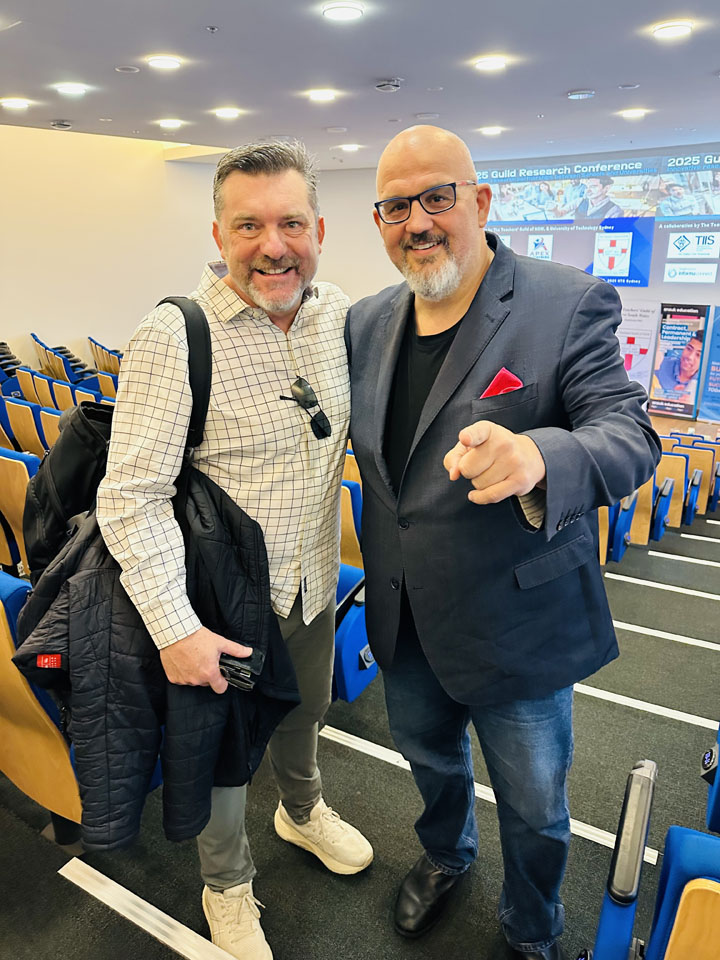
On Saturday 17 October, I had the pleasure of attending the very first Amba Press Community Day, hosted at the Centre for Strategic Education in Melbourne. This free event brought together authors, readers, teachers and people who simply love a good book for a day of connection, conversation and celebration.
Writing can involve many hours working alone, so opportunities to meet readers and spend time with fellow authors are particularly valuable. The day was a reminder of the community behind every publication, and the conversations that continue long after a book reaches its readers.
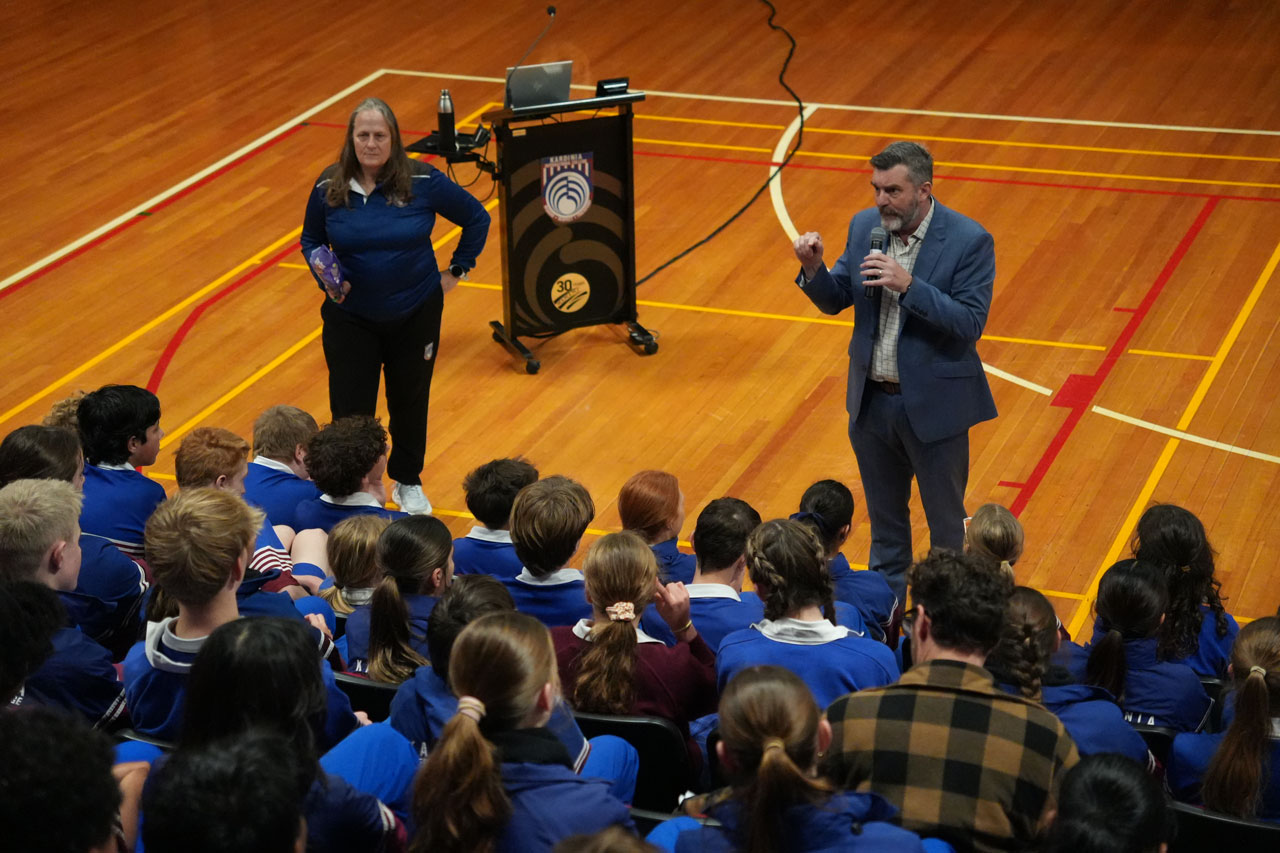
Leon’s latest book explores some of the important questions facing educators as generative AI develops, including critical AI literacy, ethical considerations, and approaches to curriculum and assessment. It encourages educators to look beyond individual tools and consider what these technologies mean for teaching and learning. These are questions closely connected to my own work with schools, and it was a pleasure to celebrate this contribution to the discussion.
Another personal highlight was meeting Hazel Edwards OAM, whose writing has reached generations of children, teachers and adult readers. Her much-loved picture book, There’s a Hippopotamus on Our Roof Eating Cake, was first published in 1980 and has since grown into a series, with adaptations including classroom play scripts, a musical stage production and a short film. Hazel has written over 220 books.
It was also lovely to catch up with Andrew Fuller, a clinical psychologist and family therapist whose work spans neuroscience and learning, resilience and wellbeing. Andrew works with schools, communities and organisations across Australia, New Zealand, Asia and the United Kingdom, and is an Honorary Fellow at the University of Melbourne.
A finished product can tell us a great deal about what a student has made. But how much does it reveal about what they have learned?
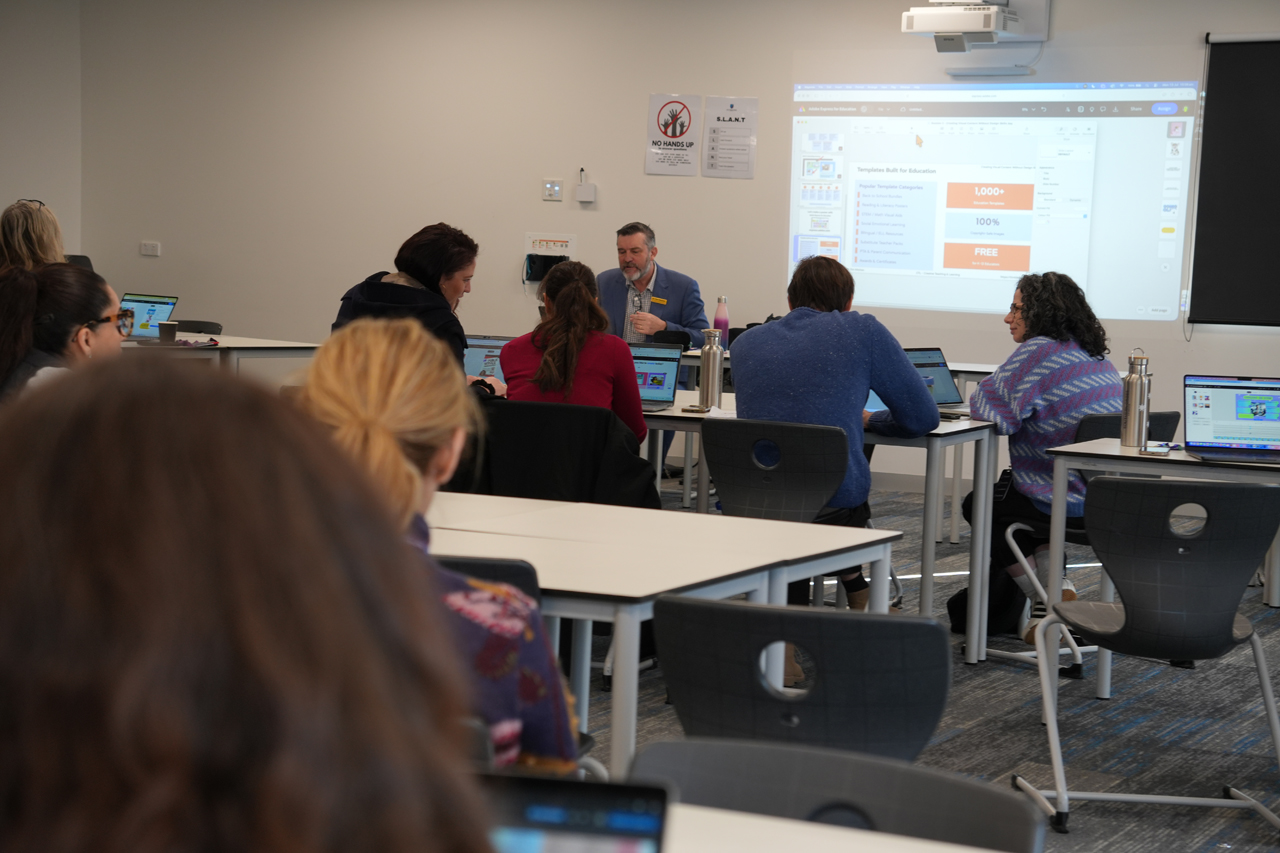
This question framed two workshops I facilitated on Friday 16 October at a special TAS (Technological and Applied Studies) conference event organised by IS-NSW at Meriden School in Sydney. Across the two repeated sessions, approximately 35 teachers explored Making Thinking Visible: Digital Design Folios and Authentic Evidence.
Beyond the polished folio
A beautifully presented folio can communicate a design journey clearly. However, presentation alone does not necessarily reveal the quality of a student’s thinking. An unsuccessful prototype, accompanied by a thoughtful explanation of why it failed and what changed next, may provide particularly valuable evidence of learning.
Digital portfolios offer ways to capture these moments using more than written descriptions. Prototype photographs, short videos, voice reflections and testing results can help students explain what they tried, what they noticed and how their understanding developed.
A photograph might show a joint that failed under pressure. A brief recording could explain why a student changed a fabric, ingredient or component. A comparison of two prototypes might demonstrate how testing informed a revision.
The evidence becomes more meaningful when students explain its significance. What does this photograph show? Why was this change necessary? What did the test reveal that was not obvious beforehand? These questions help move a folio beyond a record of activity towards an account of learning.
Making feedback visible
Feedback is another important part of the design process that can disappear from a finished folio. Students may receive useful suggestions from teachers, peers or potential users, but the final submission does not always show how those suggestions influenced their decisions.
A manageable digital folio can make this relationship clearer. Students can capture a piece of feedback, explain their response and show the resulting change. They can also justify why they chose not to follow a suggestion.
That distinction matters. Responding thoughtfully to feedback involves judgement. Students need opportunities to weigh advice against their design brief, testing results and intended users.
Prompts such as “What feedback did you receive?”, “What did you change?” and “Why?” can reveal that judgement without requiring lengthy written reflections at every stage.
The two sessions at Meriden centred on a practical assessment question: how can we make the learning behind the product easier to see?
A well-designed digital folio can help answer that question. By bringing together evidence of experimentation, feedback, revision and evaluation, it gives students a way to explain their decisions and teachers a richer basis for understanding individual learning.
The finished product remains important. Its educational value becomes clearer when we can also see the thinking that brought it into being.
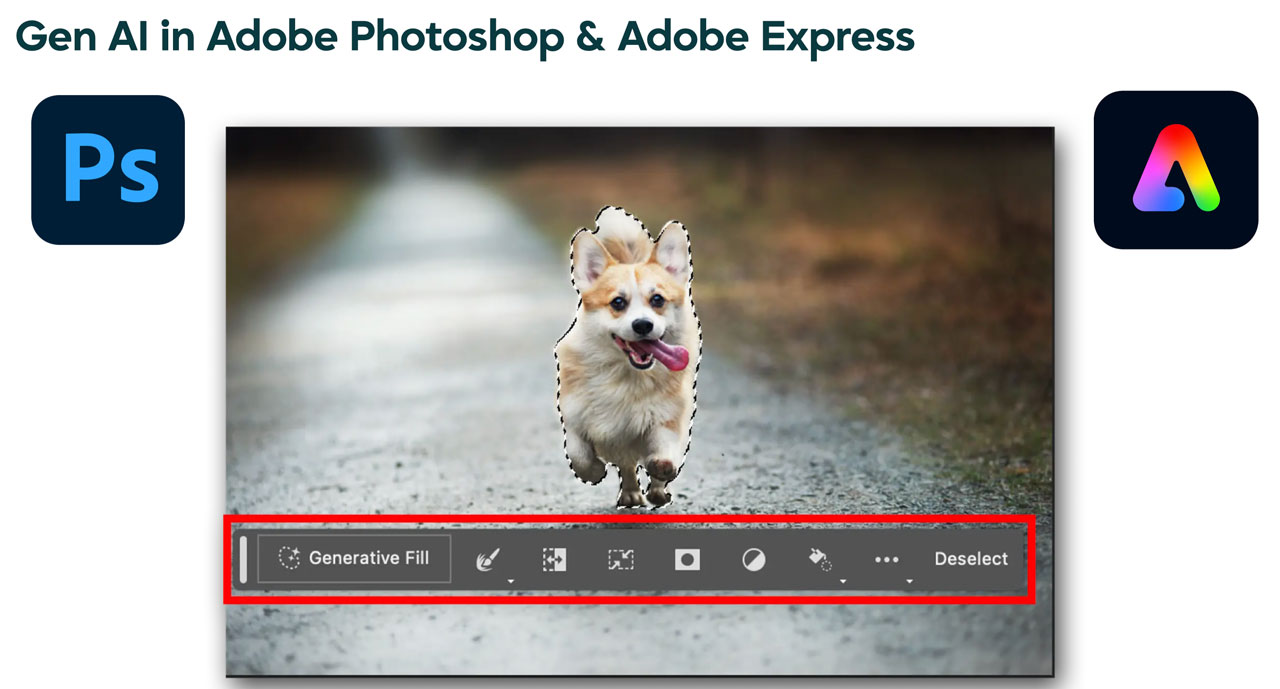
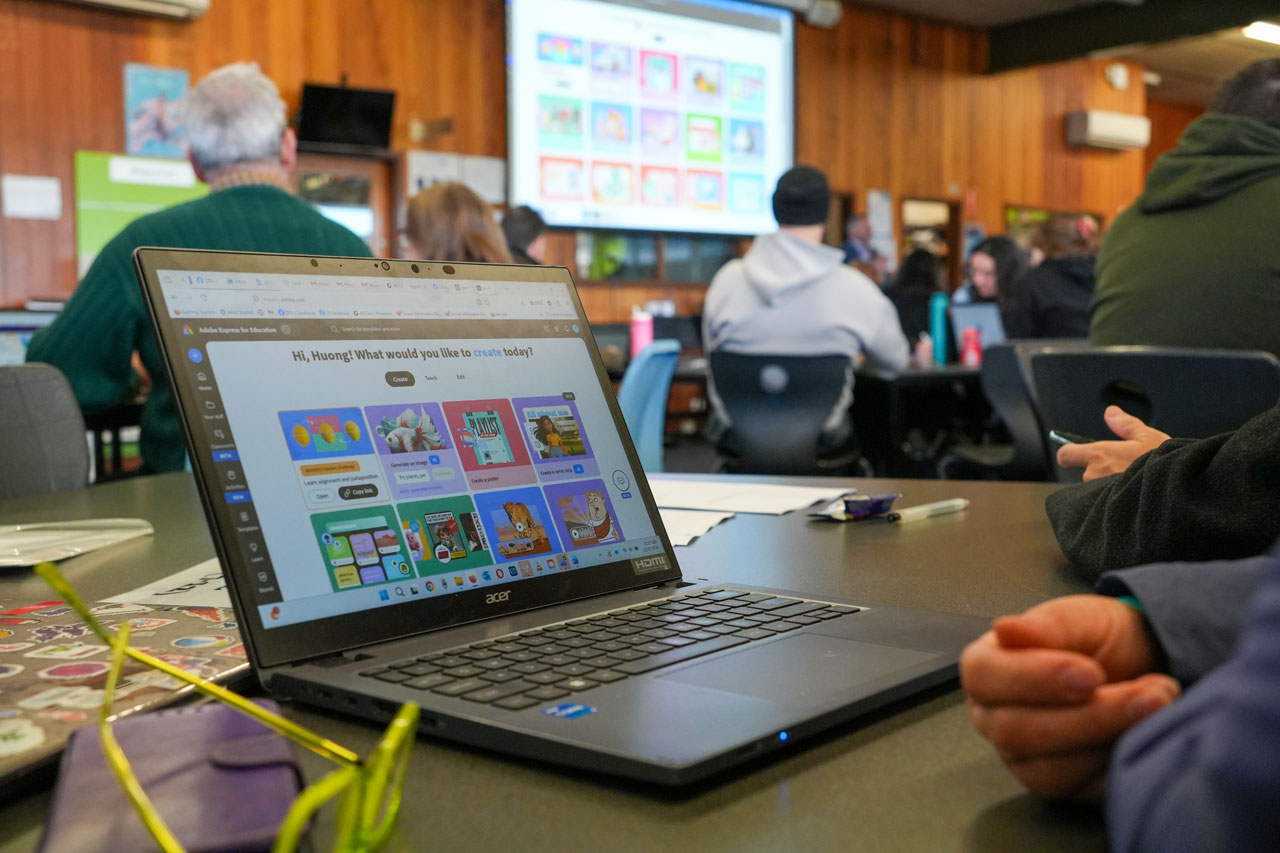
One of the highlights was showing the value of Adobe Express for Education as a tool to make artifacts and document them within a digital portfolio.
Special thank you to Chris Woldhuis and his team at IS-NSW for organising this conference.
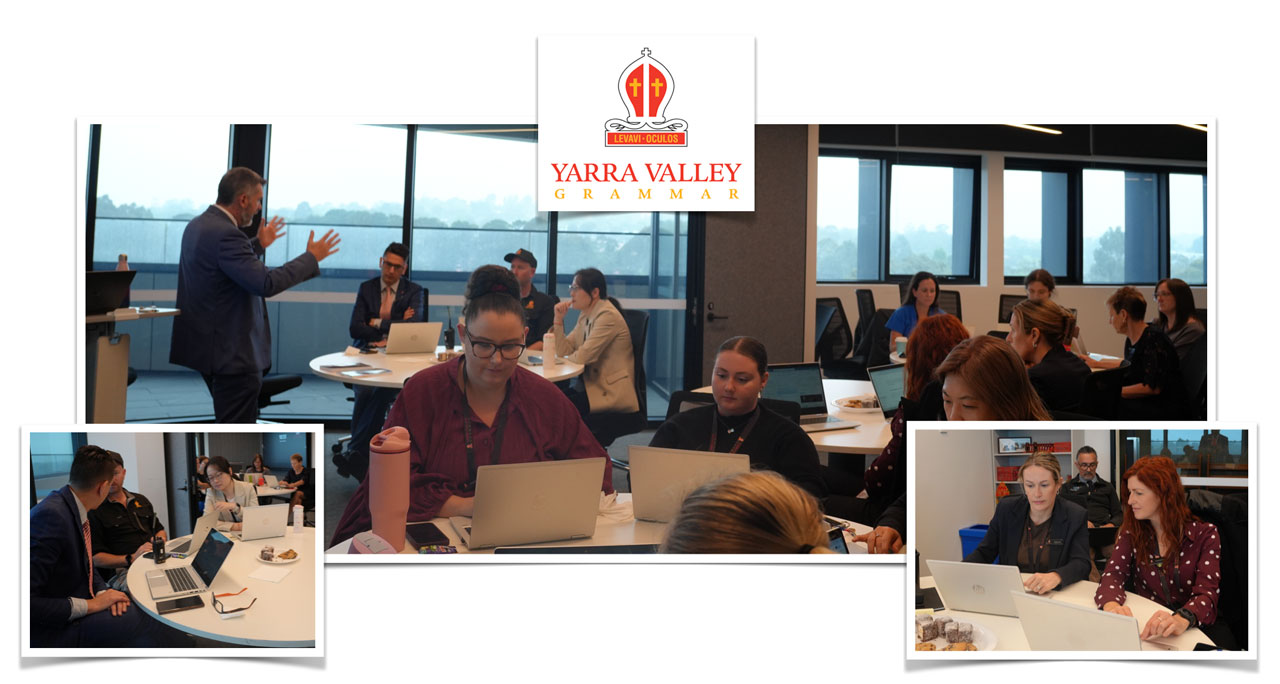
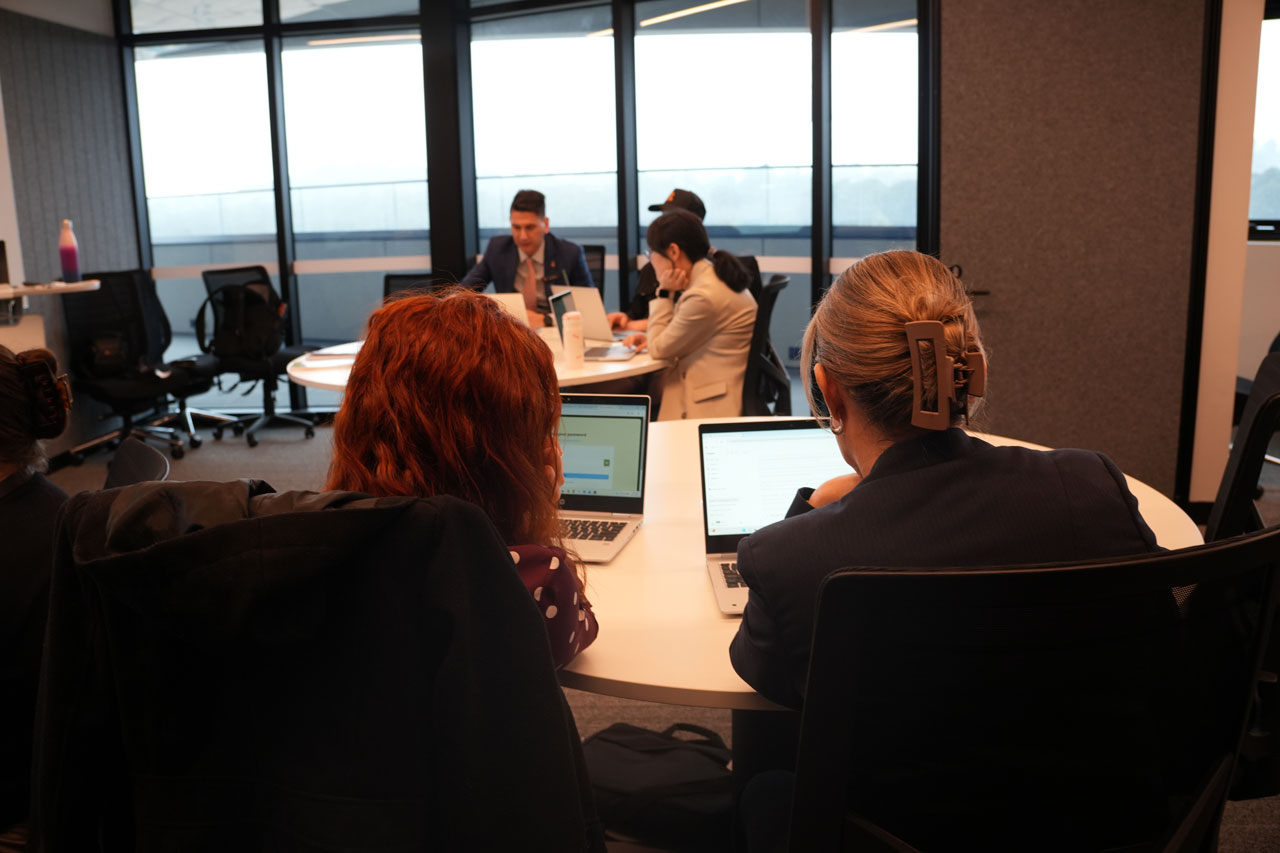
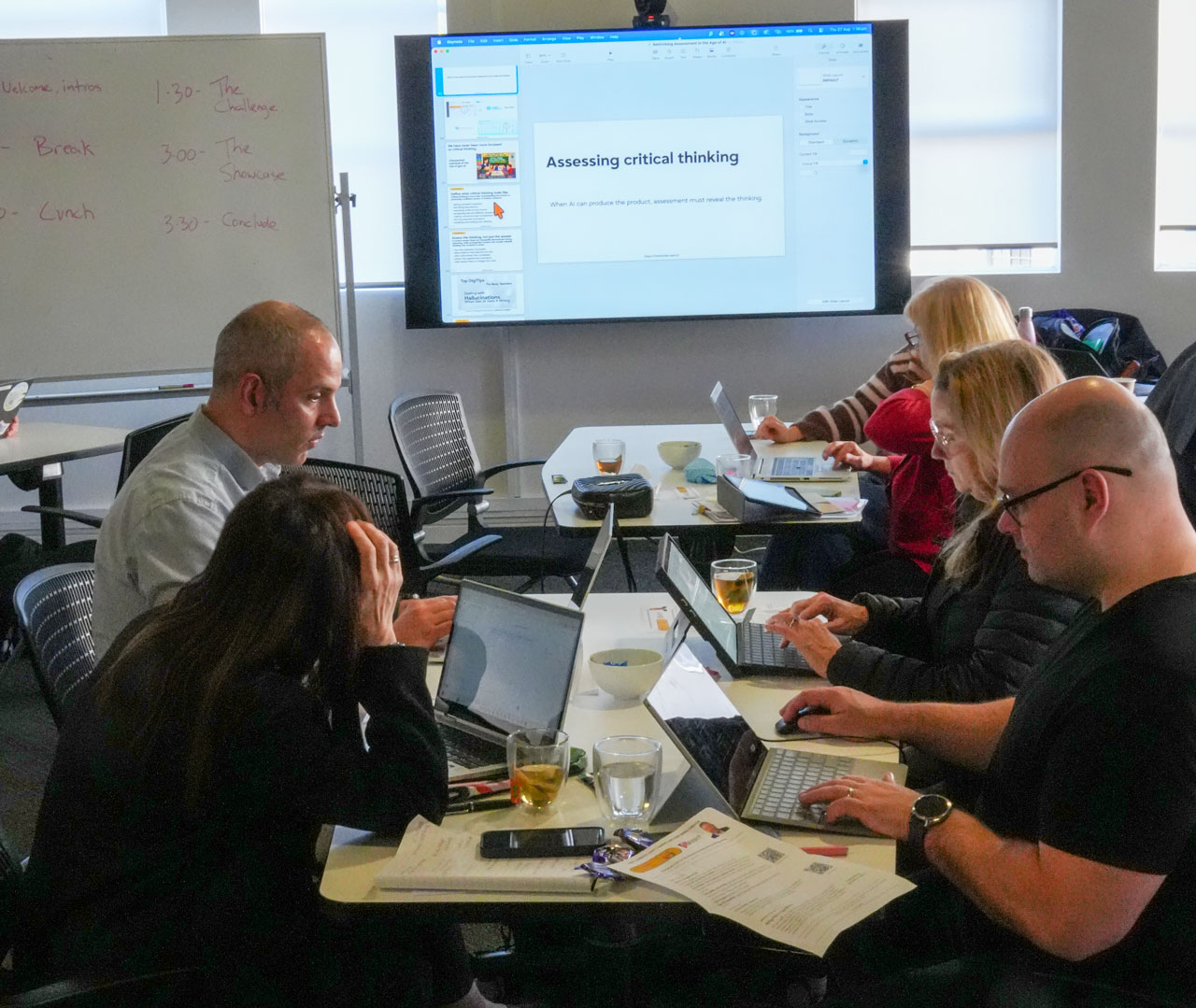
On Monday 12 October 2026, I worked with approximately 20 support staff at Yarra Valley Grammar to explore practical ways Microsoft Copilot could assist with everyday school administration. The session, Working Smarter with Copilot: Practical Shortcuts for School Admin Staff, focused on a simple principle: AI drafts. You decide.
School support staff handle work that shapes how families experience a school. An email, a reception response, a newsletter or a meeting follow-up can make a difference to whether people feel informed and supported. Generative AI offers ways to make some of this work more manageable, but the staff member’s knowledge of the school and its community remains essential.
Putting automation in perspective
We began by placing AI within the much longer story of automation. The workshop traced examples from water clocks and mechanical systems through to industrial machinery, household appliances, barcode scanners and spellcheckers.
This provided a starting point for considering what we might delegate to technology. With generative AI, that question extends to drafting, summarising and organising information. The opportunity is to reduce repetitive work while keeping people responsible for accuracy, judgement and relationships.
Briefing an assistant well
Throughout the session, Copilot was framed as a fast first-draft assistant. It can help with language and structure, yet a fluent response can still contain errors or miss the context that matters to a school community.
A practical prompting framework brought together six elements: role, context, audience, task, tone and constraints. Rather than simply asking for an email about an excursion, staff could specify the year level, what families already know, the details that need emphasis, the desired tone and a word limit.
The same approach applies to staff updates, event invitations and parent enquiries. Clear instructions give the assistant a more useful brief. Follow-up requests then help refine the draft: make it shorter, remove jargon, offer a warmer version or adapt it for a different audience.
Writing that still sounds like us
A substantial part of the workshop focused on everyday communication. AI can turn rough notes into a draft or help edit an existing message for clarity, grammar and flow. It can also suggest where wording sounds abrupt, defensive or ambiguous.
For schools, preserving an authentic voice matters. Families are communicating with people they know and trust. Asking AI to improve a draft while retaining the writer’s wording is one way to keep that relationship visible. Providing suitable, non-sensitive examples of previous writing can also help establish the preferred style.
Another useful approach is to ask what a busy parent might find confusing or what a new staff member would still need to know. Such prompts can reveal omissions, although any suggested additions need checking. AI should not fill a gap by inventing a date, requirement or school policy.
From information to useful action
The practical tasks also explored turning newsletter dot points into several communication formats, extracting key decisions and action items from a meeting transcript, and converting handwritten notes into typed text and a summary.
These examples highlight a common administrative challenge: information exists, but it needs to be organised for someone else to use. A school leader may need a short executive summary, while another staff member needs an action list. AI can help draft both from the same source.
The review remains crucial. A summary must reflect the original discussion, an action owner must be correctly identified, and unclear handwriting must be checked rather than confidently guessed. A draft response to a concerned parent likewise needs to reflect the school’s actual approach.
Keeping responsibility with people
The workshop set out four guardrails: protect student data, verify before sending, keep your voice and follow school policy. Staff were encouraged to use the school-approved account and describe situations generically rather than entering identifying student or family information.
We also included the less visible environmental considerations behind AI, including energy, water, carbon and electronic waste. These broaden the question from what a tool can produce to whether its use serves a worthwhile purpose.
My closing encouragement was to start with one recurring task, save prompts that prove useful and share effective approaches with colleagues. Building confidence through a manageable routine gives staff room to check quality and decide where AI adds value.
For school support staff, working smarter with AI means using assistance thoughtfully while continuing to own the work. The person reviewing the draft brings the context, care and judgement that a school community depends on.
A special thank you to Phil Callil, Director of IT and Digital Learning who initiated this workshop.
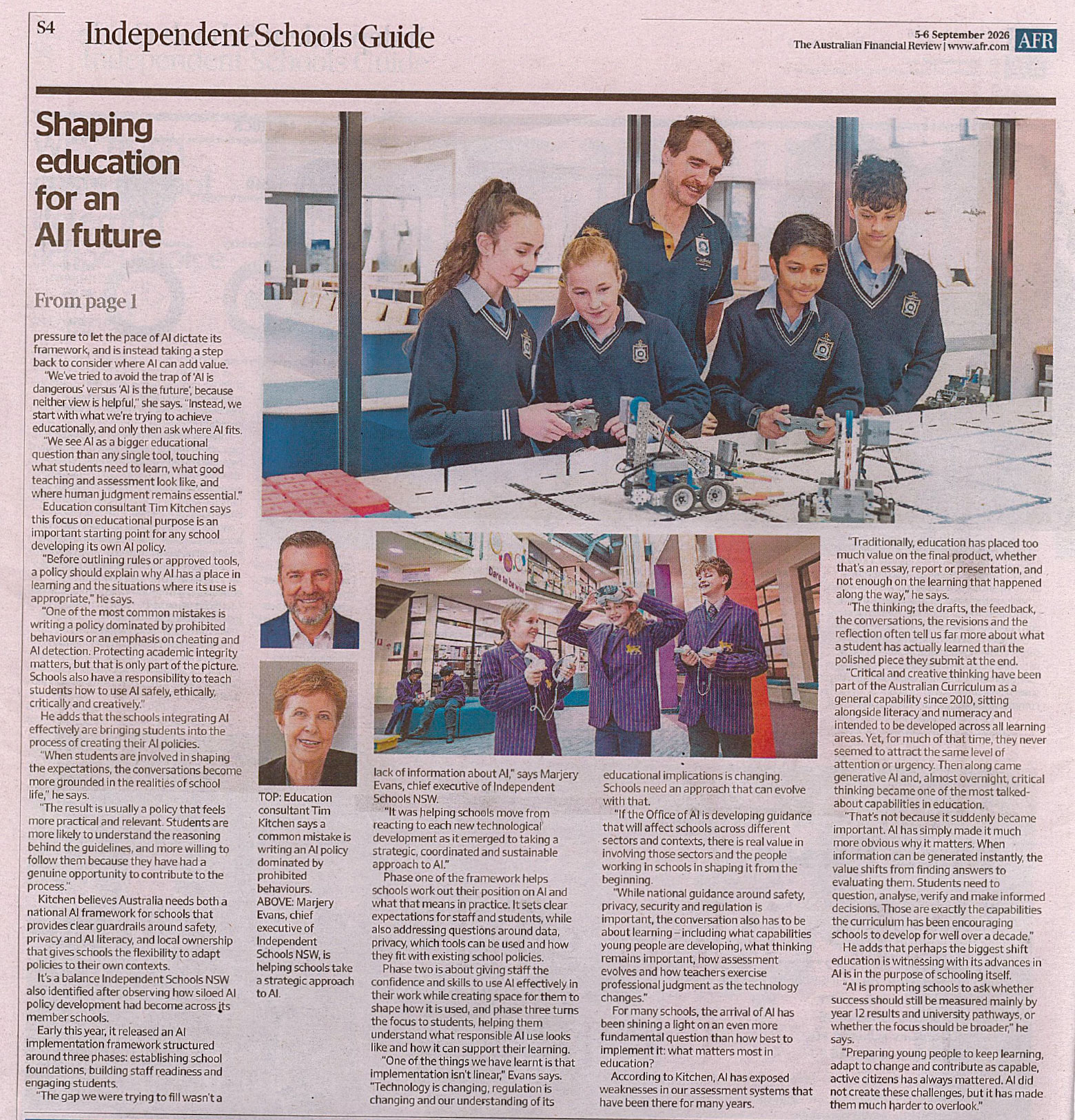
I was surprised to discover that I’d been quoted quite extensively in The Australian Financial Review earlier this month, in an article titled “Shaping education for an AI future.”
I remember the interview, but I hadn’t realised the article had been published until a kind reader sent me a copy. I’m grateful they did.
It’s encouraging to see a national conversation about how we prepare young people to learn, think and create in a world shaped by AI.
In this episode of The Kitchen Think, I’m joined by Alwyn Hunt, co-founder of The Rookies, a global community helping emerging creatives explore pathways into games, filmmaking, animation, design and other creative industries.
We explore what happens when a young person loves playing games and wants to learn how to make one? Or watches a film and wonders what it would be like to create its characters and visual effects? Alwyn explains how The Rookies connects students with learning resources, a community of peers and feedback from industry professionals.
We discuss what teachers can do when a student’s interest in 3D art or game development goes beyond their own expertise, and how parents can better understand the careers available in these fields. We also talk about Alwyn’s work in visual effects, the creative opportunities available here in Australia, and how AI is changing industry workflows.
Throughout the conversation, Alwyn makes a compelling case for staying curious and developing the creativity, problem-solving and critical thinking that young people will need as these industries evolve. With the first Rookies Schools Week coming up in October 2026, this conversation is a timely invitation to help young creatives see where their interests could take them.
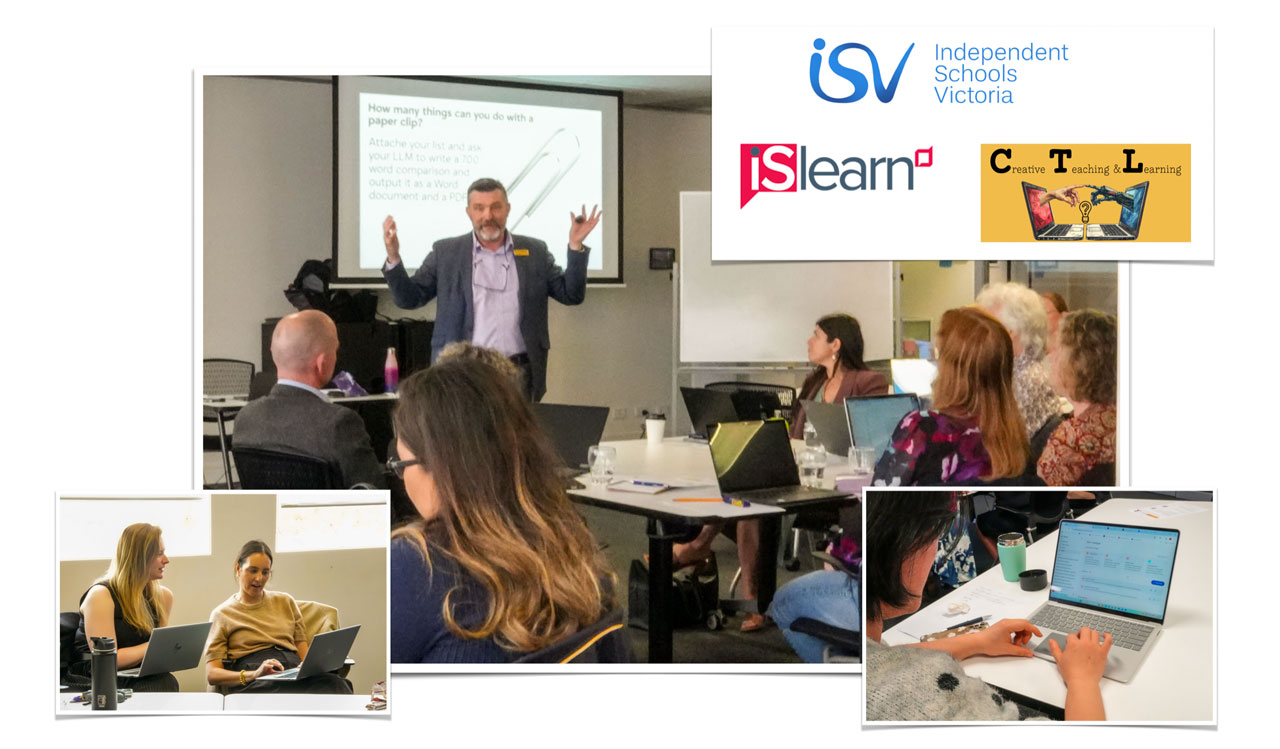
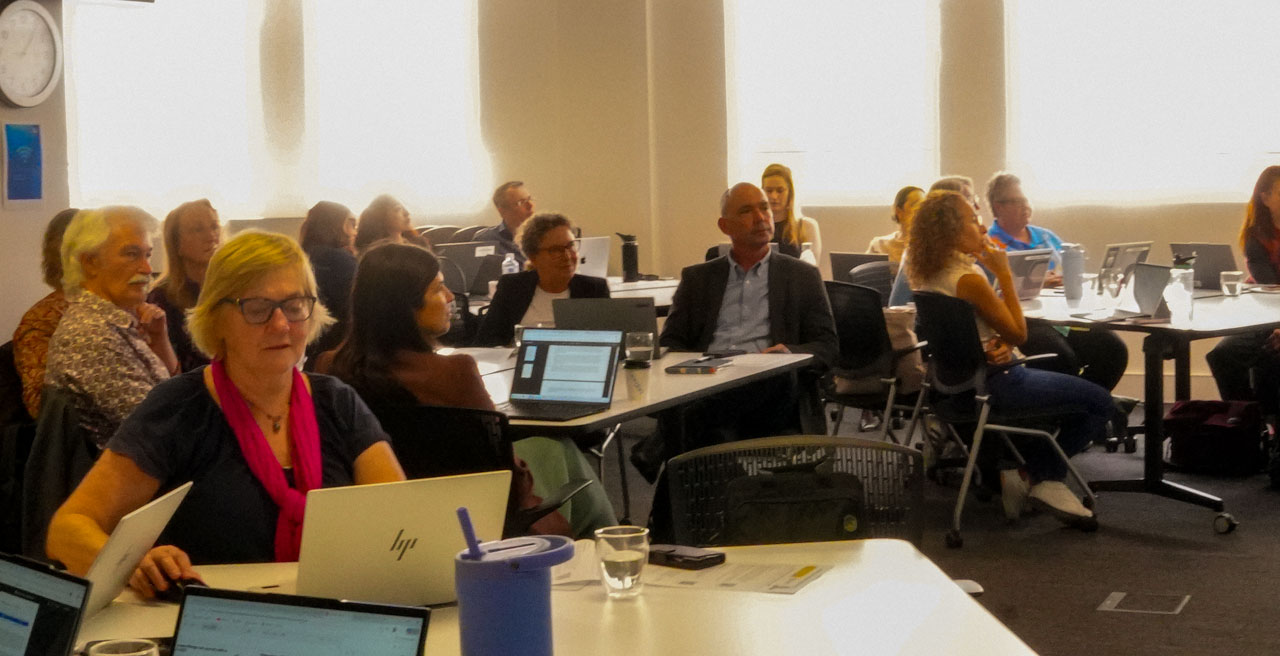
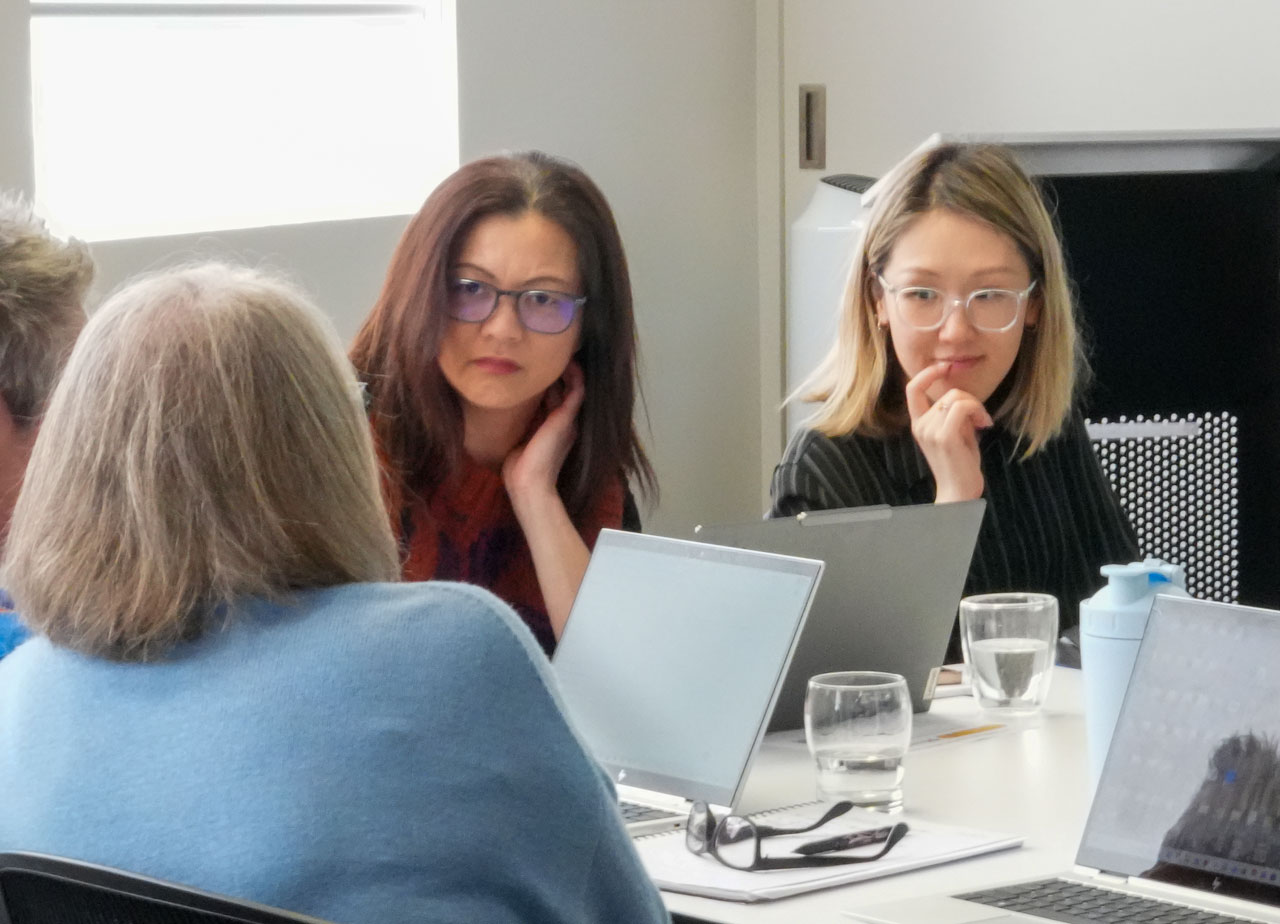
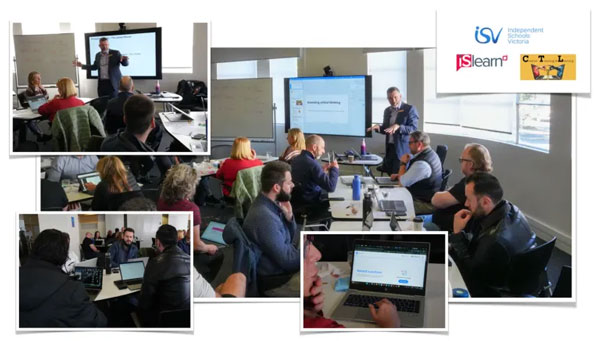
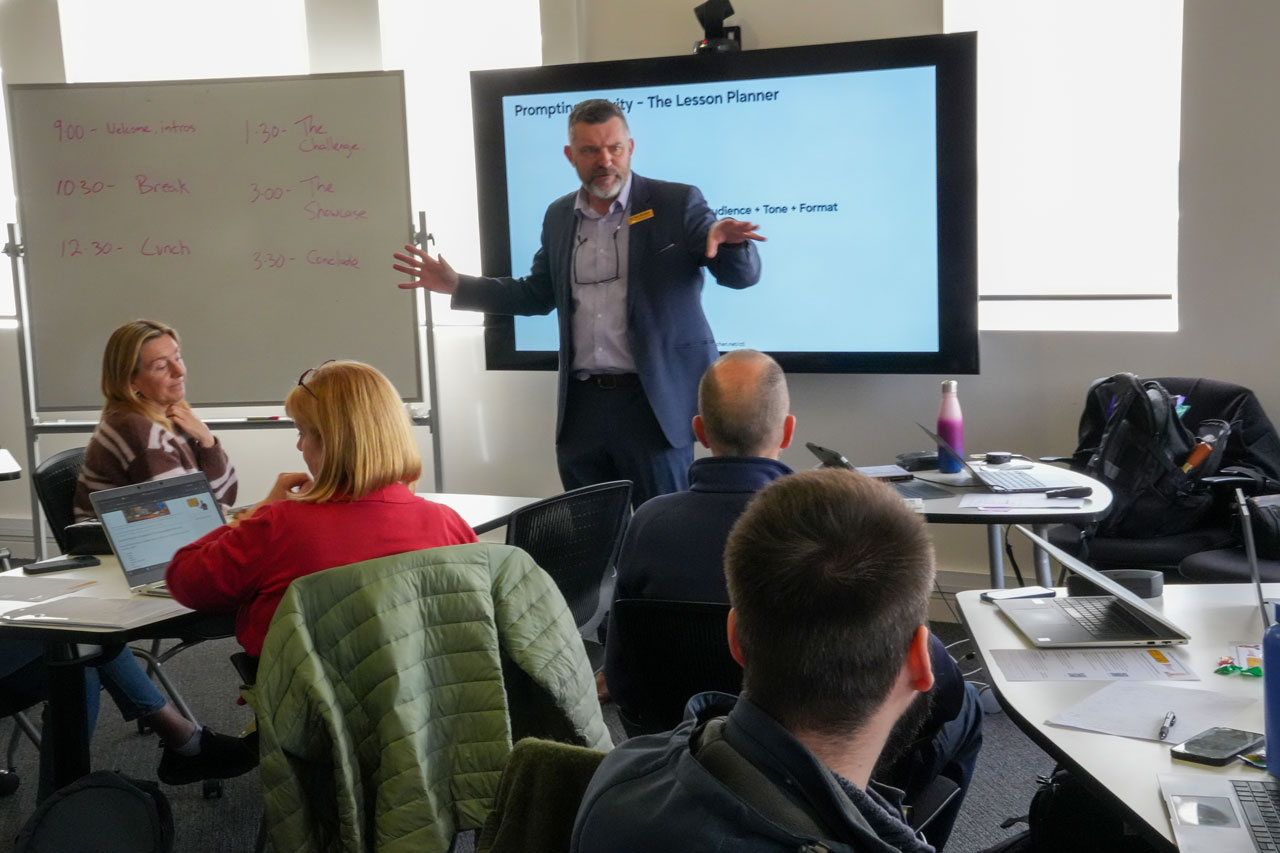
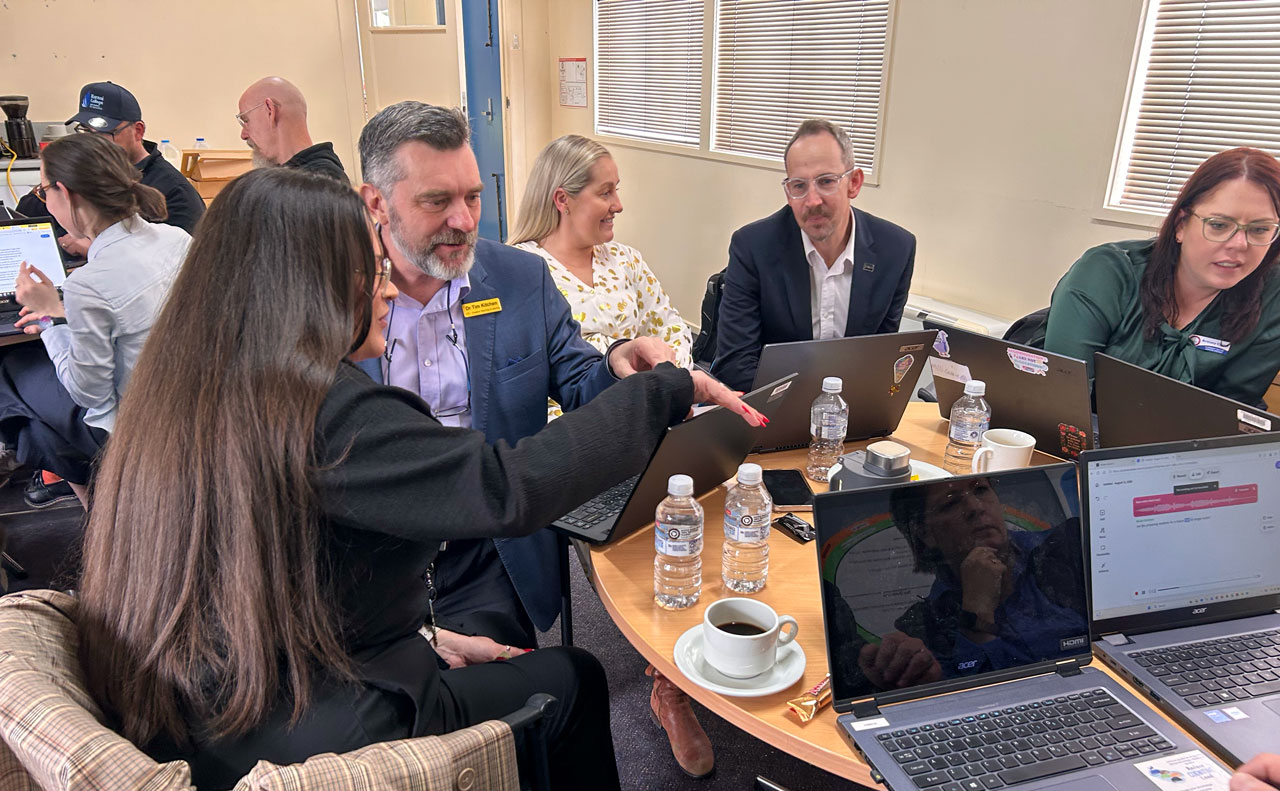
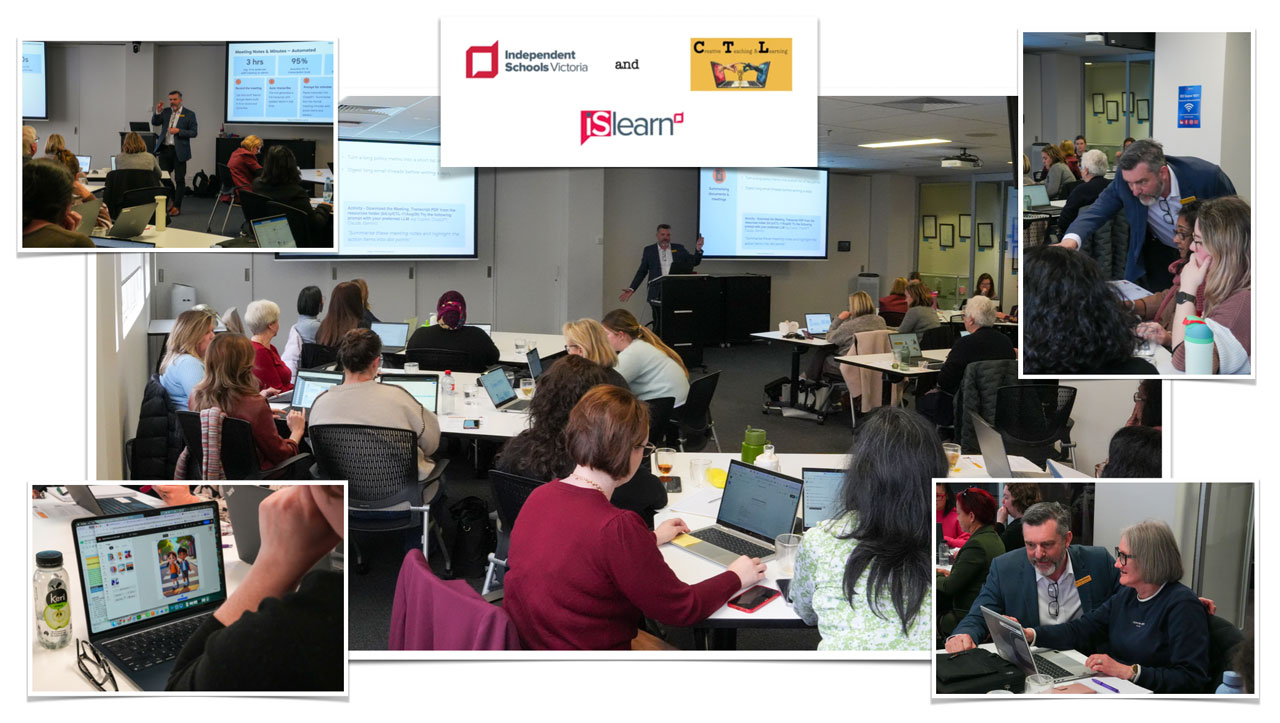
On 14 September, I facilitated a workshop with ISV titled AI for Everyday Communication: Writing Smarter, Not Harder that involved about 30 non-teaching admin staff from 15 different Victorian independent schools. The session was designed specifically for staff who manage much of a school’s daily communication.
These staff are often responsible for an extraordinary range of writing tasks. On any given day, they may be drafting emails to parents, preparing staff notices, updating newsletters, responding to enquiries, writing event announcements or translating complex information into language that is clear and accessible.
Each task may seem relatively small, but together they consume a significant amount of time. They also carry considerable responsibility. A poorly worded message can create confusion, damage trust or result in a long chain of follow-up emails.
Generative AI can help, but only when it is used thoughtfully.
The aim of the workshop was not to hand school communication over to AI. It was to explore how AI could support staff as a drafting assistant, helping them work more efficiently while maintaining the care, professionalism and distinctive voice of their school.
The blank page is often the hardest part
For many people, the most time-consuming stage of writing is getting started. You may know exactly what needs to be communicated but struggle to find the right opening sentence. You might write and rewrite the same paragraph several times, trying to make it sound professional without becoming too formal or impersonal.
Generative AI can be particularly useful at this early stage.
Instead of asking an AI tool to simply “write an email”, we explored how to provide it with the context it needs:
Who is the audience?
What is the purpose of the communication?
What information must be included?
What tone should be used?
Is there anything that should be avoided?
What action should the reader take?
Finding the right tone
Tone is one of the most important (and difficult) parts of school communication.
A message can be factually correct but still sound abrupt, defensive, overly formal or strangely impersonal. This is particularly risky when communicating about complaints, overdue payments, student wellbeing, changes to school procedures or other sensitive issues.
During the workshop, participants explored how AI could help revise a message without changing its underlying meaning.
One message, different audiences
Schools regularly need to communicate the same information to different groups. A policy update might require one version for staff, another for parents and a simplified explanation for students. Information supplied by a government department or external organisation may also need to be rewritten in plain language before it can be shared with the wider community.
Generative AI can help transform a source document into several audience-specific drafts.
Newsletters, notices and announcements
Newsletters and community announcements are another area in which AI can reduce the time spent drafting and editing.
Participants explored how brief notes or dot points could be developed into a polished article. AI could also suggest headings, shorten a long draft, remove repetition or generate several versions for different communication channels.
The purpose of using AI for everyday communication is not simply to produce more words, more quickly.
It is about reducing the time staff spend staring at blank pages, restructuring paragraphs and repeatedly rewriting routine messages. That time can then be redirected towards the work that requires genuine human understanding: supporting a concerned parent, helping a colleague, coordinating an event or strengthening relationships across the school community.
The most effective use of AI is not to remove people from communication. It is to give them more time and capacity to communicate well.
Used carefully, generative AI can become a valuable writing partner for non-teaching staff. It can help create first drafts, improve clarity, adjust tone, simplify complex information and adapt messages for different audiences.
But the human contribution remains essential.
The AI may help write the words. It is the people within the school who provide the context, judgement, empathy and authentic voice that give those words meaning.
That is what it means to write smarter – not harder.
If you would like to find out more about Dr Tim Kitchen’s consultancy CTL – click here
The Kitchen Think podcast/vodcast – Season 1, Episode 8
What if the city itself became the classroom?
In this episode of The Kitchen Think, Dr Tim Kitchen interviews Laura Bain, Director of Vision and Development for the Immanuel Lutheran College Urban Campus Project on Queensland’s Sunshine Coast.
Laura is helping to develop an innovative senior learning community in the heart of the Maroochydore CBD on the Sunshine Coast on QLD, Australia. Built around the idea that “the city is your campus”, the project aims to connect students with local businesses, universities, community organisations and authentic real-world learning opportunities.
During the conversation, Laura explores:
Why traditional schooling does not meet the needs of every student
How curriculum, wellbeing, technology and community partnerships can work together
The importance of student agency and personalised learning
How physical spaces can influence learning
The potential for AI to provide timely feedback and support individual learning journeys
How schools can help young people use AI thoughtfully, responsibly and discerningly
At the heart of the conversation is a hopeful vision for education – one in which every student is deeply known, learning is connected to the wider world, and schools become springboards into the future.
Subscribe to The Kitchen Think for more conversations about education, creativity, technology and preparing young people for an AI-rich world.
Dr Kitchen’s CTL – Creative Teaching & Learning site – https://timkitchen.net/ctl is also worth a look if you for more resources and support around the safe & ethical use of AI and digital creativity.
Across Australia this year, “back to basics” has become an increasingly attractive answer to some of the challenges facing schools. Put the laptops away. Bring back exercise books. Get students writing by hand. Less screen time, fewer distractions and perhaps a return to the quieter, more orderly classrooms many of us remember.
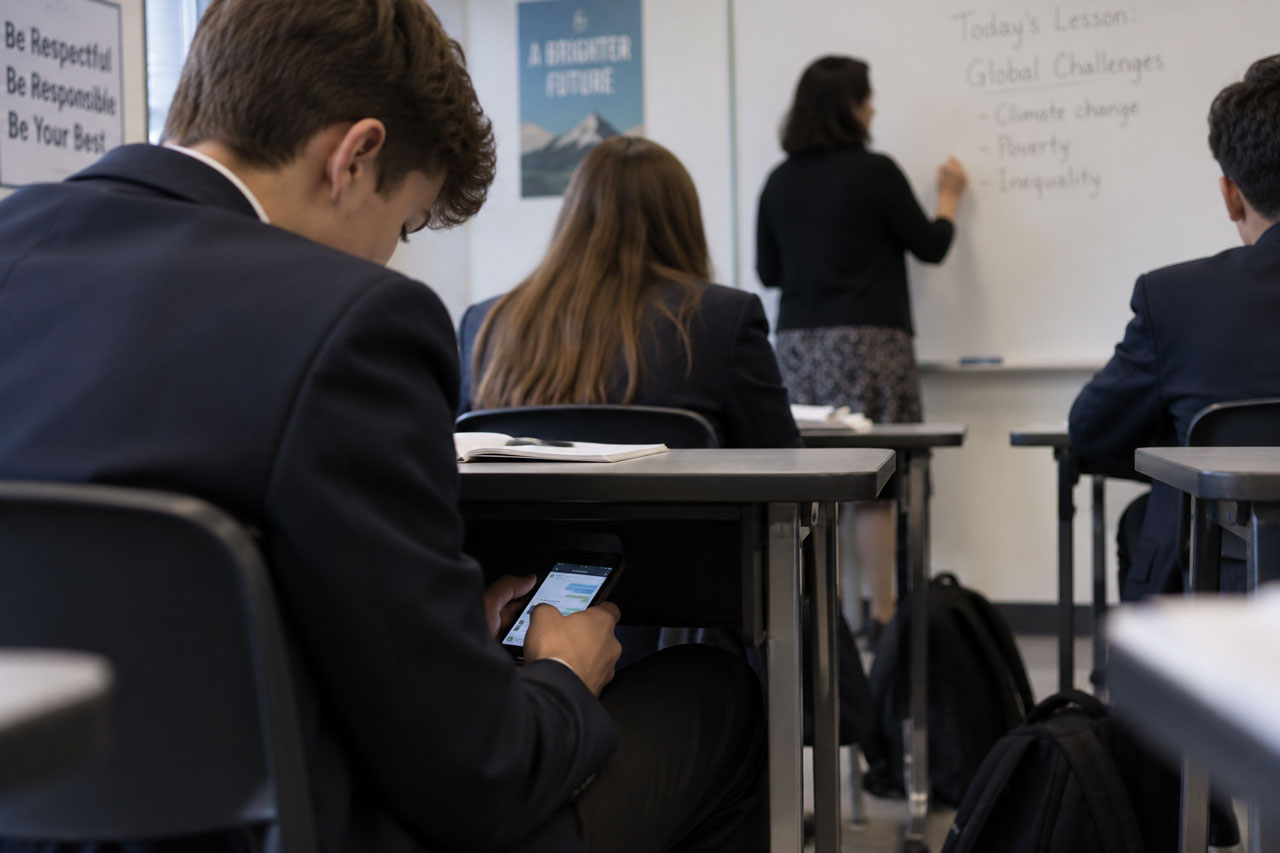
Schools are dealing with genuine issues around attention and distraction. Young people spend a lot of their lives looking at screens. Anyone who has watched a student flick from a piece of schoolwork to YouTube in about half a second knows the challenge is real.
But I think we’re asking the wrong question. The question isn’t whether screens belong in classrooms. They’re already part of the world our students live in, and they’ll be part of the world they graduate into. The better question is what we’re asking students to do with them.
Are they creating something? Solving a problem? Getting feedback? Collaborating with someone? Thinking more deeply? Or are they sitting in front of a laptop completing a digital worksheet that would have been just as useful on paper?
Because putting a worksheet on a screen doesn’t make it better learning. But taking the screen away doesn’t automatically make the learning better either.
That’s where I worry about the “back to basics” conversation. There’s a danger that we confuse nostalgia with evidence. The classroom we remember isn’t necessarily the classroom our students need. And quieter doesn’t always mean better learning.
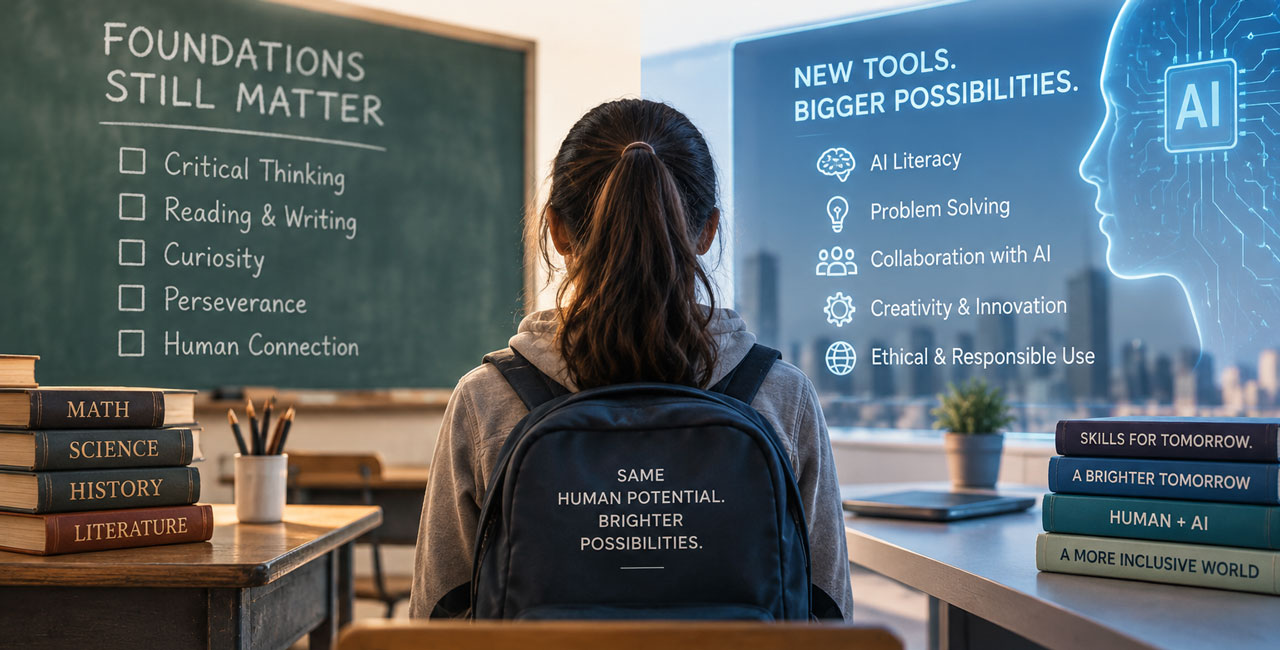
Made with ChatGPT 5.6 and Photoshop
We absolutely should teach students to write by hand. They should read books, work without distractions, talk to each other, concentrate for extended periods and sometimes put every device in the room away.
But they also need to learn how to use technology well. When to reach for it. When to ignore it. How to question what it gives them, and how to use it to do things that simply weren’t possible in the classrooms we grew up in.
So perhaps the conversation shouldn’t be about choosing between exercise books and laptops. It should be about choosing the right tool for the learning. Because if we diagnose the problem as “technology”, taking technology away feels like a solution. If the real problem is how we design learning, that’s a much harder conversation. And it’s one worth having.
The decisions we make now will shape the future our students walk into.
What the recent PISA results tell us
When I started teaching more than 35 years ago, nobody talked about a “digital detox”. We used pens, paper and textbooks because, well, that was school. There wasn’t really another option. A lot has changed since then.
If you’re looking for evidence that technology has become a problem in Australian classrooms, the latest PISA results give you plenty to work with. Around 41% of Australian students said noise and disorder were a regular feature of their classrooms, compared with a global average of 31%. Another 39% said their peers were distracted by digital resources, well above the OECD average of 28%.
Australia’s disciplinary climate ranked behind 68 participating countries. Over the longer term, our results in reading, mathematics and science have also continued to slide. Yes, Australia remains above the OECD average in all three, but I’m not sure that should make us feel particularly comfortable (Cassidy, 2026).
Stop there and the solution seems pretty straightforward. Take away the devices. Except that’s not the whole PISA story.
One of the findings that has received far less attention is how Australian students performed in the newer “learning in the digital world” domain. This looks at whether students can use technology to learn, evaluate information, solve problems and create things.
Australian students performed well above the OECD average (OECD, 2026). That makes the picture a bit more complicated. The same students who tell us technology is distracting them are also developing strong skills in using it. And PISA does show a relationship between distraction, excessive device use and poorer academic performance. What it doesn’t show is that putting a laptop in front of a student automatically makes the learning worse.
In fact, moderate use of digital devices for learning is associated with better results than no use at all. Performance starts to fall away when that use becomes excessive, or when the device becomes more about entertainment than learning (OECD, 2026).
So perhaps we need to be careful about what lesson we take from these results. If a student is watching YouTube while the teacher is explaining algebra, the problem is fairly obvious. If that same student is using a digital simulation to test a mathematical idea, collaborate with classmates or get immediate feedback on their thinking, we’re talking about something quite different.
Both involve a screen. They’re not the same learning experience. Which brings us to the question I think matters far more than whether technology belongs in our classrooms:
Are we actually using it well?
A phone is not the same as a laptop
Made with ChatGPT 5.6 and Photoshop
On balance, I think restricting mobile phones in schools has been the right move. I didn’t always think that.
I was teaching at an independent girls’ school in Melbourne when students having their own phones started to become the norm. This was before our 1:1 laptop program, and at the time those phones were actually pretty useful.
A student could quickly research a question that came up in class, check another perspective or take a photo of something on the whiteboard to come back to later.
Were they distracting? Absolutely. Parents would sometimes message their daughters during lessons. Occasionally they’d even ring them, which was always interesting in the middle of a class.
My approach was fairly simple. Phones on silent, face-down on the desk where I could see them. It wasn’t perfect, but most of the time it worked. But those were different phones. Or perhaps more accurately, it was a different digital environment.
That was before “the algorithm” really took hold. The phone I was managing in those classrooms is quite different from the one sitting in a teenager’s pocket today. What was once a useful device that occasionally interrupted a lesson is now connected to social feeds, recommendations, notifications, messages and a seemingly endless stream of content, all competing for attention.
I noticed the change outside the classroom too. My work as Adobe’s Education Specialist took me into schools regularly, and before the phone bans I’d often walk through playgrounds at recess or lunchtime and see groups of students sitting together, each absorbed in their own phone.
They were together, but they weren’t really together. Not much conversation. Not much laughter. Mostly heads down, scrolling.
Then the phone bans started arriving and the difference was hard to miss. I saw students kicking a ball around again. Sitting in groups talking. Laughing. Moving around. Looking at each other.
For me, that shifted the conversation. This wasn’t just about whether a teacher could manage phones during a lesson anymore. Something bigger had changed.
But this is also where I think we need to be careful. A phone is not the same thing as a laptop. Yes, laptops can distract students too. Anyone who has taught in a 1:1 classroom knows that. But a laptop is also a working environment.
Students use laptops to research, write, analyse data and code. They design things, edit video, build portfolios, collaborate and access specialist tools that simply don’t have a paper equivalent. That distinction gets lost surprisingly quickly when we bundle everything together under the label of “screen time”.
An hour scrolling through social media is screen time. So is an hour editing a documentary, building a 3D model or writing an essay. Counting the minutes tells us very little about what was actually happening during them.
That’s why I’m quite comfortable supporting phones being kept out of classrooms while also wanting students to have access to laptops when there’s a good educational reason for using them.
They both have screens. That doesn’t make them the same thing.
From screen time to screen purpose
Maybe we need to stop talking quite so much about “screen time” and start talking about “screen purpose”. Because the number of minutes a student spends looking at a screen tells us surprisingly little about the learning taking place.
What are they actually doing? Are they passively consuming content or making something of their own? Are they bouncing between websites with no real direction, or using a digital tool as part of a lesson that has been carefully designed? Are they distracted, or so absorbed in what they’re doing that they’ve lost track of time?
Those are much more useful questions.
I’d be very happy to see less low-value screen use in schools. Much less, in fact. But at the same time, I’d like to see better digital learning. More creating. More designing and investigating. Students analysing information, solving problems, making things and working with other people. Some of that can happen perfectly well without a computer. Some of it can’t.
Paper still matters enormously. There are plenty of times when I’d rather walk into a classroom and see pens in hands, books open and laptops closed. Students should write by hand. They should read physical books, make things, have conversations without a device between them and learn how to concentrate on one thing for more than a few minutes.
If we’ve lost some of that along the way, then yes, let’s bring it back. But let’s not pretend paper can do everything.
You can read about video production in an exercise book, but eventually you need to pick up a camera and edit some video. You can explain coding on a whiteboard, but at some point, students need to write code, run it, break it, work out why it broke and try again.
The same applies to data visualisation, multimedia, design and collaborative publishing. These are things students learn by doing, and doing them requires digital tools.
Generative AI now sits in that mix too. Whether we’re comfortable with it or not, students are going to encounter these technologies well beyond the school gate. I’d much rather they learn how to question them, use them responsibly and understand where they fall short while there’s a teacher in the room.
So, I don’t think the choice was ever paper or laptop. Sometimes the best tool is a pen. Sometimes it’s a conversation around a table. It might be a camera, a laptop, a piece of software or no technology at all. Good teaching is knowing which one to reach for, and when.
Made with ChatGPT 5.6 and Photoshop
We cannot prepare students for 1991
When I began teaching, there was no generative AI. No social media. No Google. The web hadn’t arrived in our classrooms and nobody was walking around with a computer in their pocket.
If students needed to research something, we went to the library. We were preparing them for the world they were about to enter. But we’re not preparing students for 1991.
The students sitting in our classrooms today will work in a world of AI, algorithms, digital communication, data and multimedia. They’ll collaborate with people they may never meet. They’ll need to work out whether information is credible, recognise when an algorithm is shaping what they see and decide whether an AI response is useful, misleading or just plain rubbish.
None of that happens simply because we hand them a laptop. It has to be taught.
Taking laptops away might mean fewer tabs open and fewer opportunities to disappear down a digital rabbit hole. The classroom might even become quieter. But quieter doesn’t necessarily mean better.
Remove technology from learning altogether and we also remove the chance for students to learn how to manage it, question it and use it well, with a teacher nearby.
Our job isn’t to recreate the schools we remember. There are things from those classrooms worth keeping. There are probably a few things worth bringing back too. But our students aren’t heading into our past.
They’re heading somewhere we never had to navigate at their age.
AI makes digital capability more important
Our students are going to use generative AI. Many already are. It’s appearing in search engines, writing tools, phones and the apps they use every day. We can ban ChatGPT from a classroom, but that doesn’t make AI disappear when students walk through the school gate.
I’d rather they learn how to use it with a teacher in the room. They need to know when using AI makes sense and when it doesn’t. They should question those wonderfully confident answers it produces, recognise hallucinations and bias, and think carefully about what happens to the information they type into these systems.
Then there’s the much harder question of authorship. If AI writes the paragraph, creates the image, summarises the reading and answers the question, where exactly is the student’s thinking? That’s a conversation worth having with students.
When is AI supporting your work? At what point is it doing the work for you? What have you learned if you hand the thinking over to a machine?
Students won’t learn to make those calls by pretending AI doesn’t exist. A student who is shielded from generative AI throughout school doesn’t magically walk out the gate as an AI-literate young adult. They’ve simply missed years when they might have experimented with it under supervision, got things wrong, challenged its answers and talked through the messy questions with a teacher.
They’ll learn about AI somewhere. I’d prefer school was one of those places.
What purposeful technology use looks like
So, what might this look like in practice? For a start, I’d keep classrooms phone-free. I’d also deliberately build device-free times into lessons. Students need time to write by hand, read quietly, talk to each other and make things. They need opportunities to concentrate without a stream of notifications sitting a few centimetres away.
Sometimes the best thing we can do with technology is turn it off.
And when a laptop genuinely adds something to the learning, open it. Use it to research, create, code, analyse data, edit video, collaborate, design or experiment with AI. Just don’t open laptops automatically at the beginning of every lesson because they happen to be sitting there.
Classroom routines make a difference here too. “Screens down” should mean screens down. Notifications can be turned off. Unnecessary tabs can be closed. Students can learn that opening a laptop comes with an expectation about what they’re there to do.
That sounds simple. In practice, it takes good classroom management and clear habits. Schools need to support teachers with this as well. Buying devices is the easy part. Working out how to use them well for learning takes time, professional learning, experimentation and plenty of conversations between teachers about what works and what doesn’t.
We should also be teaching students how to manage their own attention. They’re growing up with digital environments deliberately designed to keep them clicking, watching and scrolling. Telling them to “concentrate” probably isn’t enough.
Assessment needs another look too. If AI can produce a polished response in seconds, perhaps the polished response shouldn’t be the only thing we assess. Show me the drafts. Explain why you made that decision. Tell me what you changed and why. Show me where AI was used. What did it get wrong? What did you reject? Where did you struggle?
I want to see some evidence of the thinking. That, to me, is purposeful technology use. The laptop comes out because there’s a reason for it to be there. When there isn’t, close the lid.
Equity: who loses when schools withdraw?
There’s another part of this conversation that worries me. Imagine two students walking out of the same school at the end of the day. One goes home to reliable internet and their own laptop. Their parents understand digital tools and AI. There might be paid software, online courses, tutoring and plenty of opportunities to experiment.
If the school cuts back on digital learning, that student will probably be fine. They’ll keep learning anyway.
The second student goes home without those things. Perhaps there’s no suitable computer. Maybe the internet is unreliable. Nobody at home is experimenting with AI or showing them how to use digital tools well.
For that student, school might be the place where they get access to the technology. More importantly, it might be the only place where they get access to someone who can teach them what to do with it.
Take digital learning out of school and those two students don’t lose the same thing. That matters.
Socioeconomic background remains strongly connected with educational achievement in Australia, and we should be very careful about introducing policies that might make that divide wider (OECD, 2026).
A rule can look equal because it applies to every student. The opportunity it removes isn’t necessarily equal at all. For some young people, school is one place among many where they’ll develop digital and AI skills. For others, it might be the only one.
Better basics for a different world
Perhaps what we really need is a better definition of “the basics”. Literacy and numeracy remain foundational. Of course they do. But the basics students need today are broader than the ones I was teaching when I walked into my first classroom in 1991.
Students need to think critically about what they read, watch and hear. They need to understand something about how digital media works and how algorithms influence what appears in front of them. They need to distinguish credible information from something that simply looks convincing.
They need to create, communicate, collaborate and solve problems. And now they need to work out when AI is useful, when it needs to be questioned and when they’re better off doing the thinking themselves. That’s part of literacy now.
I began teaching with pens, paper and textbooks, and I still value all three. Walk into a good classroom today and I hope you’ll still see students writing by hand. I hope you’ll see books open, conversations happening, practical work underway and stretches of time where nobody is looking at a screen.
But I’d also hope to see students creating with technology. Analysing information. Editing media. Coding. Designing. Working together. Experimenting with AI and having a teacher challenge them when they accept its first answer without thinking.
We don’t need screens everywhere. And we don’t need to recreate the classroom of 1991. Phones can stay out. Laptops can stay closed when they add nothing to the lesson. Books, pens, conversations, practical work, cameras, laptops and AI can all belong in a modern classroom.
The important question is why they’re being used. That decision is best made by the teacher who knows the students in front of them, understands the learning and knows what they’re trying to achieve.
Maybe that’s a version of “back to basics” I could get behind.
Good teachers, clear purpose, and the freedom to choose the right tool for the learning in front of them.
Tim regularly works with teachers, admin staff and students both in-person and online with a focus on safe, ethical & creative use of AI and other digital technologies. You can find out more and book Tim to work with your school via – https://timkitchen.net/book-tim
AI Use Statement
Generative AI tools were used to support the research and development of this article. Claude Sonnet 5 and ChatGPT-5.6 assisted with exploring ideas, locating and synthesising information, refining the structure, and editing selected passages. Adobe Firefly and ChatGPT-5.6 were used to create supporting visual content. All AI-generated material was critically reviewed, fact-checked and revised by the author, who takes full responsibility for the article’s final content, arguments and conclusions.
Drawing on his recent PhD research, Leon and Amba Press have produced an outstanding and highly practical resource that addresses many of the questions teachers and school leaders are currently grappling with around AI in education. I highly recommend grabbing a copy and including it in your school’s professional learning program.
AI in Education Podcast
I was rather chuffed to receive a mention and recommendation from Ray Fleming and Dan Bowen towards the end of their popular AI in Education Podcast episode, “AI in Education: Who Gets to Decide?”, released on 27 August. I’m always impressed by the quality of the content and interviews Ray and Dan share, as well as their ability to produce such a valuable podcast every week. Very impressive!
Partnering with The Smith Family
It is hard to believe that Term 3 is already drawing to a close across Australia. Over the past month, I have had the privilege of working with a number of schools, teachers, leaders and administrative staff to build awareness, confidence and practical skills for working effectively, safely and ethically with generative AI.
It is a pleasure to support such a diverse range of schools, from communities facing significant socioeconomic challenges to some of Australia’s most well-resourced schools. Despite their different contexts, every school is navigating the opportunities and complexities created by the rapid growth of AI.
One recent highlight was partnering with The Smith Family to support educators from several schools across Victoria and South Australia.
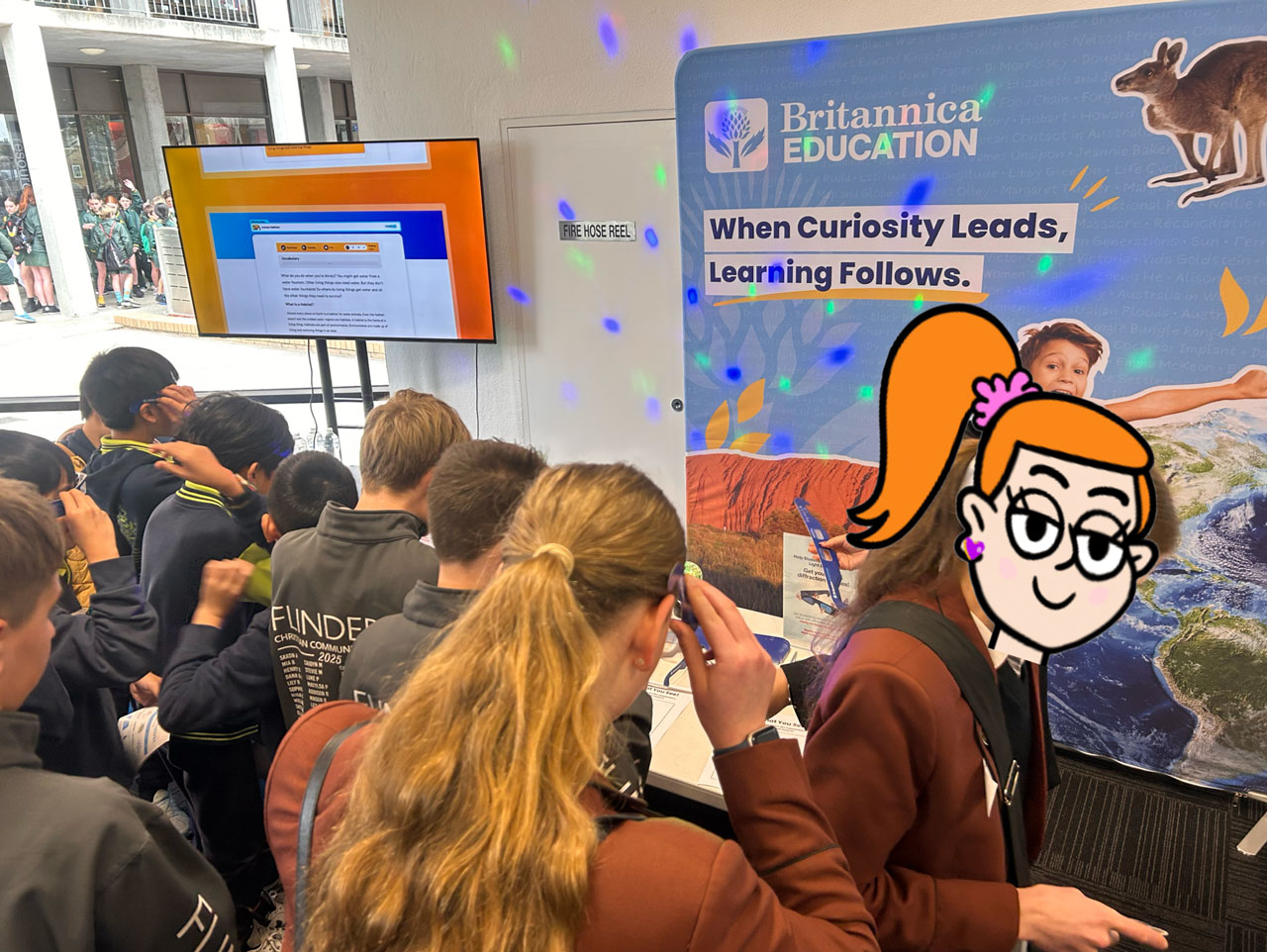
I also partnered with Real Time Learning to facilitate a full-day event at Flinders Christian Community College focused on rethinking mathematics teaching and learning in an AI-rich world.
I’ve enjoyed working with teaching & non-teaching staff from Victorian independent schools through my professional learning series with Independent Schools Victoria (ISV).
It was lovely to be back involved in the 2026 National Education Summit at the Melbourne Convention and Exhibition Centre. This event brought together teachers, school leaders, education consultants, authors, researchers and industry partners for two days of professional learning, practical ideas and valuable conversations. With conference streams, free seminars and an extensive education exhibition, the Summit provides educators with many opportunities to learn, connect and be inspired.
Book Tim to work with your school
If you would like to book me to work with your school (either in person or online) click here to find out more and get in touch.
Some of the presentation and workshop topics currently available include:
Taking Control of AI in Your School
Talking to AI: How Great Prompts Unlock Great Answers
Who Owns AI-Generated Work and How Should We Use It Fairly?
When Does Generative AI Support Learning and When Does It Cross the Line?
Your Feed Is Watching You: How AI Shapes What We See, Believe and Share Online
AI Has a Hidden Cost: Energy, Water, Carbon and E-Waste
Rethinking the Way We Do Assessment in the Age of AI
Generative AI for School Administration
Engaging Students Through Digital Creativity with Adobe Express
Two new episodes of The Kitchen Thinkhave been released over the past month.
Episode 6 — The Castlereagh Statement: What It Means for Everyday Teachers
This episode explores Australia’s cross-sector call to action for education in the age of AI, translating its big ideas into practical strategies for everyday teaching and learning.
Episode 7 — School Culture, Leadership & AI
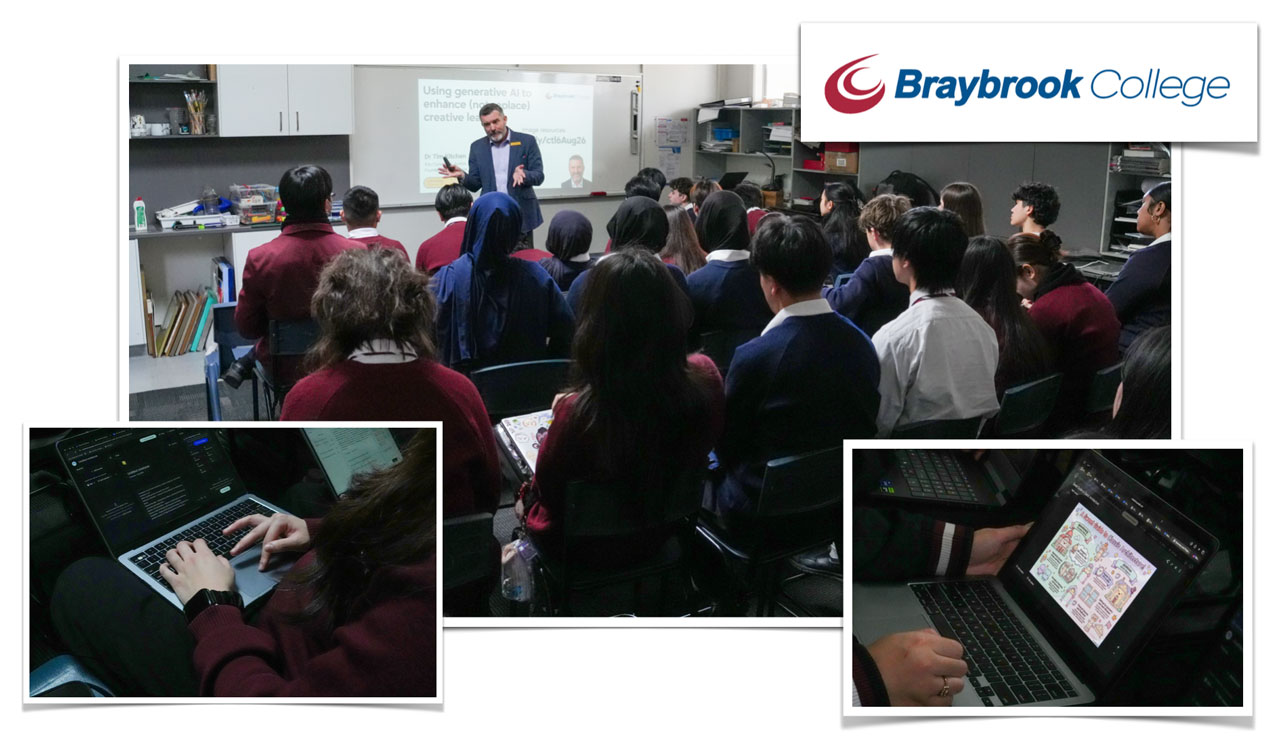
Featuring an interview with Sean McMahon, Assistant Principal at Braybrook College, this episode explores how a strong and diverse school community can help students thrive and prepare for an increasingly AI-shaped world.
You can listen to or watch The Kitchen Think through Spotify, Apple Podcasts and YouTube.
My New Book
My new book (and my first with Amba Press) The Human Advantage: Teaching, Learning and Leading in a Gen AI World is now available to pre-order ahead of its official launch in November. Drawing on more than 35 years of experience in classrooms, school leadership and education consultancy, the book offers practical strategies and frameworks to help educators rethink curriculum and assessment, embrace AI wisely and ethically, and strengthen the uniquely human qualities that matter most. Find out more and pre-order your copy.
Booklet Resource
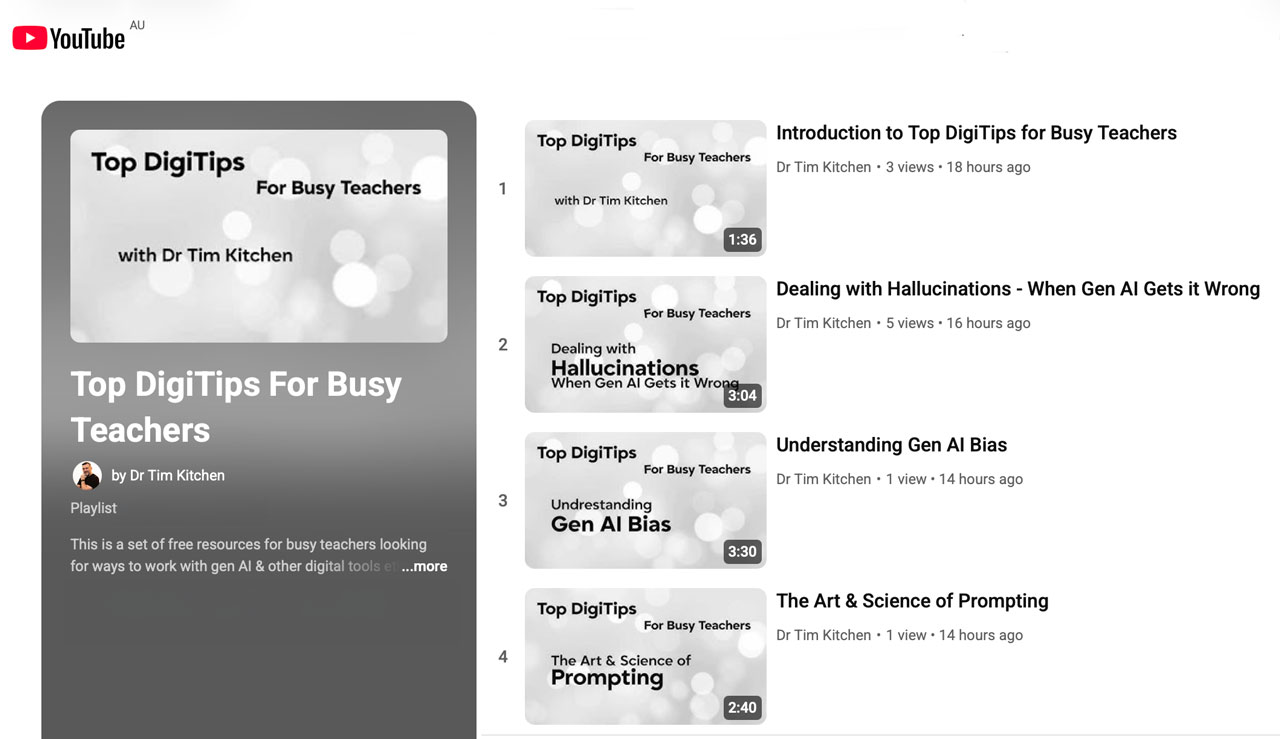
Volume 1 of the Top DigiTips for Busy Teachers booklet is now available via Amazon for AUD $16.50 This is a practical, companion for the YouTube series designed to help educators confidently navigate the rapidly evolving world of educational technology and generative AI.
The Next Word
Is your school in need of an AI audit, or some extra support and advice about AI use in the classroom? The Next Word is a forward-thinking education consultancy that helps schools navigate the rapidly evolving world of generative AI.
I am very pleased to be on The Next Word team as an Associate and encourage you to look up what we can offer your school.
The Best Way to Learn is to Make – Creativity in a Gen AI World is available here through Amazon.
Teacher PD Australia
Have you discovered Teacher PD Australia yet? It’s a growing Australian platform designed to help busy educators easily discover high-quality professional learning opportunities — courses, events, webinars, books, and resources tailored to their subject areas, career stage, interests, and teaching context. An all-in-one, easy-to-navigate directory built specifically for Australian teachers. Well worth sharing with your networks.
Book me to visit your school
If you would like to book some time for me to visit your school(s) to work with key leaders, teaching staff, non-teaching staff and/or students, use this site to help with the planning.
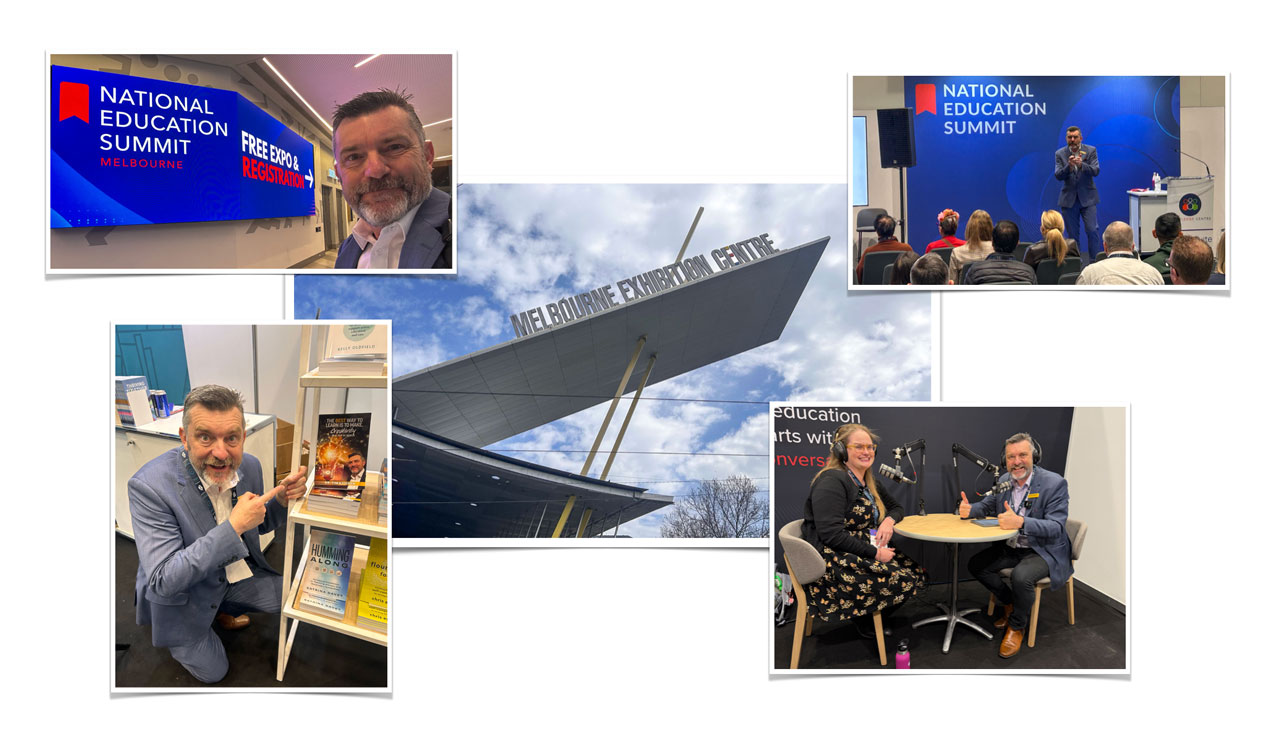
On 3 and 4 September, I had the great pleasure of being involved in the 2026 National Education Summit at the Melbourne Convention and Exhibition Centre.
This event brought together teachers, school leaders, education consultants, authors, researchers and industry partners for two days of professional learning, practical ideas and valuable conversations. With conference streams, free seminars and an extensive education exhibition, the Summit provides educators with many opportunities to learn, connect and be inspired.
My involvement across the two days included MCing, podcasting, presenting and book signing – four activities I thoroughly enjoy.
Day 1: Early Stages, podcasting and conversations with readers
My first role on Thursday was to MC the Early Stages Theatre. This free seminar program focused on early childhood and the early years of schooling, featuring a range of educators and specialists sharing practical insights and experiences.
One of the great privileges of being an MC is the opportunity to help create a welcoming environment for both presenters and audience members. It was a pleasure to introduce the speakers, learn from their work and help keep the program flowing throughout the day.
Sam Butterfield, Director of Teaching and Learning, Hume Anglican Grammar
Alice Vigors, Principal, Tumut Public School
Between MC responsibilities, I moved across to the Summit’s Podcast Hub to record two special episodes of The Kitchen Think. My guests were Adrian Cotterell, Managing Director of Thinking Mode, and Tory Spicer-Stuart, Head of Teaching and Learning – Digital Practice at Beaconhills College. The Podcast Hub was located on the exhibition floor and hosted a curated series of live recordings featuring education podcasters, researchers, teachers and school leaders.
With Adrian Cotterell,
With Tory Spicer-Stuart,
Adrian and I explored the increasingly complex relationship between assessment, generative AI and AI-detection software. We discussed why schools need to be cautious about relying too heavily on detection tools and why assessment practices must evolve to place greater emphasis on process, dialogue, reflection and evidence of learning. We also promoted his amazing assessment resource for schools called Thinking Mode.
Tory shared some of the thoughtful work taking place at Beaconhills College to integrate AI into teaching and learning. Our conversation also considered a much bigger question: what does it mean to be human in a world increasingly influenced by generative AI?
I also spent time signing books and meeting educators in the Amba Press Book Nook area. These sessions are about much more than simply adding a signature to a book. They provide an opportunity to speak directly with readers, hear about the challenges they are encountering in their schools and discuss the ideas that are most relevant to their work. This was an opportunity to promote my soon to come publication with Amba Press – The Human Advantage: Teaching, Learning and Leading in a Gen AI World.
For an author, there is something particularly rewarding about meeting the people who engage with your writing. Each conversation is a reminder that books can become the starting point for new thinking, professional dialogue and meaningful change.
Day 2: Exploring the Human Advantage
On Friday morning, I had the honour of opening the Knowledge Centre Theatre with my presentation:
The Human Advantage – how teaching and learning is changing in an AI-rich world
The session examined the rapid influence of generative AI on education and the need to reconsider some of our established approaches to teaching, learning and assessment.
AI can generate text, images, audio, video and computer code within seconds. It can help educators brainstorm ideas, differentiate resources, provide feedback and reduce time spent on repetitive administrative tasks. It can also support students as a creative partner, research assistant and thinking companion.
However, easy access to sophisticated AI-generated content also raises important questions. What does authentic student work now look like? How can teachers assess understanding rather than simply evaluate a polished final product? How do we help students use AI safely, ethically and transparently?
A key message from the presentation was that AI may change how we teach, learn and assess, but it does not diminish the importance of being human.
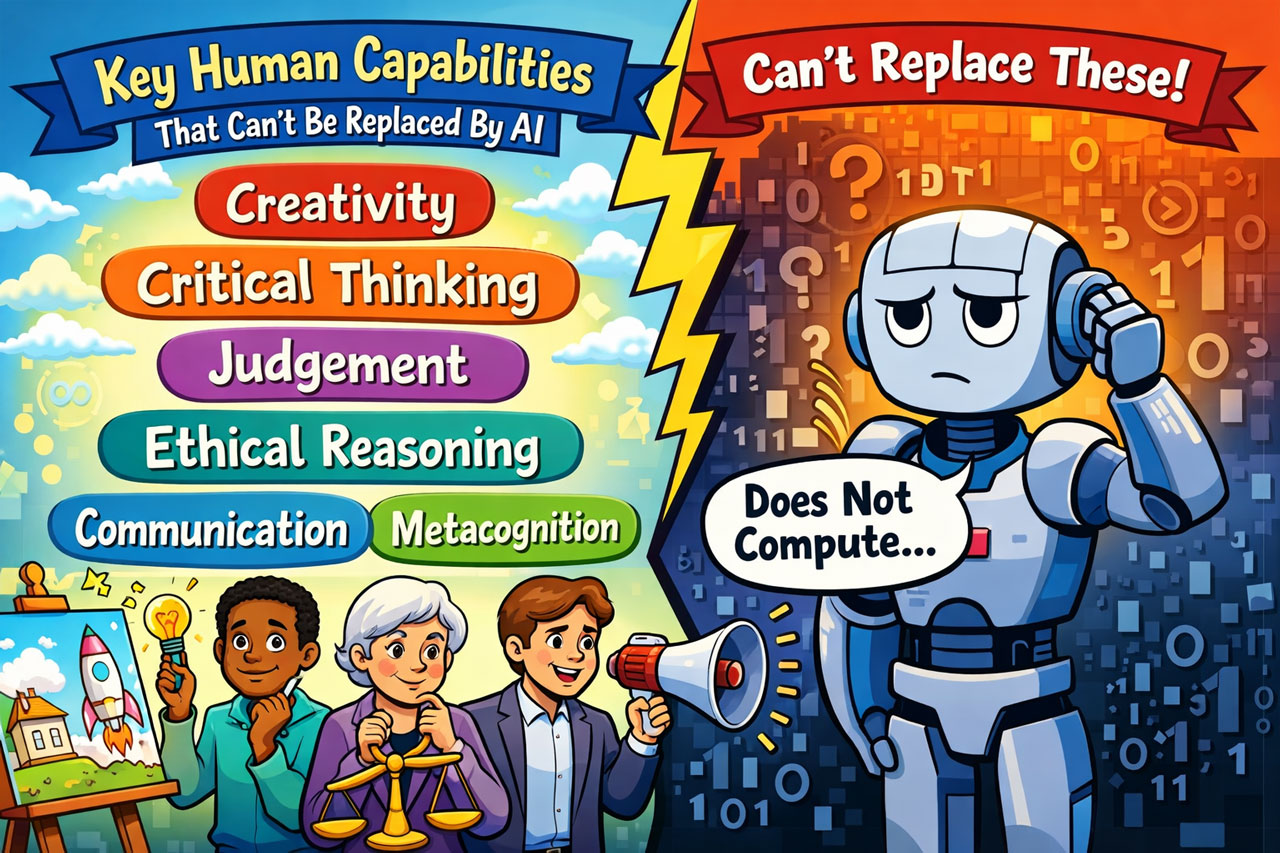
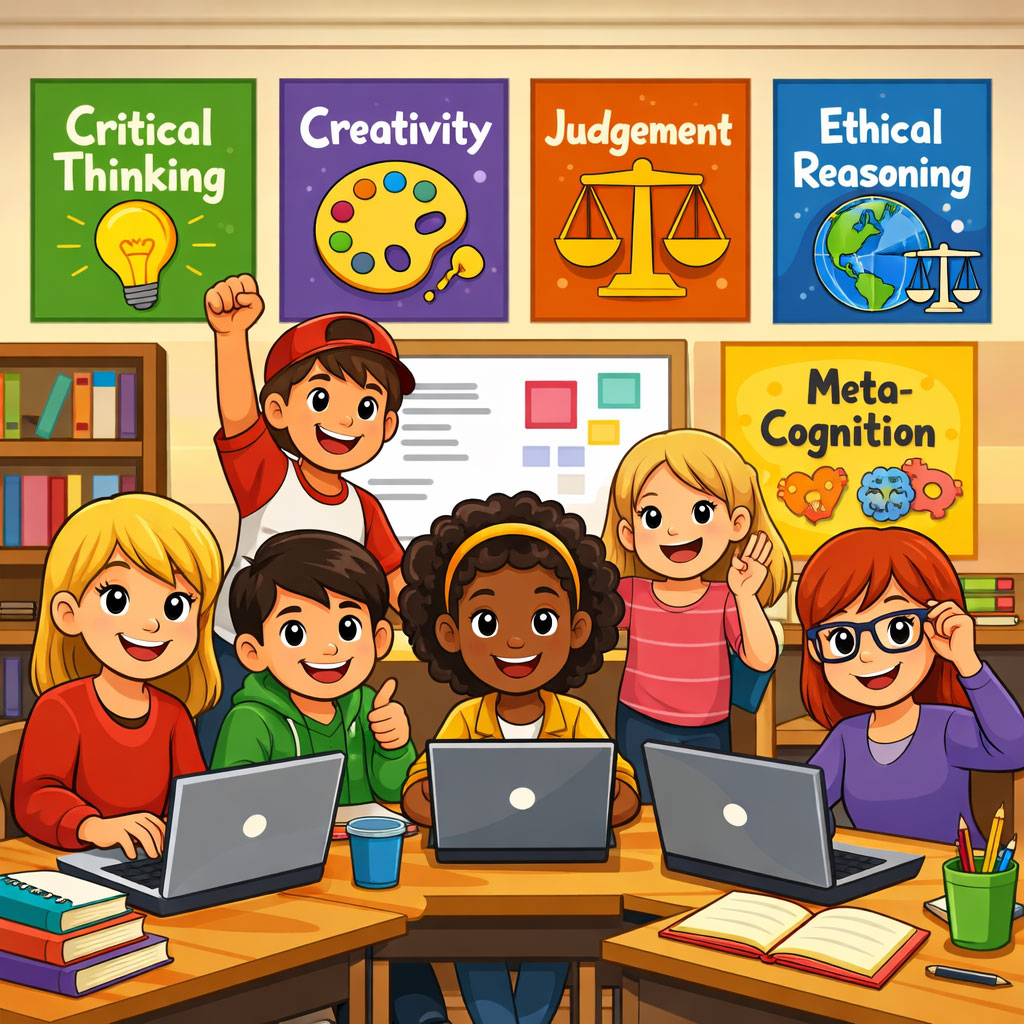
Our advantage lies in qualities such as curiosity, empathy, judgement, creativity, ethical reasoning and meaningful connection. These are not optional extras in education. They are central to the kind of people and communities we are trying to develop.
A highlight for me was seeing the work created by Marty from Sketch Group, a talented artist who visually captured the key ideas from my presentation as I spoke.
A valuable two days
Across both days, the strongest feature of the Summit was the opportunity to connect.
Whether I was MCing a theatre, recording a podcast, presenting to educators or signing books, the most valuable moments came through conversations with people who care deeply about education and the future of young people.
With Andrew FullerWith Matt EstermanWith Ray Flemming & Adrian CotterellWith Dan Bowen & Tory Spicer-Stuart
Events such as the National Education Summit remind us that educators do not need to navigate rapid technological and social change alone. By sharing our experiences, asking difficult questions and learning from one another, we can develop more thoughtful and human-centred responses.
Thank you to the National Education Summit team, the presenters, exhibitors, podcast guests, Amba Press and everyone who attended my session or stopped by for a conversation.
It was a busy, energising and inspiring two days, and a wonderful opportunity to celebrate the human advantage at the heart of education.
On Tuesday 1st September, I had the pleasure of facilitating a practical workshop titled Time-Saving Automation with AI for 19 non-teaching staff representing approximately 12 Victorian independent schools.
Designed specifically for school administrative and office staff, the workshop explored practical ways AI tools can help reduce repetitive work, streamline everyday processes and give staff more time to focus on the people and responsibilities that require human judgement and care.
A poll conducted with the group revealed that generative AI is already becoming part of everyday administrative practice. Ten participants, or 53%, reported using generative AI daily, while another four, or 21%, said they use it several times a week. However, confidence has not necessarily kept pace with adoption. Fourteen participants, representing 74% of the group, described themselves as “still learning.” This included six of the ten daily users.
This was one of the most interesting findings from the workshop. Regular use does not automatically translate into confident, safe or effective practice. Staff may be experimenting frequently with AI while remaining uncertain about prompting, privacy, accuracy, appropriate use and the reliability of the information being generated.
Microsoft Copilot was the most widely used AI tool among the group, selected by 79% of respondents. Canva or Adobe Express AI features followed at 63%.
The most established applications were:
Drafting emails — 84%
Writing documents — 79%
Preparing meeting notes — 58%
Brainstorming ideas — 53%
These results reflect the immediate value that generative AI can offer administrative staff. Email and scheduling were also identified as the most time-consuming responsibilities, making them logical areas in which to explore safe and practical automation.
During the workshop, we examined how AI could assist with repetitive administrative tasks without removing human responsibility. The emphasis was not on handing entire roles over to AI, but on identifying small, recurring tasks where AI could provide a useful first draft, organise information, suggest a structure or accelerate an established process.
Participants were interested in applying AI to a broader range of practical tasks, including:
Organising files
Analysing spreadsheets
Drafting meeting notes
Creating standard letters and forms
Summarising documents
Responding to routine enquiries
The workshop highlighted the need for schools to establish clear guidance around approved AI tools, data privacy and human oversight.
Professional learning for non-teaching staff should be practical and closely connected to their roles. It should include opportunities to work with genuine administrative processes, learn how to check AI-generated outputs and understand how to handle confidential information safely.
The workshop reinforced that school administrative staff are not waiting for AI to arrive. Many are already using it regularly and are eager to develop more sophisticated workflows. The priority now is to ensure that adoption is supported by the confidence, guidance and safeguards needed to use these tools well.
When introduced thoughtfully, AI has the potential to take some repetitive work off the plates of busy school staff. However, the most effective approach will continue to combine the efficiency of AI with the experience, accountability and human judgement of the people who keep schools running.
Click here to find out more this series of events for non-teaching & teaching staff at ISV schools.
Click here to book Tim to work with your school (on-line or in-person)
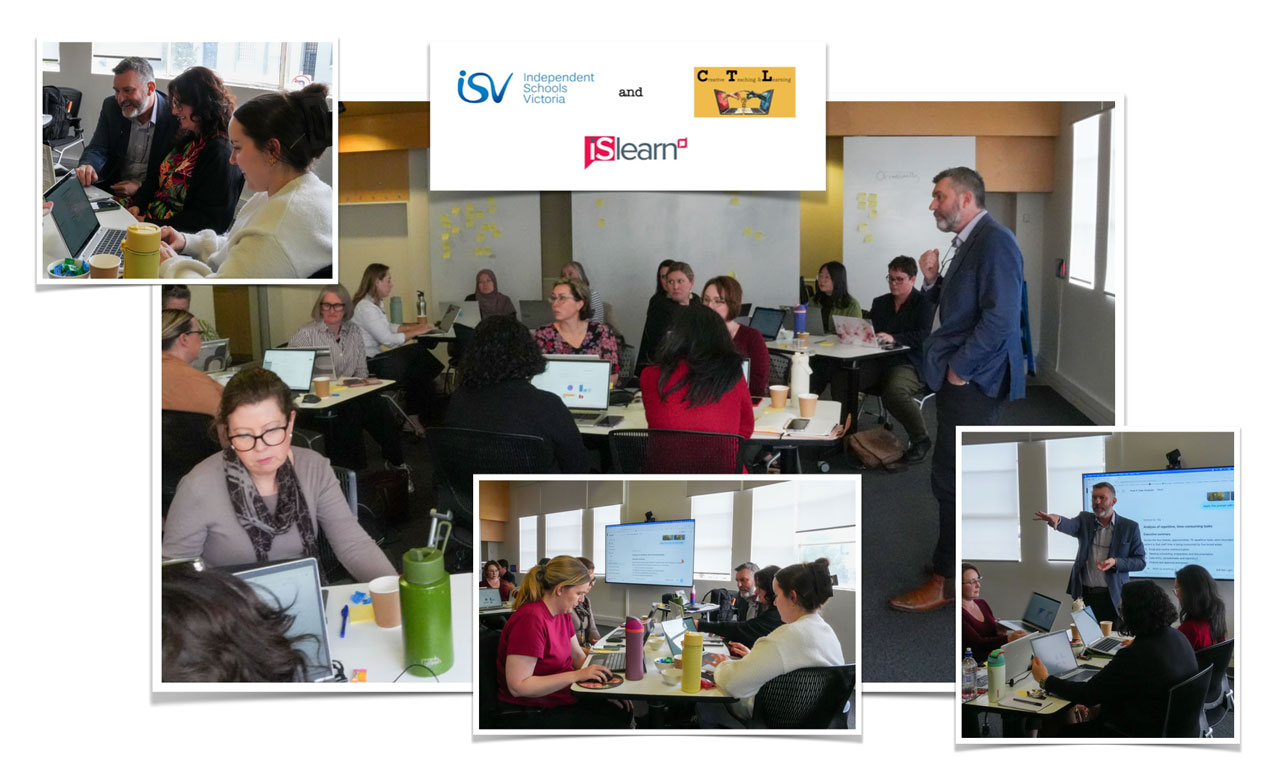
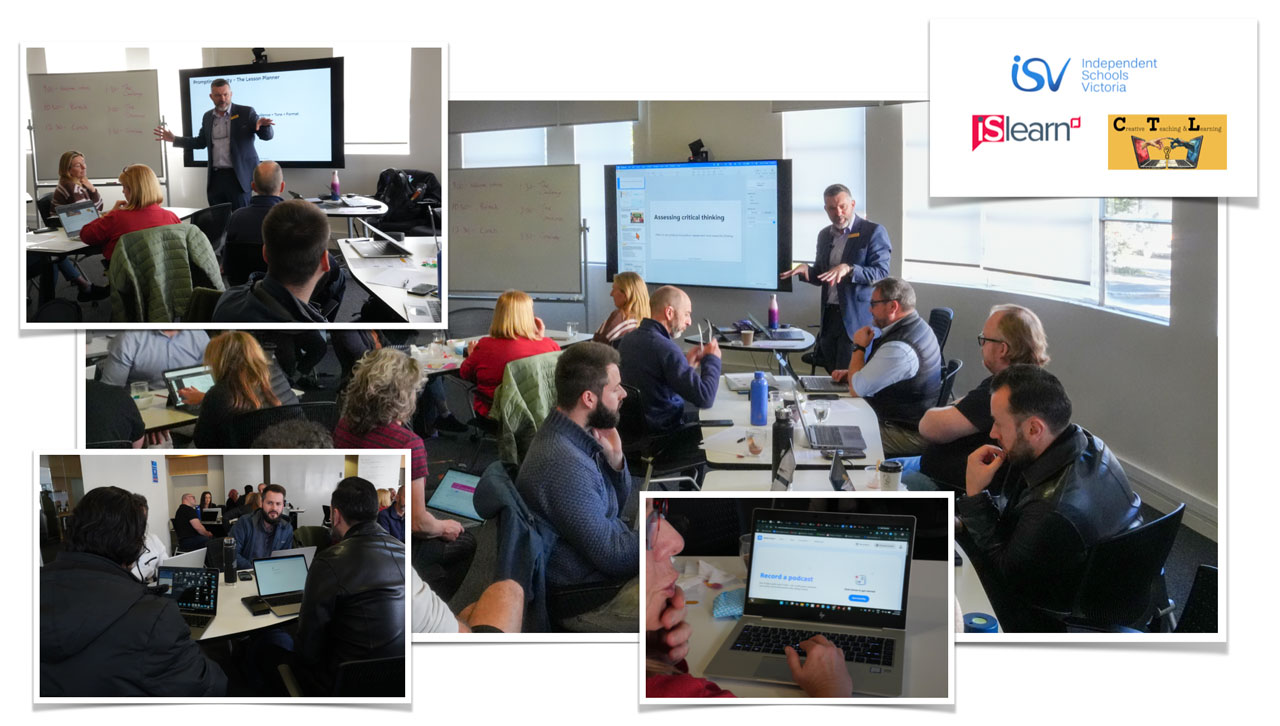
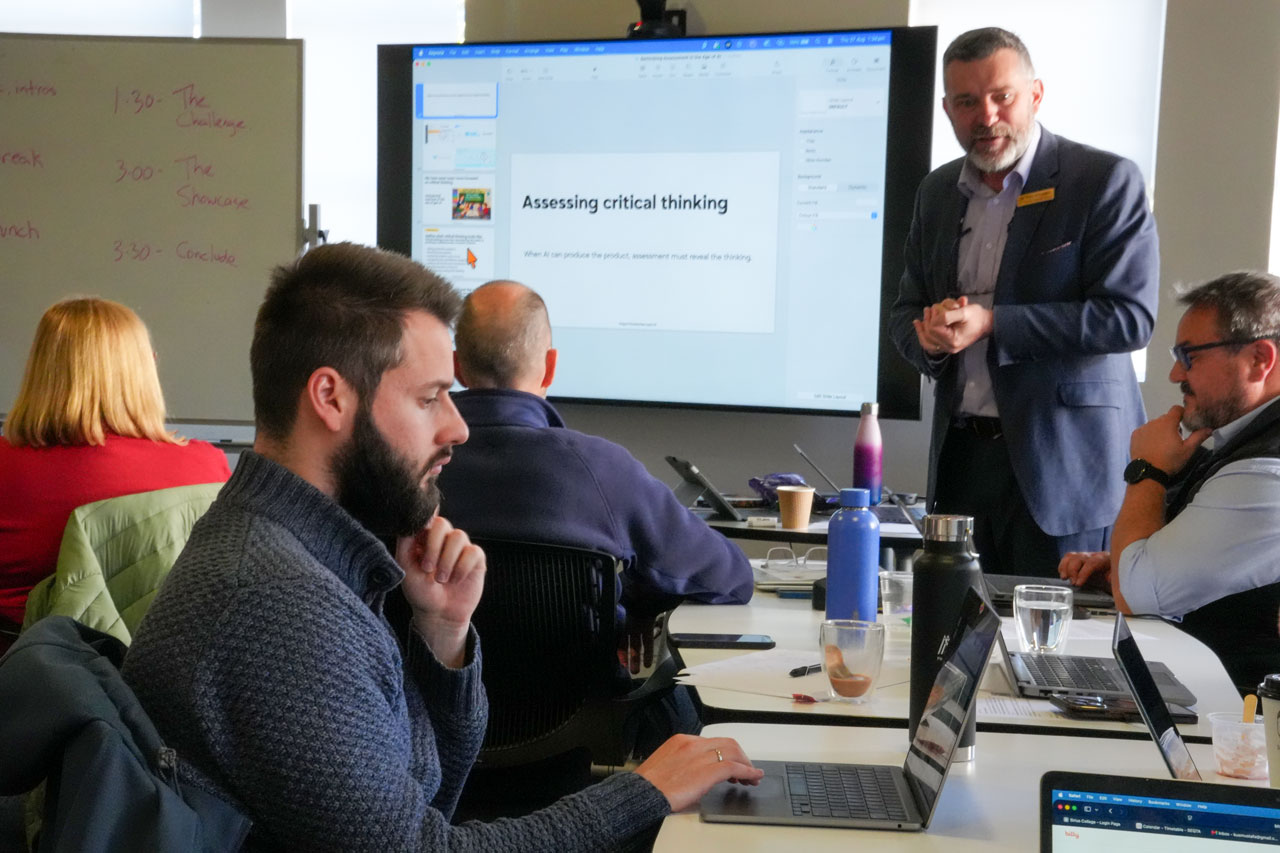
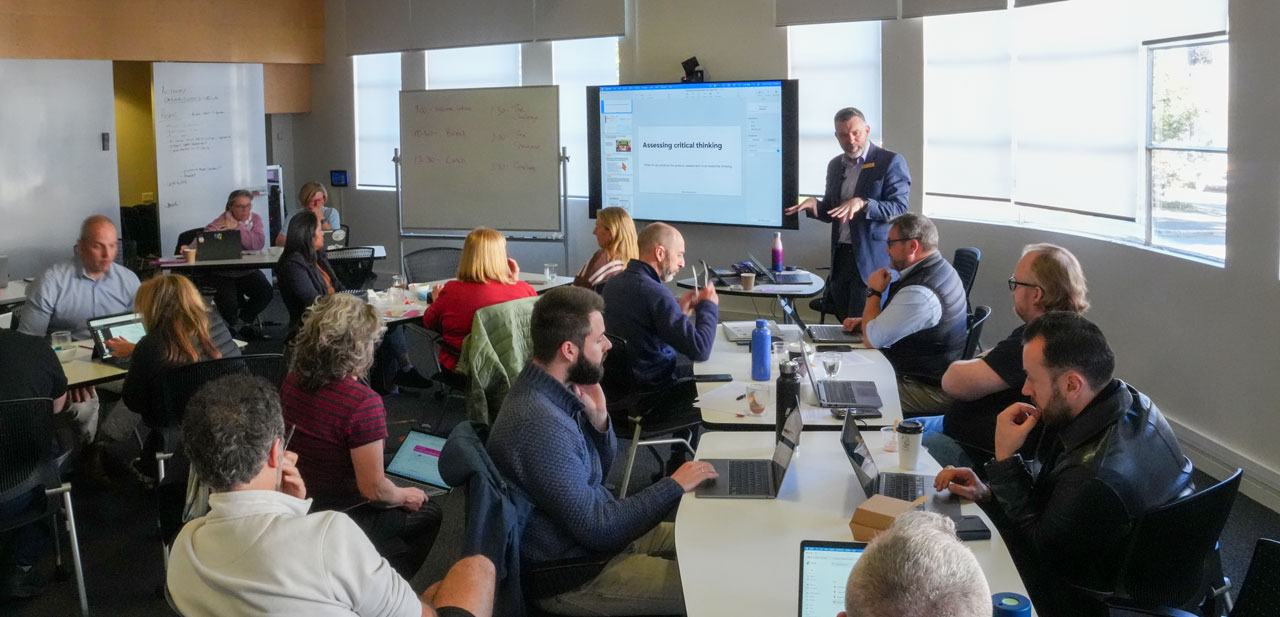
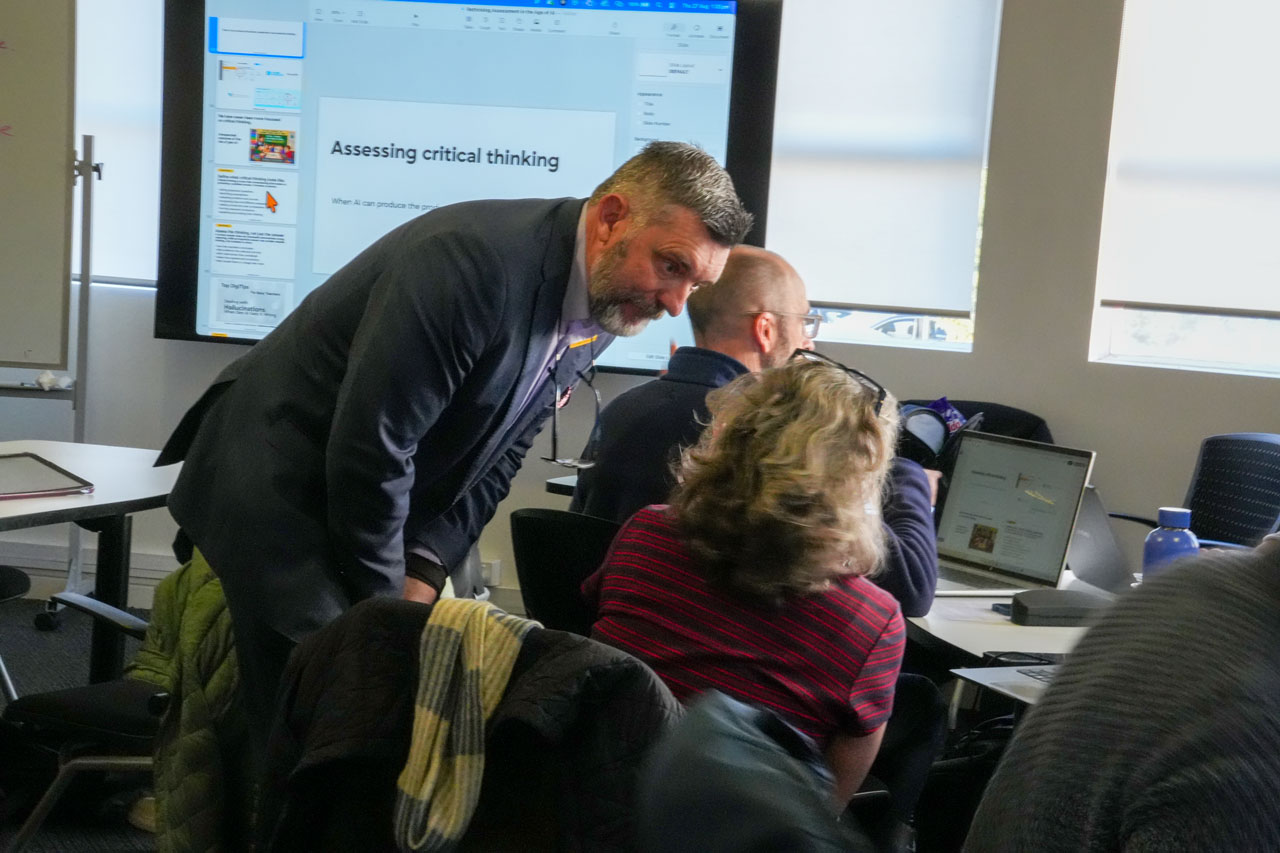
On 27th August 2026, I had the privilege of working with 22 teachers from about 10 different schools for a professional learning workshop hosted by ISV titled Rethinking Assessment in the Age of AI.
Generative AI is placing increasing pressure on many traditional forms of assessment. When students can produce polished essays, reports, images and presentations within seconds, it is becoming more difficult to determine what they genuinely understand and how much of the work reflects their own thinking.
However, the answer is not simply to return to handwritten examinations or rely on unreliable AI-detection tools. Instead, schools have an opportunity to design assessment that provides richer evidence of learning, makes students’ thinking more visible and values the learning journey as much as the final product.
The morning was devoted to exploring and discussing several important aspects of this challenge.
We began by considering why traditional assessment is under pressure and identifying the types of tasks that are particularly vulnerable to inappropriate AI use. Teachers reflected on whether some long-established assessment practices still provide trustworthy evidence of student learning.
From there, we explored ways of designing more AI-resilient assessment tasks. These approaches included making tasks more personal and contextual, incorporating opportunities for discussion and oral explanation, collecting evidence at different stages of the learning process and asking students to reflect on the choices they made.
A major focus was the principle of process over product. A polished final submission does not always reveal how a student developed an idea, responded to feedback, overcame difficulties or used AI and other forms of assistance. Digital portfolios can help address this problem by capturing drafts, research, feedback, reflections and evidence of revision over time. They provide teachers with a much clearer picture of how learning has developed.
We also examined practical principles for redesigning assessment through an AI lens. This involves asking questions such as:
What do we genuinely want students to learn?
What evidence would demonstrate that learning?
Which parts of the task should students complete independently?
Where might AI appropriately support the learning process?
How will students explain and take responsibility for their decisions?
What evidence of thinking and development should be collected along the way?
Podcasting was explored as one valuable alternative to conventional written assessment. A podcast requires students to understand their topic, organise their ideas, communicate clearly and make decisions about audience, tone and structure. It can also incorporate conversation, questioning and reflection, making it more difficult for students to submit material they do not understand.
We spent time examining how critical and creative thinking can be assessed more explicitly. Rather than treating these capabilities as vague qualities or judging only the final outcome, teachers can look for observable evidence. Critical thinking might involve evaluating sources, questioning assumptions, comparing perspectives and justifying conclusions. Creative thinking might be demonstrated through generating possibilities, experimenting with alternatives, making connections and refining an idea in response to feedback.
During the afternoon, the teachers moved from discussion to creation. Working in small groups and using Adobe Express, they were asked to produce either a podcast or a short animation addressing one of two topics: defining what critical thinking looks like or exploring how creative thinking might be assessed.
The results were very impressive. In a relatively short period, the groups transformed complex educational ideas into engaging and accessible multimedia pieces. The activity also modelled the kind of assessment we had been discussing throughout the day. Teachers needed to collaborate, interpret a challenging concept, generate ideas, make creative decisions and communicate their understanding to an audience.
Importantly, the task was not simply about producing a polished podcast or animation. The conversations, decisions, revisions and reflections that took place during its creation provided equally valuable evidence of learning.
Generative AI has exposed weaknesses in assessment practices that were already present. It has also given schools a powerful opportunity to reconsider what they value, what they assess and how students can best demonstrate genuine understanding.
Rethinking assessment in the age of AI is not about making every task resistant to technology. It is about designing assessment that values human thinking, creativity, judgement, communication and reflection. Yesterday’s workshop showed what is possible when educators are given the time to question established practices, experiment with new approaches and become learners and creators themselves.
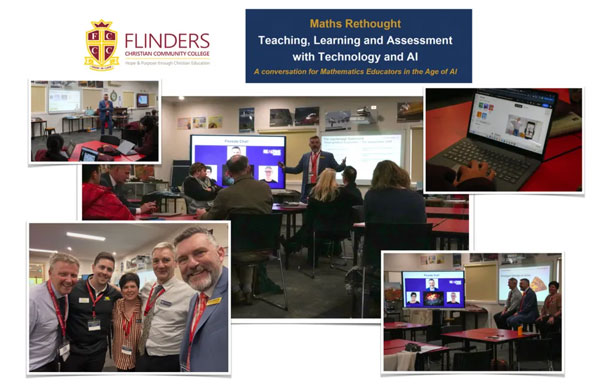
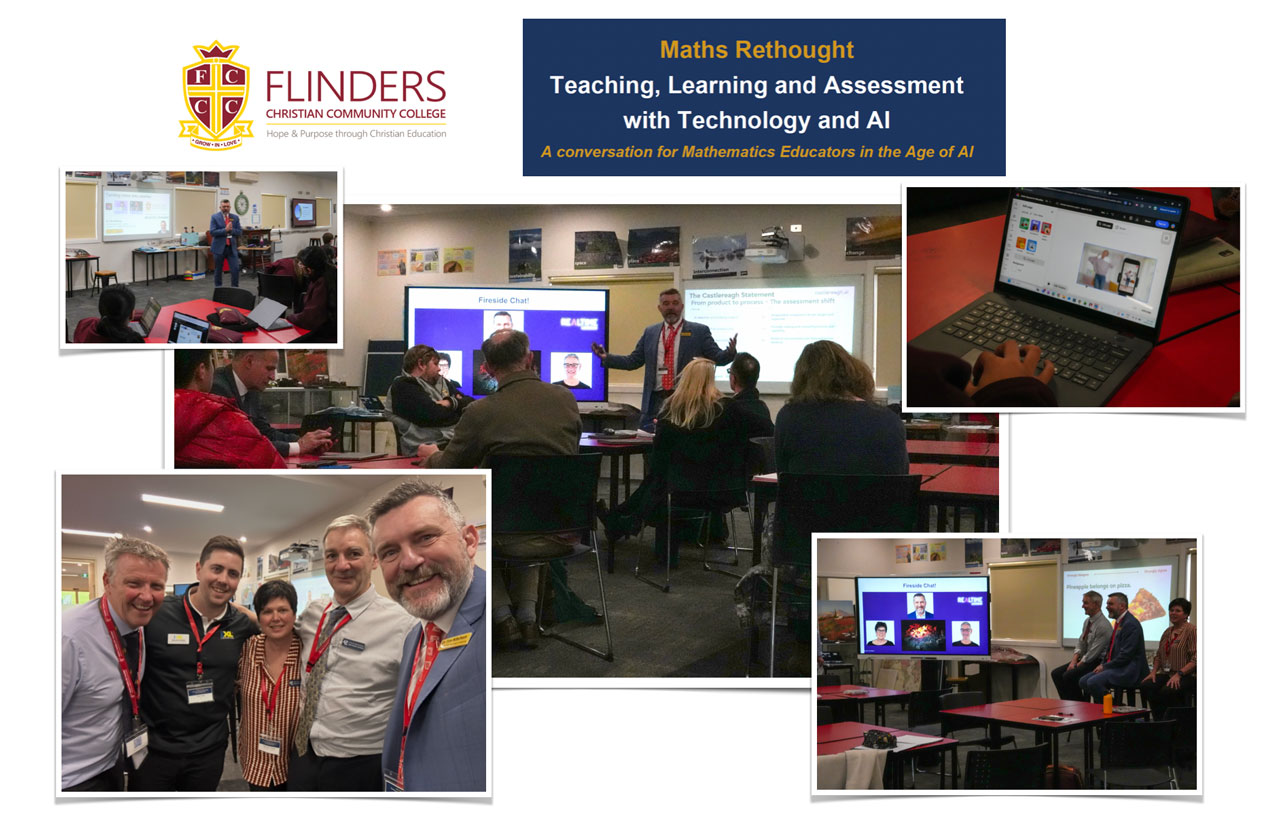
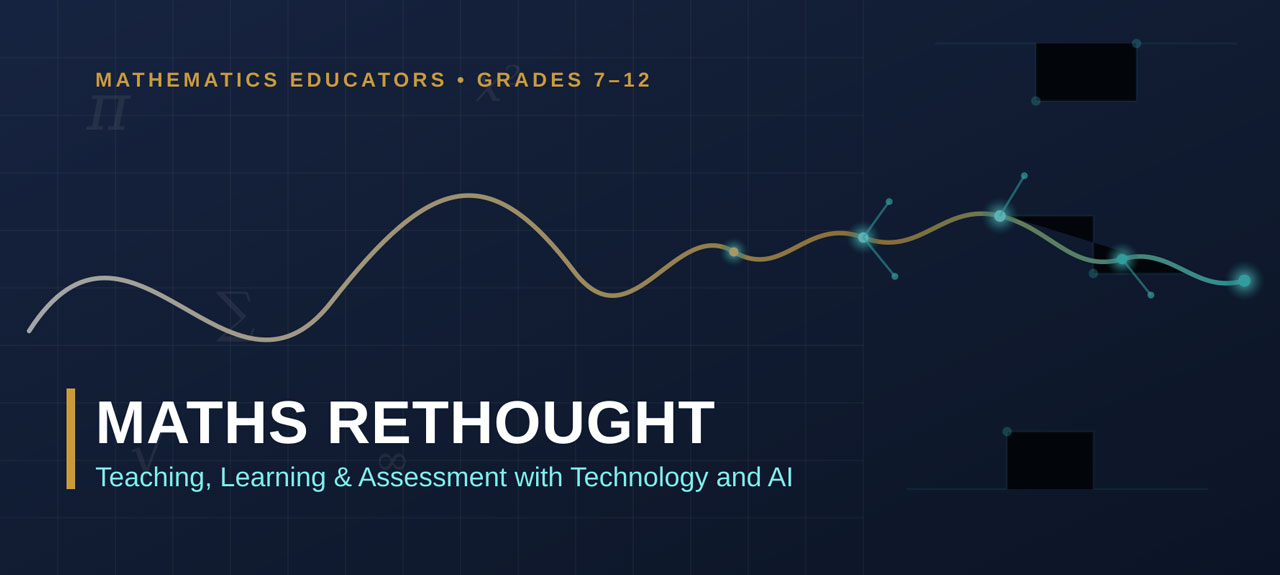
On 24 August 2026, Flinders Christian Community College hosted Maths Rethought at their Carram Downs Campus, a day of professional dialogue, live classroom demonstrations and practical exploration focused on the changing nature of mathematics education.
The event brought together school leaders, mathematics educators and education specialists to consider an important question: how can we best prepare students and teachers for learning, working and contributing in a rapidly changing, AI-rich world?
Luke Kerr, maths teacher at Flinders as well as the founder of Real Time Learning, was the brains behind this event which was partnered by Texas Instruments, Realtime Learning, Leigh Lancaster Consulting, IXL, Edunet and CTL.
The day began with a think tank involving members of the Flinders Christian Community College executive team. Our discussion explored the growing influence of artificial intelligence on education and the strategic directions schools may need to consider.
Rather than focusing only on particular AI tools, the conversation examined broader educational priorities. What knowledge, skills and human capabilities will students need? How should curriculum, pedagogy and assessment evolve when AI can generate sophisticated content almost instantly? How can schools support teachers to use emerging technologies safely, ethically and purposefully?
Following the think tank, mathematics teachers from several schools joined the event to observe a series of live teaching demonstrations. These sessions provided an opportunity to see experienced educators working with real students and to reflect on the decisions teachers make while learning is taking place.
Dr David Leigh-Lancaster and Antje Leigh-Lancaster (from Leigh Lancaster Consulting), conducted two live demonstrations. The first was a VCE mathematics lesson exploring modelling with circular functions. The second involved a Year 10 class working with quadratic functions. Both lessons demonstrated the importance of helping students move beyond simply applying a memorised formula or procedure. Through questioning, modelling and discussion, students were encouraged to recognise patterns, make connections and develop a deeper conceptual understanding of the mathematics.
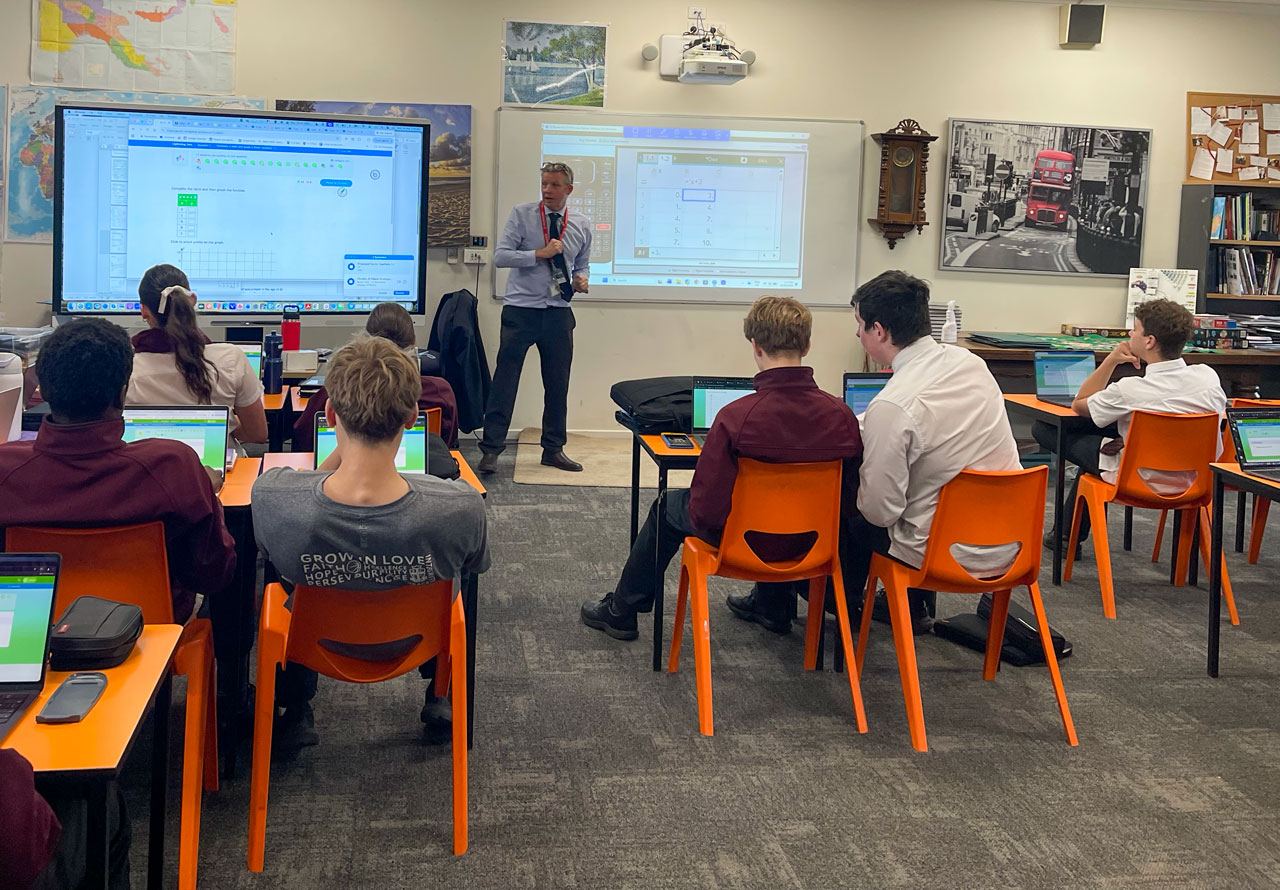
Kelvin Finger from IXL Learning and Luke Kerr from Flinders then conducted a Year 9 lesson on linear graphs. Their session explored how understanding could be developed using PhET, Navigator and IXL. The combination of interactive simulations, visual representations and targeted practice enabled students to explore the relationships between variables and connect abstract mathematical ideas with more visible and dynamic representations. The lesson demonstrated how digital tools can complement one another when each is used for a clear educational purpose.
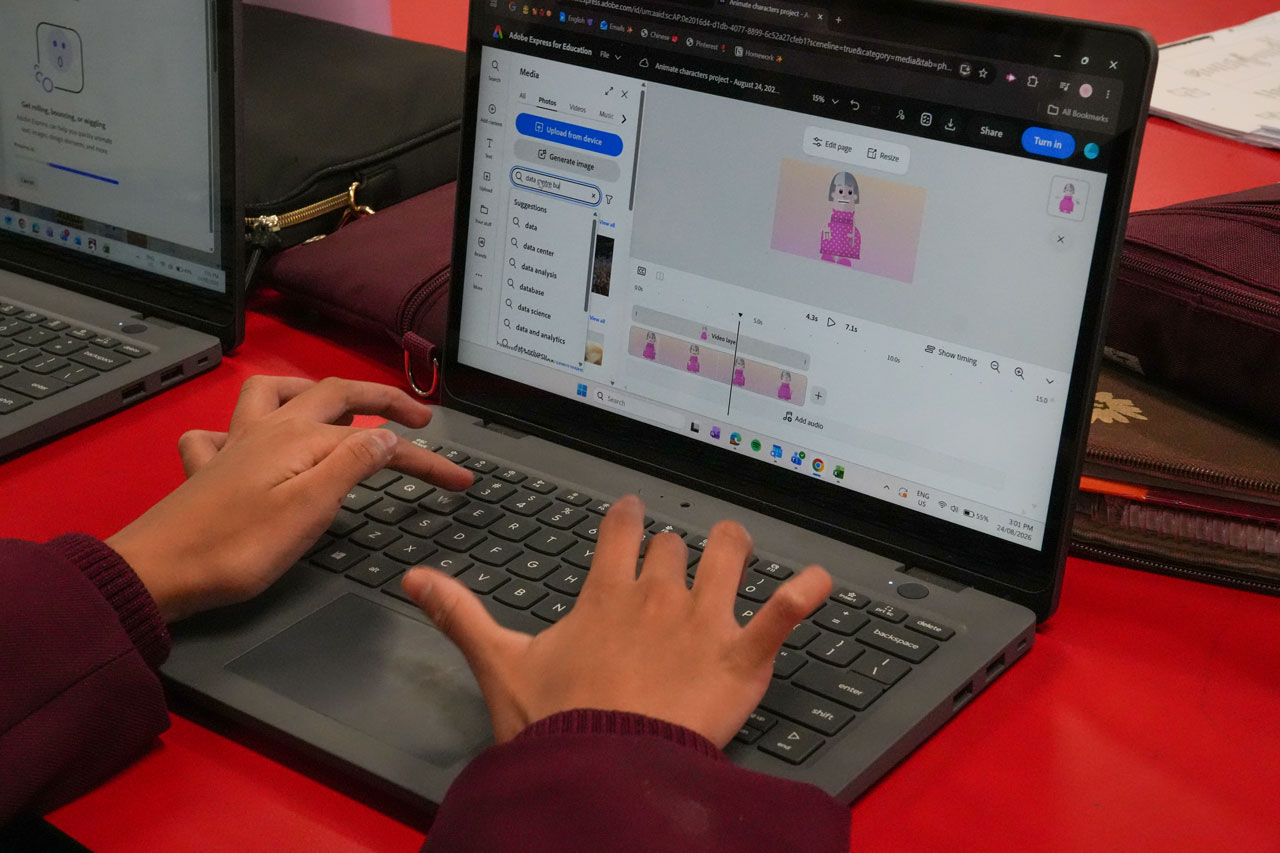
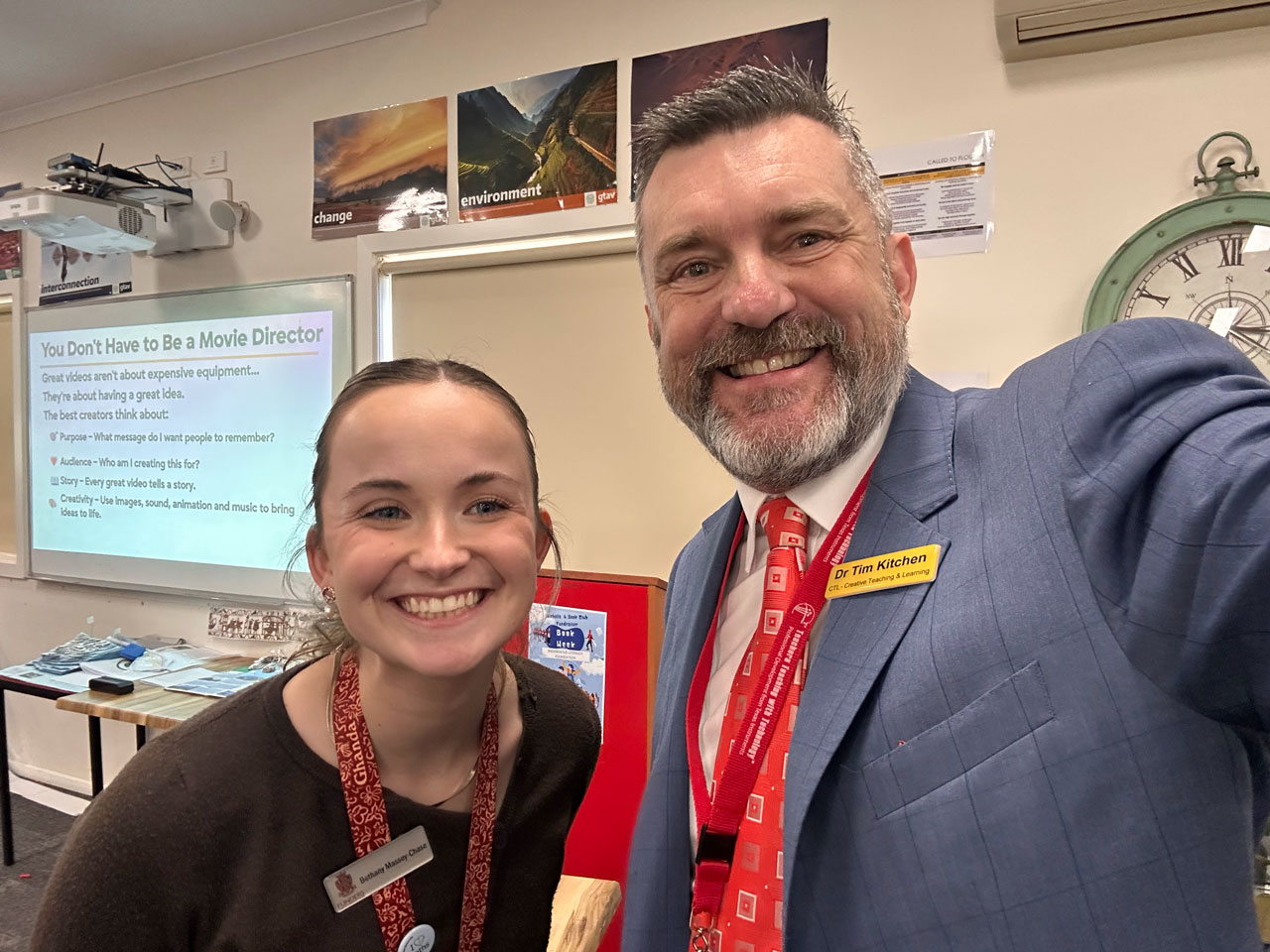
I had the opportunity to work with a Year 7 mathematics class on an activity that combined statistics, global data and digital storytelling. I would like to say a special thank you to Head of Mathematics Mrs Bethany Massey-Chase for allowing me to borrow her class for a double period.
Students explored statistics connected to data centres around the world. This was a particularly relevant context because data centres are essential to the operation of cloud computing and generative AI. They also raise important questions about energy consumption, water use, environmental impact and the growing global demand for digital infrastructure.
The students were challenged to interpret the statistics and transform what they discovered into a short video or animated story. This required them to do much more than reproduce information. They needed to decide which data was most significant, identify the story contained within it and communicate that story clearly to an audience.
By creating a video or animation, students could combine mathematical understanding with creativity, communication and digital literacy. They had to consider how graphs, numbers, narration, characters and visual elements could work together to make complex information meaningful.
This type of activity helps students recognise that mathematics is not isolated from the world around them. Statistics can help us investigate major global issues, evaluate claims and communicate evidence. Mathematics becomes not only something students calculate, but something they can use to understand and explain their world.
After the classroom demonstrations, the visiting teachers came together for an after-school professional learning session that I facilitated. The focus was on process over product and the use of digital portfolios through Adobe Express.
In an age when generative AI can produce a polished response in seconds, the final product alone may no longer provide sufficient evidence of student learning. Teachers increasingly need ways to see how students arrived at their conclusions, how their ideas developed and what decisions they made along the way.
Digital portfolios can help make this learning process visible. Students can document initial ideas, research, calculations, drafts, feedback, revisions and reflections. They can include photographs, videos, audio explanations, screen recordings and examples of work in progress.
Maths Rethought was a valuable reminder that meaningful educational change occurs when strategic thinking, classroom practice and professional collaboration come together. The day was not about abandoning established approaches to mathematics teaching or adopting technology simply because it is new. It was about thoughtfully examining what effective mathematics learning can look like in a changing world.
Across the think tank, live lessons, student storytelling activity and professional learning session, a consistent message emerged: technology is most valuable when it helps students think more deeply, explore ideas, make connections and communicate their understanding. As AI continues to influence education, the challenge for schools is not merely to keep pace with new tools. It is to ensure that learning remains purposeful, intellectually demanding, creative and deeply human.
My sincere thanks to Flinders Christian Community College for hosting the event, to the school leaders and visiting teachers who contributed to the professional dialogue, and to Dr David Leigh-Lancaster, Antje, Kelvin Finger and Luke Kerr for making their teaching practice visible.
It was particularly enjoyable to work with the Leigh-Lancaster’s who I haven’t seem for over 30 years when we all worked at Kingswood College together in the early 1990s.
Most importantly, thank you to the Flinders students who participated so enthusiastically and reminded us that the best conversations about the future of education should always remain centred on learners.
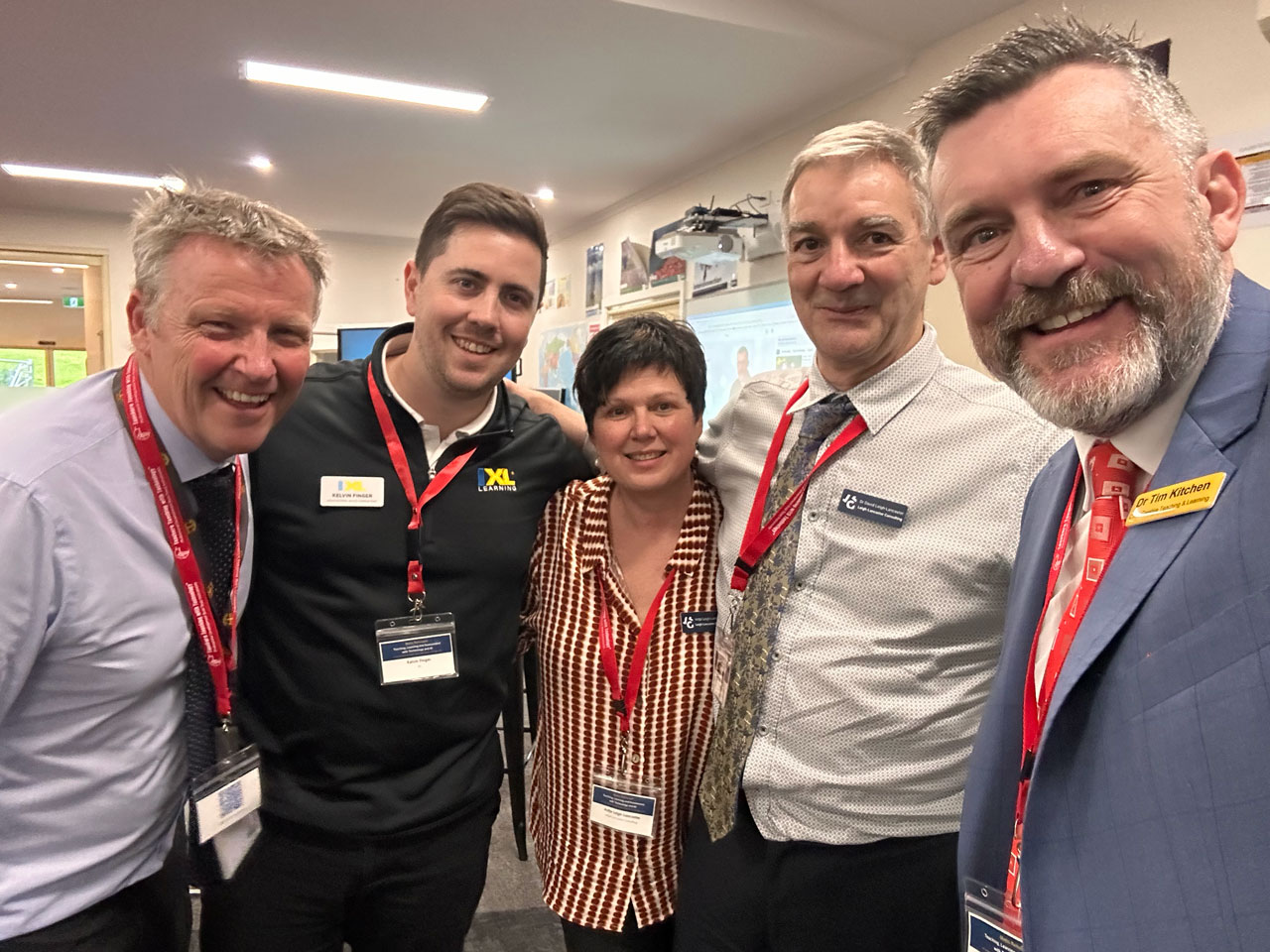
Luke Kerr, Kelvin Finger, Antje Leigh-Lancaster, Dr David Leigh-Lancaster & Dr Tim Kitchen
Drawing on more than 35 years across classrooms, school leadership and education consultancy, the book explores an idea I believe is becoming increasingly important:
AI hasn’t necessarily created many of the challenges schools are facing. It has exposed them.
And that creates an opportunity.
As intelligent machines become increasingly capable, education needs to place even greater value on the capabilities that make us distinctly human:
Curiosity
Creativity
Critical thinking
Empathy
Discernment
Ethical judgement
My new book is designed as a practical resource for teachers and school leaders. It includes strategies, classroom activities and frameworks to help educators rethink curriculum and assessment, embrace AI wisely and ethically, and keep people at the centre of learning.
Because the future of education shouldn’t be about humans competing with machines. It should be about helping young people develop the capabilities machines cannot replace.
Great teaching, now more than ever, is a deeply human endeavour.
Let your networks know about this new publication.
On Wednesday 12 August, I had the pleasure of facilitating a hybrid professional learning workshop at the wonderful Frankston East Primary School for approximately 30 teachers from nine schools across Victoria and South Australia.
The workshop was part of The Connection, an initiative working in partnership with The Smith Family to improve student outcomes in communities experiencing disadvantage. The program brings educators and school leaders together to exchange ideas, share effective practices and build strong professional relationships across schools.
With some participants joining us in Frankston and others connecting online, the hybrid format reflected the collaborative spirit of the program. Although the teachers represented different schools, communities and contexts, they shared a commitment to improving learning opportunities for their students.
Moving beyond the AI hype
Our focus was the safe, ethical and inclusive use of artificial intelligence to enhance creativity and engagement in the classroom.
Generative AI can help students brainstorm, receive feedback, explore different perspectives and express their ideas in new ways. However, its value depends greatly on how the technology is introduced, supported and embedded within learning.
The goal should never be to use AI simply because it is available. It should be used deliberately, transparently and only when it offers a genuine benefit for teachers and learners.
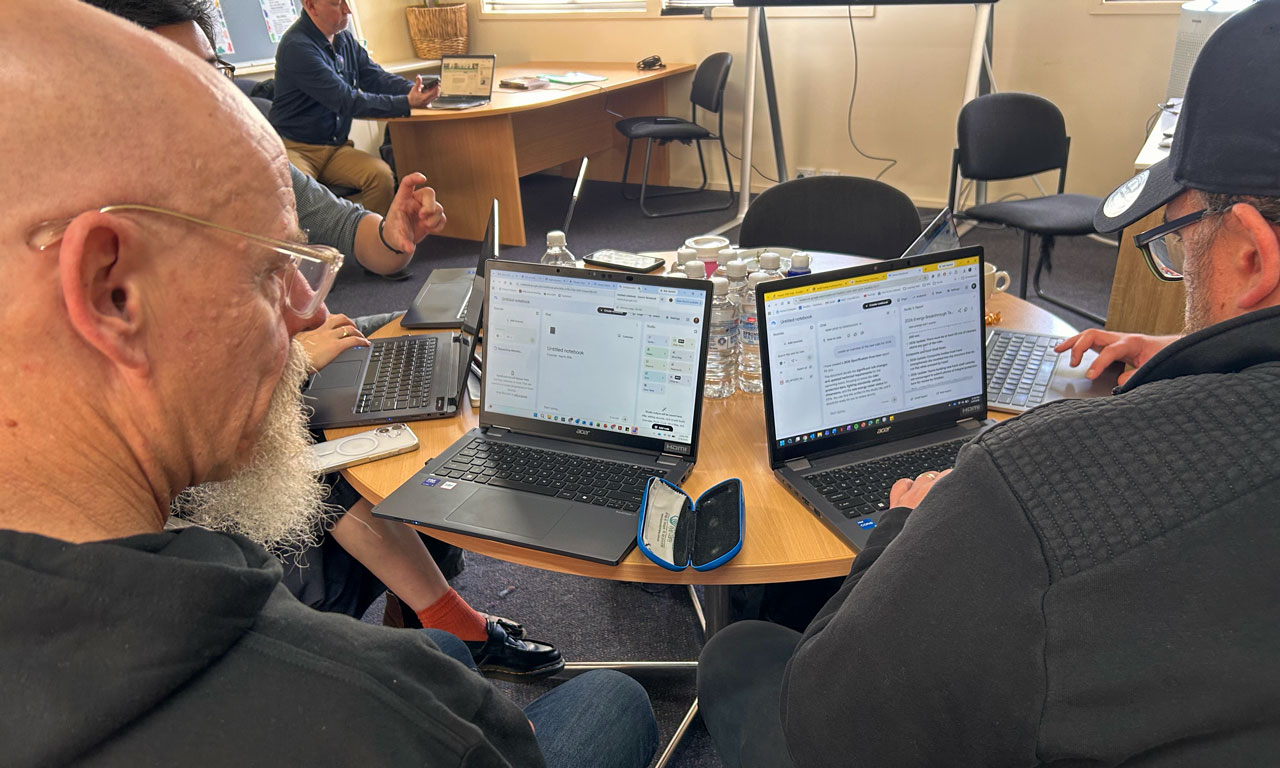
We used Gemini Notebook to allow AI to create a podcast but then took it to the next creative level by building our own podcasts using Adobe Podcast. Some of the education advantage of working with podcasts include:
A podcast lets you share ideas with potentially a wider audience than just your classroom.
Planning and recording a podcast teaches you to organise your thoughts, speak confidently, and get your message across.
Choose your topic, write a script, add music and sound effects — podcasting lets your creativity run wild!
Listeners can tune in whenever suits them — on the bus, at home, or during lunch. It fits around their lives.
Recording, editing, and publishing a podcast builds real-world tech skills that are valued in today’s world.
Podcasting is brilliant for teamwork. Research together, interview each other, and produce something you’re proud of.
Then we used the animation & video editing features within Adobe Express to build an animated introduction for our podcasts.
The feedback
The feedback from the participants was outstanding with:
100% of participants agreed or strongly agreed that the session content was useful, engaging and would inform their work as a leader
100% agreed or strongly agreed that they acquired new knowledge and skills
I would like to thank Nick Johns and Luci McFarlane from The Connection & The Smith Family for organising this event as well Warren Bull, the Principal of Frankston East Primary for hosting.
Most importantly, thank you to the participating teachers for their openness, curiosity and commitment to using technology in ways that keep learning, creativity, inclusion and human relationships at the centre.
If you would like to book me for similar events at your school or network, click here.
August is shaping up to be another busy and exciting month for CTL, with new podcast episodes, professional learning opportunities, events and resources for school leaders, teachers and school support staff.
The Kitchen Think podcast/vodcast
Episode 5 of The Kitchen Think podcast/vodcast recently dropped titled – “eSafety Report – When AI Becomes Someone to Talk To”
The series is designed for busy teachers and school leaders looking for practical, thoughtful and balanced conversations about safe and ethical AI integration, creativity, assessment redesign, digital literacy and the future of education.
Podcasting at your school
If you’re interested in exploring podcasting or vodcasting as an engaging assessment option (particularly valuable in an AI-dominated landscape) I’d be delighted to support you through an in-person or online workshop. I regularly work with students and teachers to explore the educational value of podcasting using Adobe Podcast, or, for more advanced audio production, Adobe Audition.
Podcasting provides an authentic way for students to share ideas, strengthen communication skills, build creativity and digital literacy, and collaborate with others. Click here to book a session.
Made with ChatGPT & Adobe Photoshop
Educator Intelligence Live — 6 November
I’m delighted to be involved as a facilitator at Educator Intelligence Live on Friday 6 November.
This will be Australia’s national day of hands-on AI professional learning, taking place simultaneously across seven city hubs – Melbourne, Sydney, Canberra, Brisbane, Adelaide, Perth and Launceston, with an online option for those unable to attend in person.
The program is being designed for teachers, school leaders and support staff, with practical workshops covering curriculum and assessment, responsible AI use, policy and governance, community engagement, student and staff wellbeing, administration and school operations.
Importantly, this isn’t another event focused only on where AI might take education one day. It is a practical working day built around what educators can use on Monday morning.
Professional learning for Victorian independent schools
Throughout Semester 2, I’m partnering with Independent Schools Victoria to facilitate a series of practical professional learning events for teaching and non-teaching staff.
Topics include:
Rethinking Assessment in the Age of AI
Time-Saving Automation with AI
Teaching in the Age of Generative AI
Creating Visual Content Without Design Skills
Working Smarter with PDFs
AI for Everyday Communication
All face-to-face sessions are held at the ISV office in West Melbourne and include an online follow-up. Thanks to grant funding secured by ISV, the course fees are fully funded, with only a small administration fee applying.
Attention Melbourne Mathematics teachers. Get involved in the MATHS RETHOUGHT event on Monday 24 August.
This event offers an opportunity for educators to step back and reconsider how mathematics can be taught and experienced, particularly at a time when technology and generative AI are changing the skills, processes and learning experiences we value.
The National Education Summit returns to the Melbourne Convention and Exhibition Centre on Thursday 3 and Friday 4 September, and I’ll be involved in several ways across the two days.
I’ll be:
MCing the Early Stages theatre
Presenting The Human Advantage—How Teaching and Learning Is Changing in an AI-Rich World
Recording a live episode of The Kitchen Think
Signing and discussing my books in the Book Nook
The live podcast recording will feature conversations with Adrian Cotterell about assessment and AI-detection software, and Tori Spicer-Stuart about AI integration at Beaconhills College and what it means to remain human in a world of generative AI.
There is a huge range of professional learning, exhibitions and free sessions available across the Summit.
Volume 1 of the Top DigiTips for Busy Teachers booklet is now available via Amazon for AUD $18.89 This is a practical, companion for the YouTube series designed to help educators confidently navigate the rapidly evolving world of educational technology and generative AI.
New set of presentations/workshops
Below are some of the presentation/workshops that I am currently sharing with schools. Have a think if any are relevant for your school?
Taking control of AI in your school
Talking to AI – How great prompts unlock great answers
Who owns AI generated work? … and how should we use it fairly?
When does Gen AI support learning … and when does it cross the line?
Your feed is watching you. How AI shapes what we see, believe and share online.
AI has a hidden cost – energy, water, carbon, e-waste
Rethinking Assessment in the Age of AI
Gen AI Basics for School Administration
Engaging students with digital creativity using Adobe Express
Contact me if any of the above topics interest your school
AI Governance support
As generative AI rapidly reshapes education, many school leaders are recognising the need for clear governance, practical policies, and sustainable implementation strategies. CulturePathAI works alongside school leadership teams to build the foundations for safe, ethical, and effective AI adoption through a strong governance-first approach.
I am very pleased to be part of the CulturePathAI team as a Senior Consultant and encourage your school or school system to see how we can help.Look up CulturePathAI
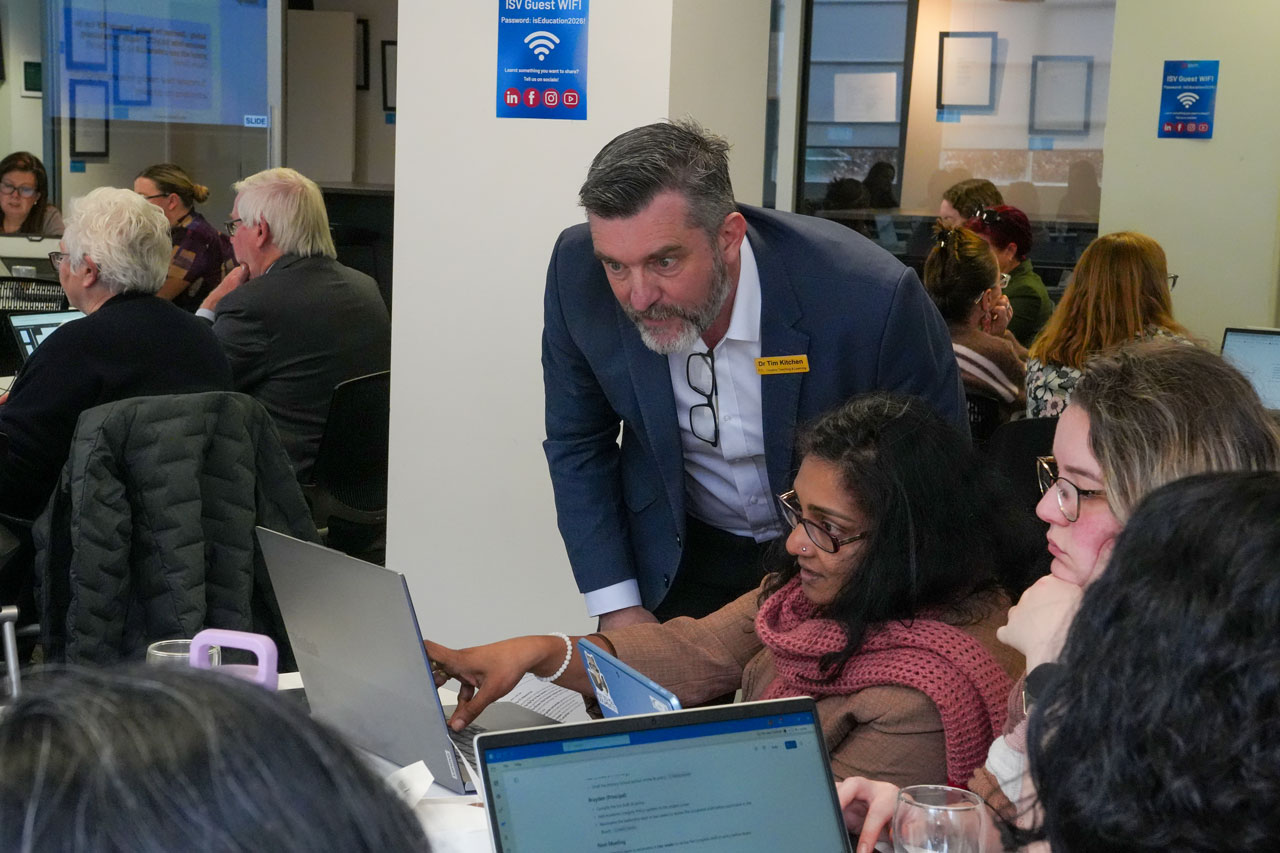
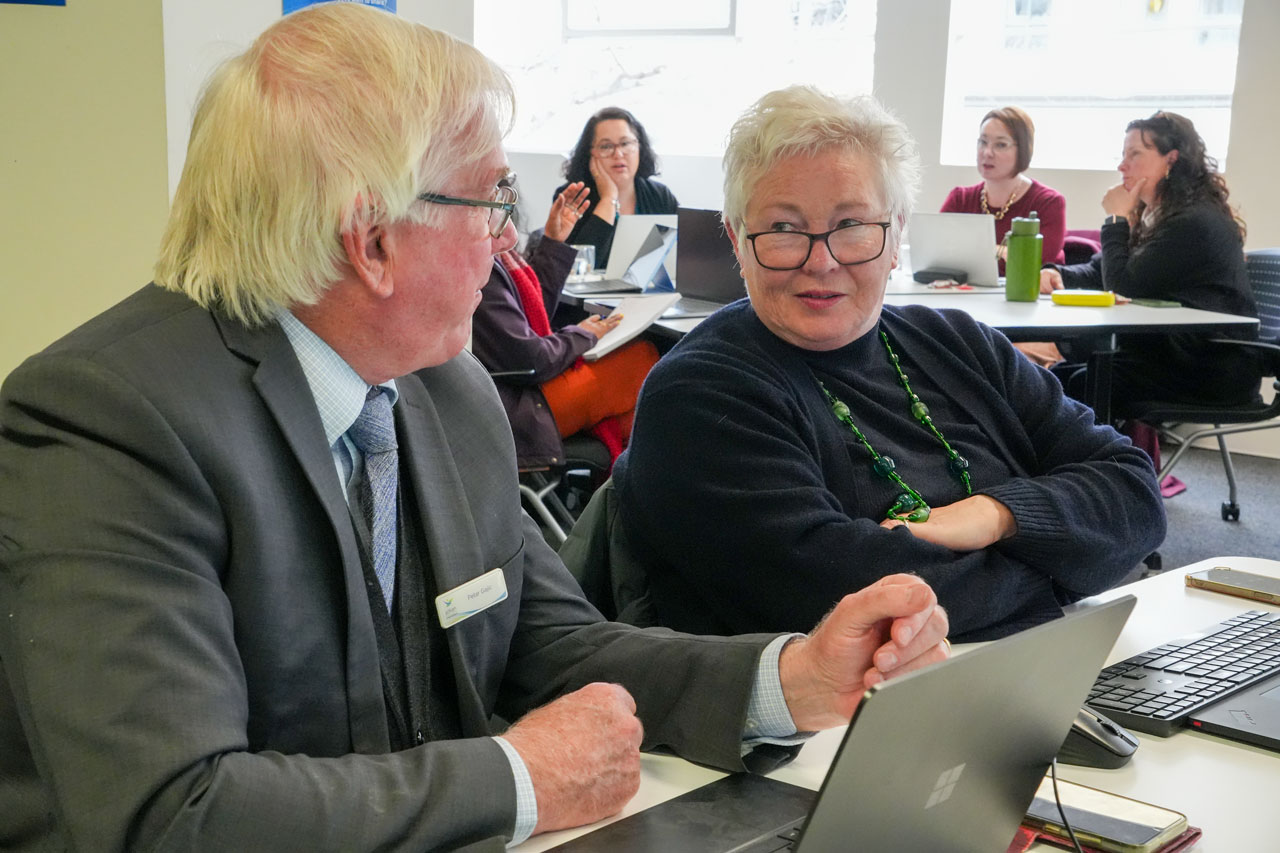
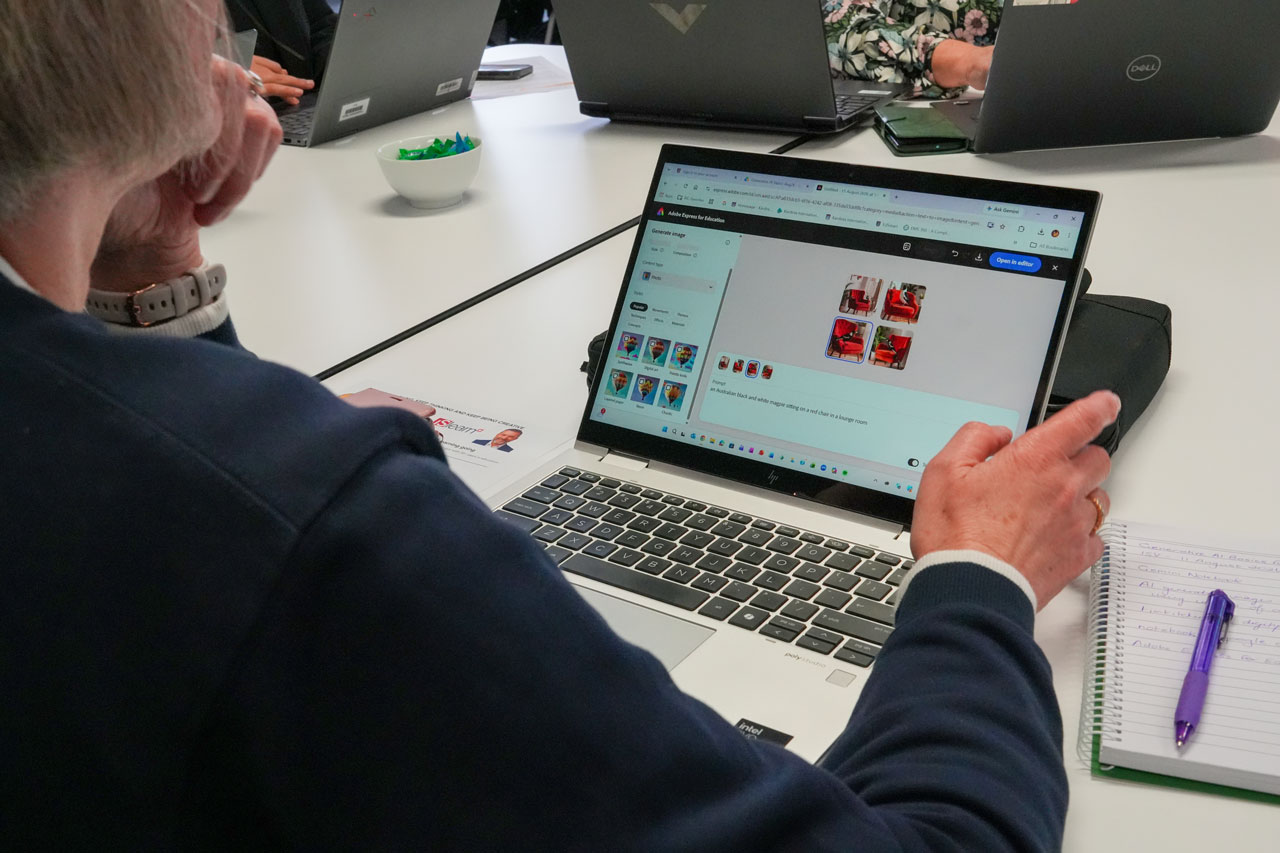
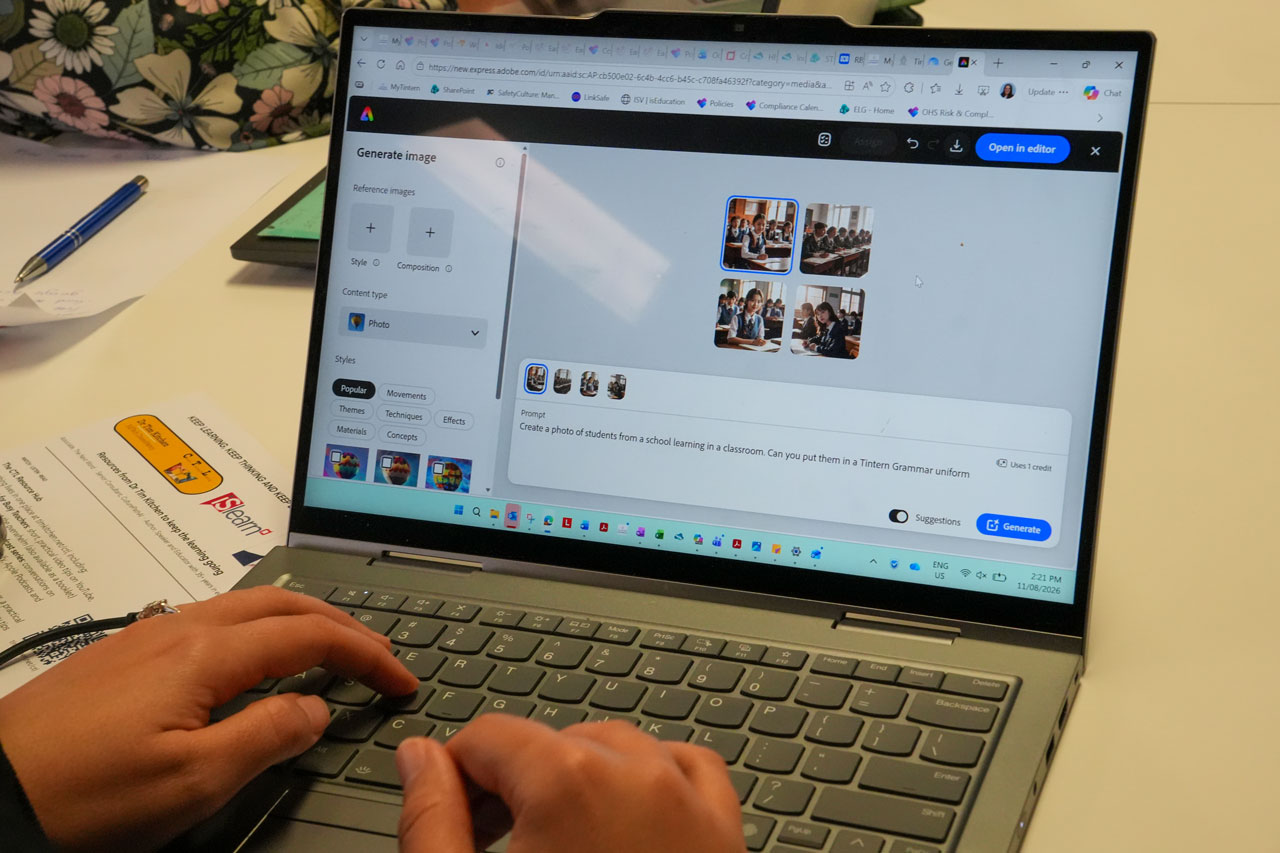
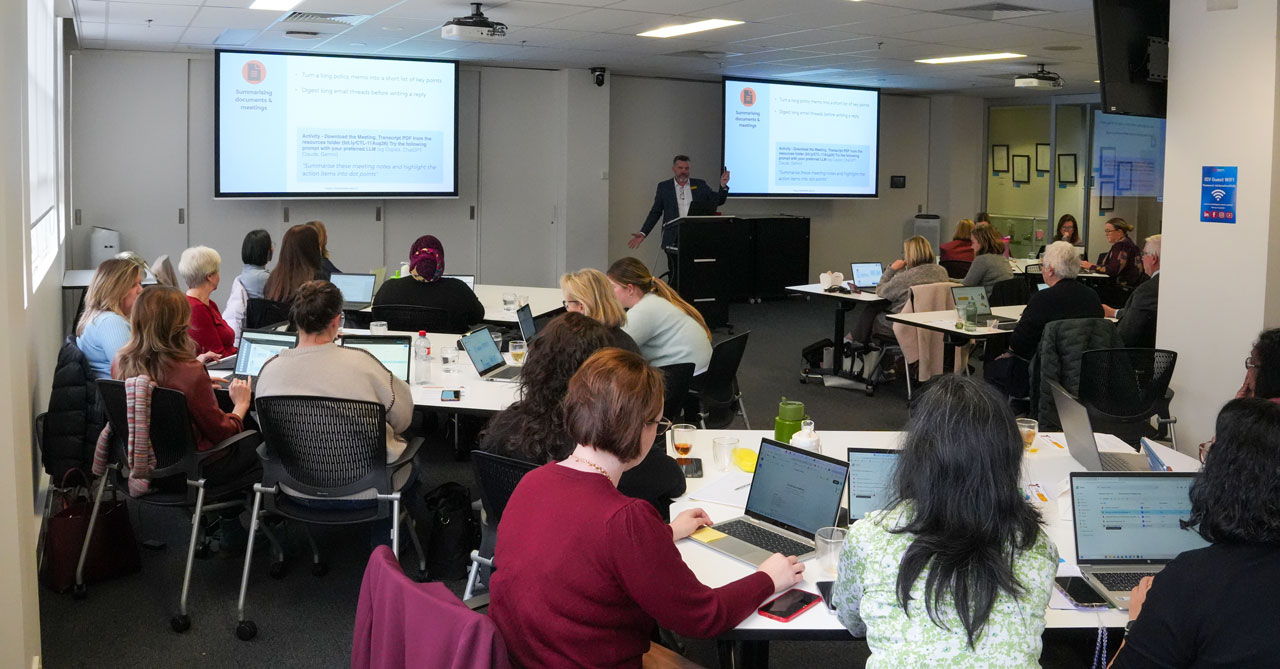
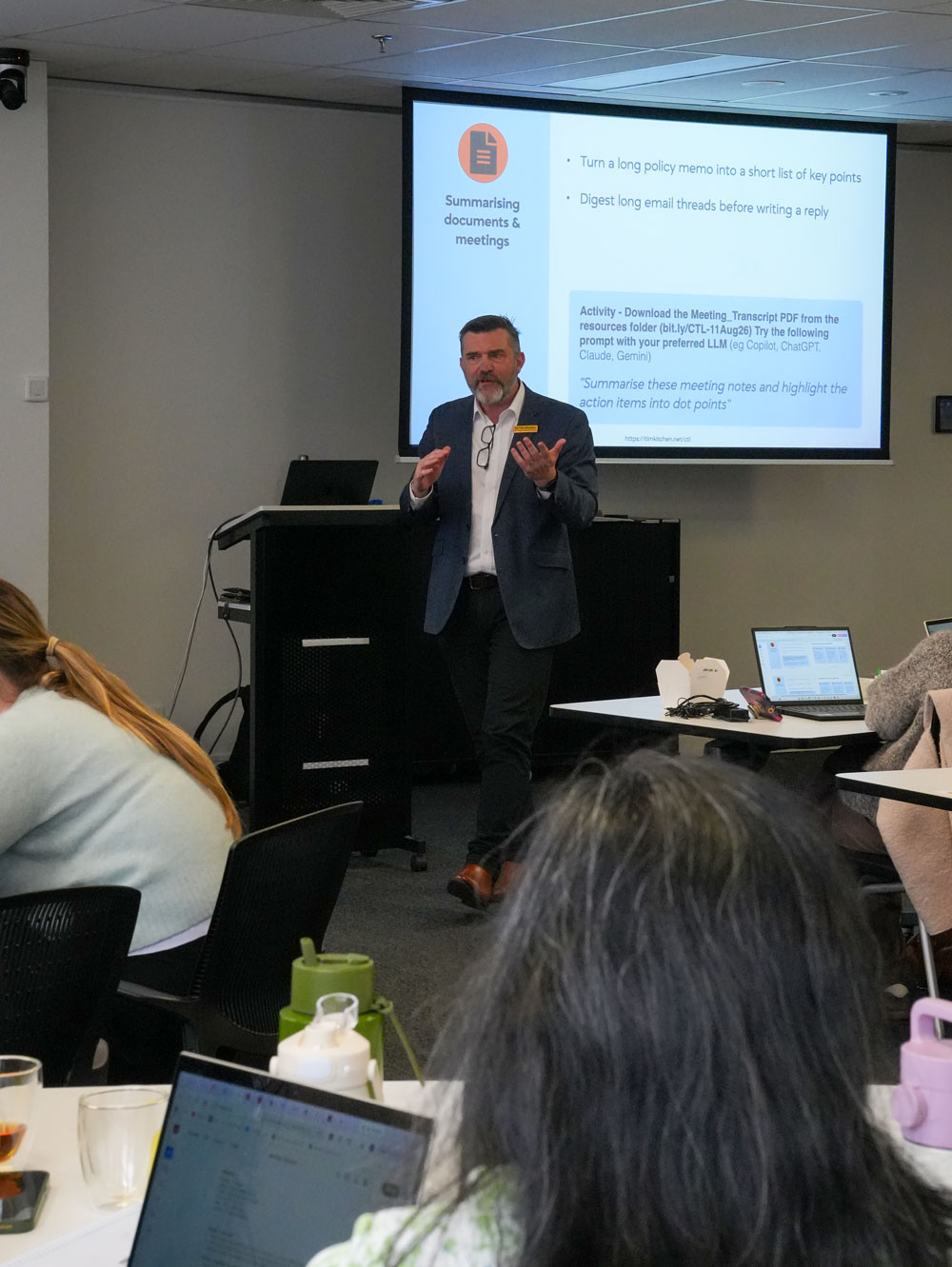
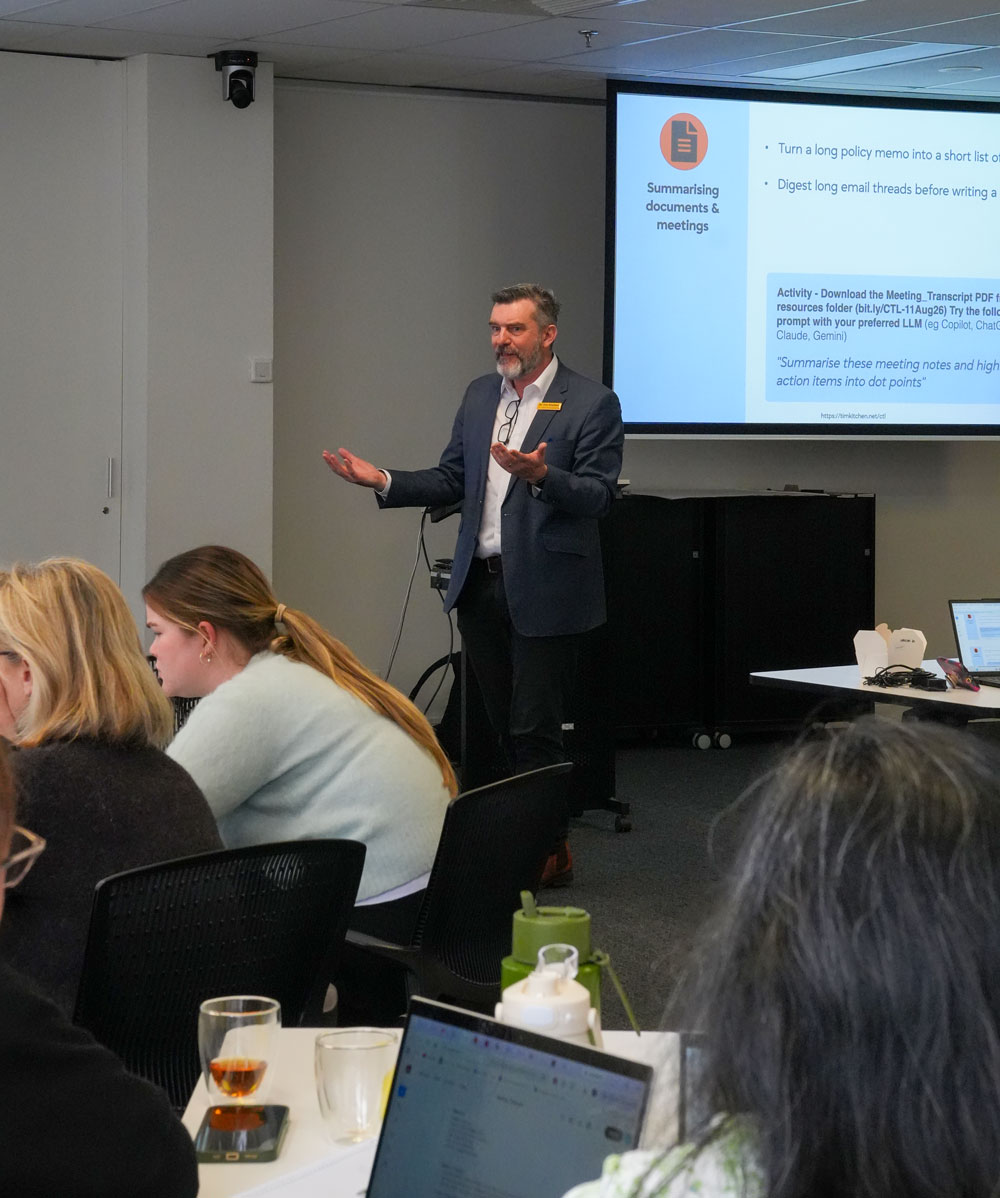
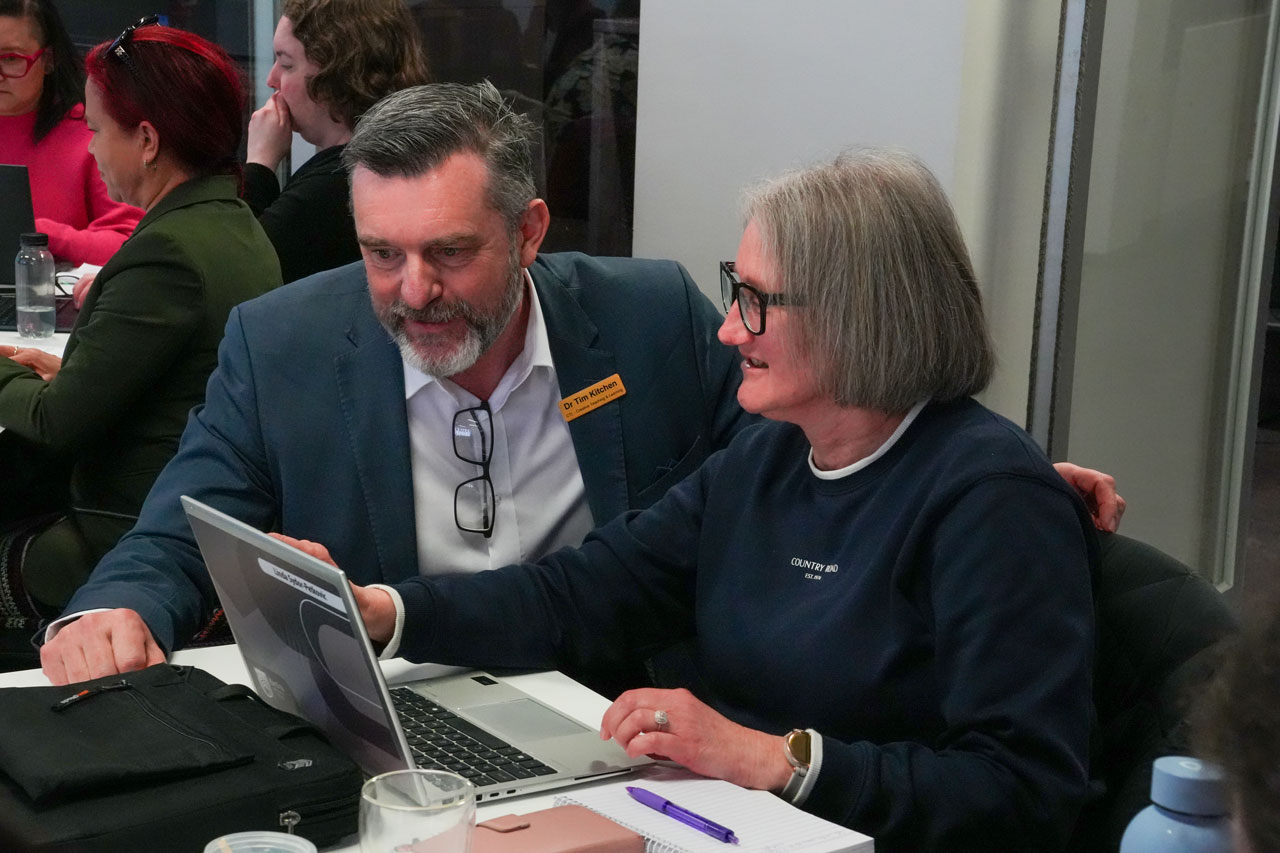
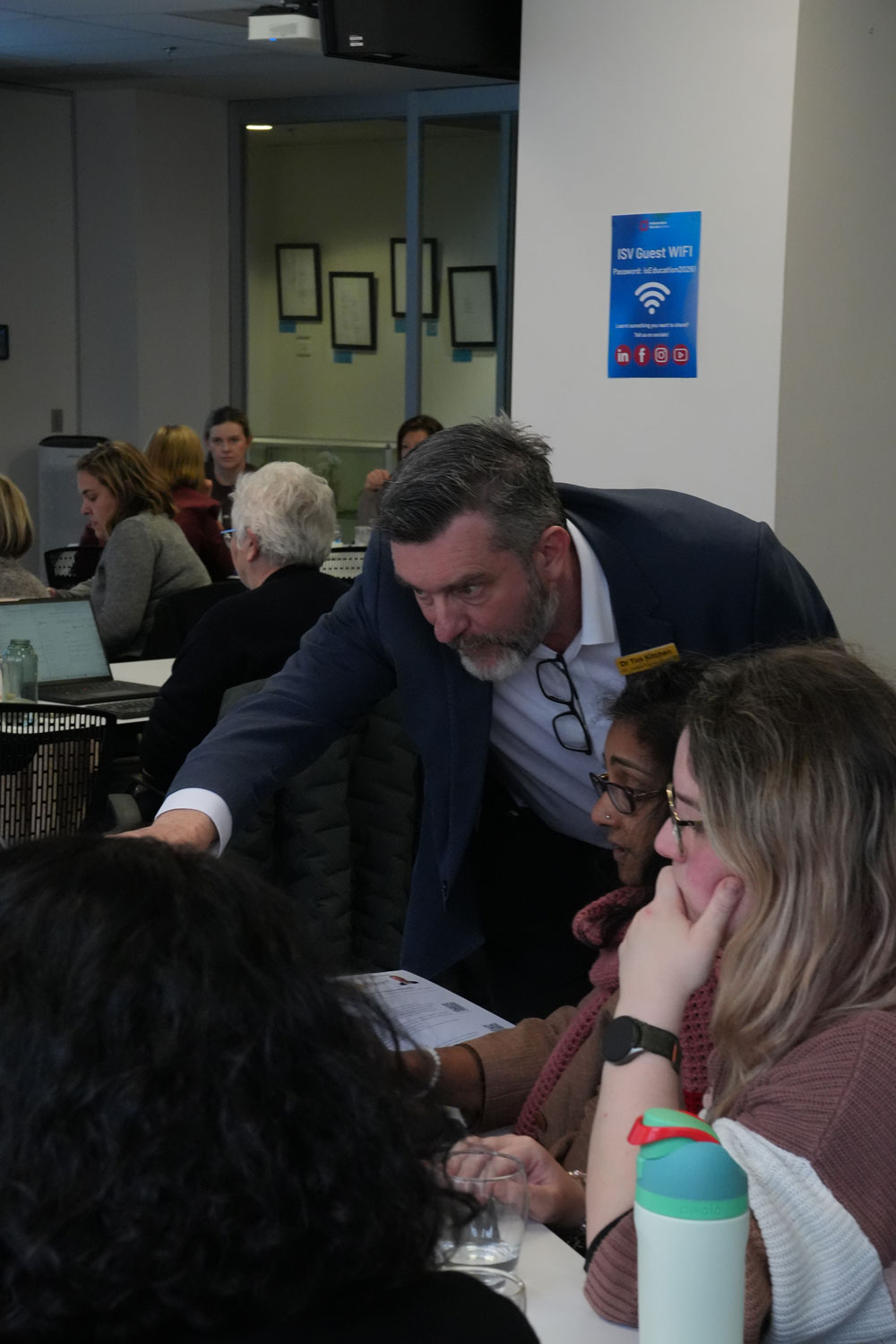
On Tuesday 11 August 2026, I had the pleasure of working with about 35 non-teaching staff from around 14 Victorian Independent schools for a half-day workshop titled Generative AI Basics for School Administration.
Administrative and professional support staff are essential to the effective operation of every school. They manage communications, enrolments, meetings, schedules, records, events, data and countless other responsibilities, often while responding to competing priorities and tight deadlines. This workshop explored how generative AI can support this important work by saving time, strengthening communication and assisting with repetitive tasks, while keeping human judgement firmly at the centre.
An anonymous survey at the beginning of the workshop revealed a group with varied levels of experience and confidence. Of the 33 participants who responded to the opening question, only two said they had a clear understanding of generative AI and how it works. Eighteen (just over half) had a general idea but did not feel they could explain it confidently, while 12 had heard the term but were unsure what it meant. One participant was starting completely from scratch.
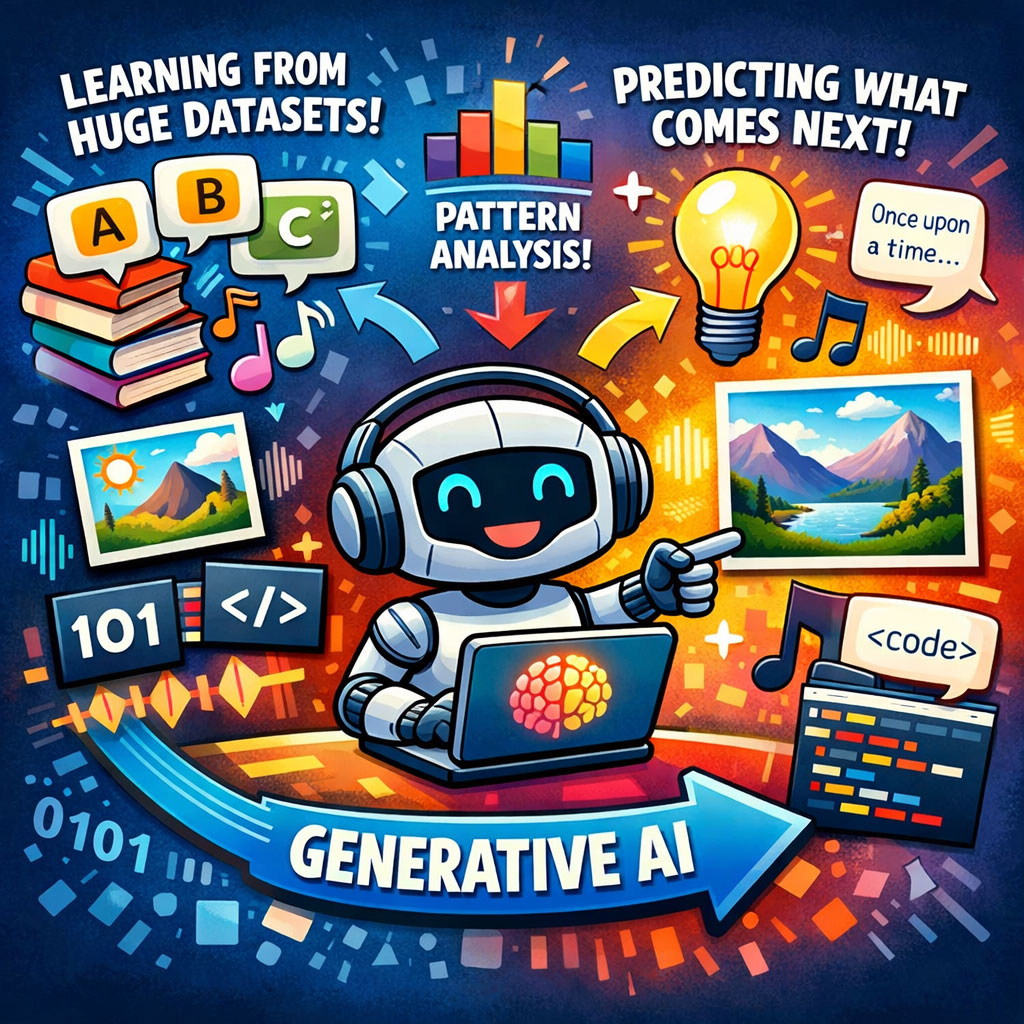
We began by unpacking what generative AI is and, just as importantly, what it is not. We explored how large language models generate responses by identifying patterns and predicting likely content rather than thinking, understanding or checking facts in the way a person would.
This provided an important foundation for the rest of the workshop. Generative AI can produce remarkably useful results, but its outputs still require careful human review. Staff need to remain alert to hallucinations, bias, outdated information and confidently presented inaccuracies.
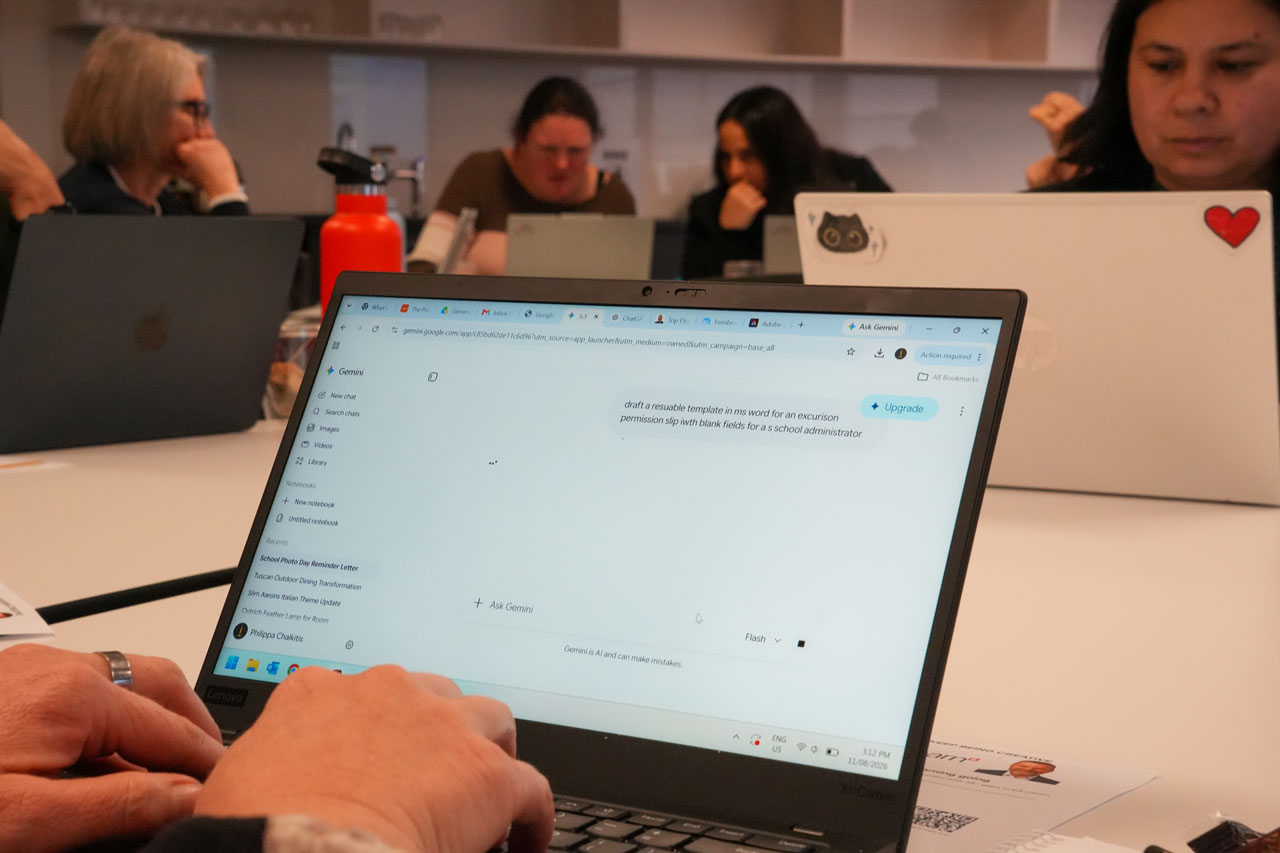
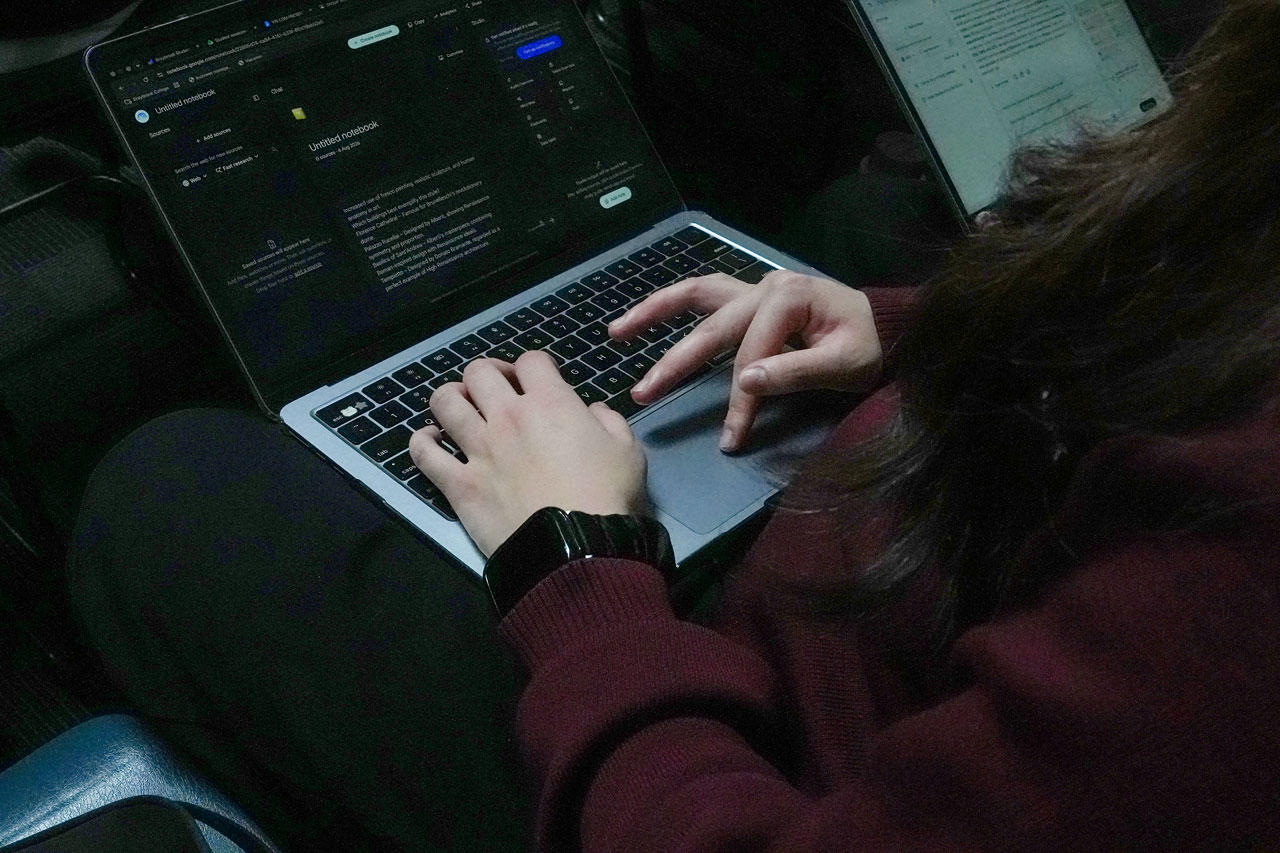
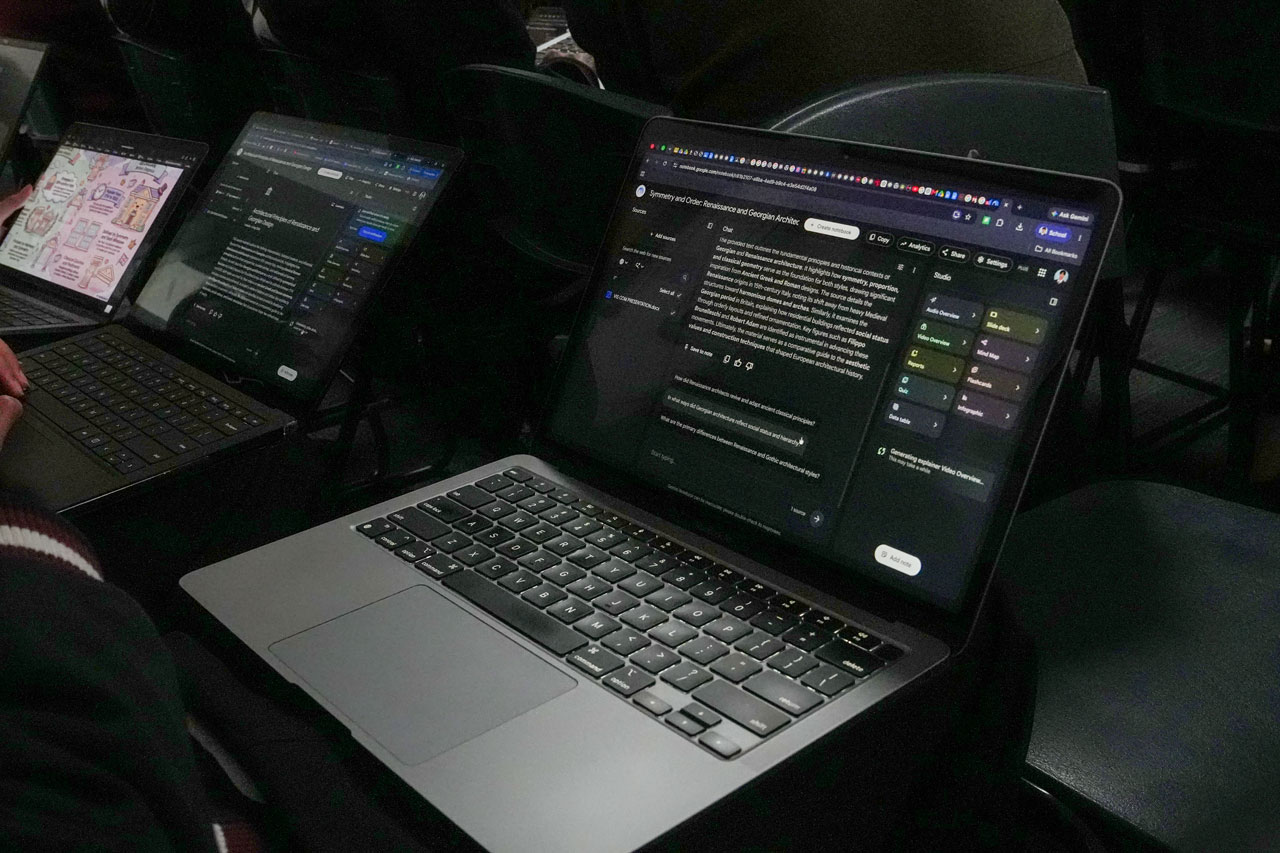
A demonstration of Google’s Gemini Notebook showed how AI can work with a selected collection of trusted source material. We examined its potential to summarise documents, identify themes, answer questions and help staff navigate lengthy policies and reference materials.
We also explored the automated production of meeting notes, summaries, action items and draft minutes. These tools can significantly reduce administrative workload, provided participants are informed, the recording or transcription process complies with school policy, and the resulting notes are checked for accuracy.
Further activities looked at using AI to assist with scheduling, event planning, task lists, timelines and organisational workflows. The goal was not to hand important decisions over to AI, but to use it as a capable assistant that can help develop a starting point and reduce repetitive work.
Another hands-on activity explored the creation of visual content with generative AI. Participants considered how school administration teams might produce safe and engaging images for newsletters, event promotions, presentations, signage and community communications.
We discussed the need to consider copyright, representation, bias and the potential misuse of realistic imagery. Generative AI can make visual communication faster and more accessible, but schools still need clear expectations about what is appropriate to create and publish.
More events like this for Victorian Independent School teachers can be found here.
Other schools can book me for similar sessions via here.
It was a pleasure to return to Braybrook College in Melbourne’s west for a full day of workshops with Year 10 Contemporary Drawing students, Year 11 Art students, and Year 11 and 12 Visual Communication Design students and their teachers.
Exploring generative AI safely and ethically
The central focus of each session was the safe, ethical and purposeful use of generative AI. Rather than simply demonstrating what the technology can produce, we explored how students can use AI to enhance their learning and creative thinking without allowing it to replace their ideas, judgement or individual voice.
Students were introduced to Google’s NotebookLM and explored how it can be used as a research and learning assistant. Because NotebookLM works with sources selected by the user, it can help students interrogate documents, organise information, generate questions and identify connections between ideas. Importantly, we discussed why students must still evaluate its responses and remain responsible for the accuracy and quality of their work.
This led to valuable conversations about AI hallucinations—the inaccurate or fabricated information that generative AI systems can sometimes present confidently as fact. We also examined how bias can appear in AI-generated responses and images because these systems are influenced by the data on which they have been trained.
Students were encouraged to approach AI output with healthy scepticism by asking questions such as:
Where did this information come from?
Can I confirm it through another reliable source?
Whose perspectives may be missing?
Is the response presenting an assumption or stereotype?
How much of the final thinking and decision-making remains my own?
These are increasingly important habits, not only for using AI but also for navigating information more broadly.
Connecting AI with creative practice
With the Year 10 Contemporary Drawing and Year 11 Art students, we also explored some of the newer AI-powered features available in Adobe Photoshop.
The emphasis was not on having AI create the artwork for students. Instead, we considered how these tools might support experimentation, visualisation, editing and the exploration of alternative creative directions. Used thoughtfully, AI can become part of an iterative creative process, helping students test possibilities while ensuring that the concept, purpose and final decisions remain human.
I also provided students and teachers with practical resources to help them develop their skills with Adobe tools beyond the workshop. These resources will allow them to revisit the techniques we explored and continue building their confidence through experimentation and practice.
Previous connections with Braybrook
My connection with Braybrook stretches back many years. During my time at Adobe, groups of Braybrook students visited the Adobe Melbourne office annually through the Australian Business and Community Network (ABCN) mentoring program. These visits were always a highlight, providing opportunities for students to explore the creative industries, meet professionals and experience a contemporary workplace.
I would like to thank teachers Claire Manning and Loc Nguyen for organising the day.
What the eSafety Commissioner’s new research reveals about children’s use of AI assistants and companions, and why schools need to widen the conversation beyond homework and cheating.
A student sits down after school. They don’t call a friend or wander into the kitchen to talk with a parent. Instead, they open an app and start typing about their day, their worries and confine to the technology what they may fear sharing with the people in their lives.
The app replies warmly. It is patient, never seems to judge and is available whenever they want to talk.
The report shows that young people are doing much more than using generative AI to find information, complete homework or improve their writing. Many are also turning to it for advice, reassurance, companionship and emotional support.
Made with ChatGPT 5.6 and Adobe Photoshop
AI is already part of everyday childhood
The eSafety Commissioner surveyed 1,950 Australian children aged 10 to 17 between 2 February and 4 March 2026. Seventy-eight per cent had used an AI assistant such as ChatGPT, Gemini or Copilot. ChatGPT alone had been used by 70 per cent of respondents. The report estimates that around 1.9 million Australian children have now used an AI assistant.
AI companions, services built more deliberately around friendship, role play and emotional connection, were less common but still far from rare. Eight per cent of those surveyed, an estimated 200,000 children, had used one, with Character.AI the best-known example.
It’s not only how many children are using these tools that matters. It’s how often they use them. Among those who had tried an AI assistant or companion, one in five used them every day or even more frequently. Across the whole sample, that works out to 16 per cent using AI at least daily.
This isn’t niche behaviour anymore. For many young people, AI is simply becoming another everyday part of growing up, much as social media did a decade ago.
More than homework help
The report distinguishes between AI assistants, designed to complete tasks and answer questions, and AI companions, which are built around conversation and emotional connection. For young people, though, that distinction often doesn’t mean much.
More than half of the children who had used either type of tool said they had used it for personal or social reasons. They asked for advice about difficult situations, physical health, friendships and mental wellbeing. Others chatted about feelings or simply spent time talking about things they enjoyed.
Half of the children who had used an AI assistant had used it for at least one personal or social purpose. Almost half of ChatGPT’s young users reported doing the same.
Schools often think of ChatGPT as the tool students use to draft essays or answer homework questions. The report suggests it is also becoming someone students confide in. Many school AI policies, and much of the professional learning around AI, are still focused on plagiarism, assessment and academic integrity. Those conversations remain important, but they no longer capture the full picture.
For many students, what starts as a practical tool gradually becomes something more familiar. As they return to it again and again, sharing personal thoughts begins to feel natural. An assistant slowly starts to feel like a companion, whether it was designed that way or not.
A growing duty-of-care issue
It’s easy to understand why a young person might choose to talk to AI. It is available late at night. It never looks embarrassed. It doesn’t seem impatient or dismissive. Saying something difficult to a machine can feel easier than saying it to another person.
The difficulty is that simulated empathy is still simulated. An AI tool does not know the child using it. It has no responsibility for their wellbeing and cannot reliably recognise when a conversation has reached the point where a trusted adult or qualified professional needs to step in.
The report also reminds us that these interactions are not always safe. One in five children who had used an AI assistant or companion reported at least one potentially harmful or inappropriate experience. Thirteen per cent said a tool had tried to control them in some way. Nine per cent encountered hateful content about groups of people. Six per cent received harmful advice, another six per cent experienced offensive or bullying behaviour, and five per cent of teenage users reported being shown sexual material or engaging in sexual conversations with an AI tool.
Some young people appear particularly vulnerable. Children with a diagnosed mental health condition and sexually diverse teenagers were more likely to use AI companions and more likely to seek personal advice from AI. Nearly two in five children with a diagnosed mental health condition had asked an AI tool for mental health or wellbeing advice. Sexually diverse teenagers were also more likely than their straight peers to use AI for personal, social and romantic conversations.
None of this means those students should be judged for using AI. In many cases, the technology is filling a gap where trusted relationships or professional support feel difficult to access. That makes their choices understandable. It also means the stakes are higher when the advice they receive is inaccurate, manipulative or harmful.
The report raises another concern. Very few children knew how to report problems. Only 11 per cent said every AI tool they had used included a clear reporting mechanism. More than half weren’t even sure whether reporting was possible.
Schools need a broader conversation
Schools have already invested considerable time thinking about AI. Much of that work has centred on assessment, authorship and academic integrity. That conversation now needs to become much broader.
AI use touches teaching and learning, digital citizenship, privacy, safeguarding and student wellbeing. School counsellors and wellbeing teams should be part of AI planning alongside curriculum leaders, digital learning staff and IT teams.
Students also need more than prompt-writing skills. They need to understand that a response which feels warm and convincing can still be wrong. Apparent empathy is generated rather than felt. Private conversations may not remain private. Serious questions about health, safety or wellbeing belong with trusted adults and qualified professionals, not chatbots.
Schools should also make the pathway to human support obvious. Students need to know who they can talk to, how to report an unsettling AI interaction and that asking for help will be met with support, not embarrassment.
Helping parents understand
Parents have an important role as well. The report found that most parents knew when their child was using an AI assistant. Awareness dropped sharply when it came to AI companions. Fewer than half realised their child had used one.
One finding stood out. Parents who had used AI themselves were much more aware of how their children were engaging with it.
There is a simple lesson here. Rather than avoiding these tools, parents should spend time exploring them. The goal isn’t surveillance or checking every conversation. It’s understanding why these interactions can feel so natural and persuasive, and creating opportunities to talk about them.
Questions such as, “What do you like asking AI?”, “Has it ever said something that didn’t feel right?”, “What would you never share with it?” or “Who would you talk to if an AI conversation worried you?” open the door to discussion without turning it into an interrogation.
Keeping a human hand within reach
The language children use to explain why they like AI is telling. They describe it as private, always available and free from judgement. Those aren’t just features of a chatbot. They point to needs that many young people are trying to meet.
The answer isn’t to shame students for talking to AI. It’s to make sure the people around them, parents, teachers, friends, counsellors and coaches, are just as approachable, just as willing to listen, and easier to reach when it matters.
Where strong relationships already exist, AI can sit alongside them. A student might use it to organise their thoughts, practise a difficult conversation or work out what they want to ask a trusted adult. When those relationships are missing, or simply harder to access, the technology starts filling a space that really belongs to people.
That is the question raised by Talking to machines. It isn’t whether children are using AI. We already know they are, and in large numbers. The real question is whether the adults in their lives understand how those conversations are changing, and whether a trusted person is still within reach when a chatbot isn’t enough.
Our job isn’t simply to teach students how to use AI well. It’s to help them recognise the moments when the better conversation is with another human being.
This article was developed with the assistance of generative artificial intelligence tools, including ChatGPT 5.6 (OpenAI) and Claude Sonnet 5 (Anthropic). These tools were used to support idea generation, drafting, editing, proofreading and the refinement of language. All content was reviewed, verified, edited and approved by the author, who accepts full responsibility for the accuracy, interpretation and final published version.
If you would like Dr Tim Kitchen to work with your school either in-person or online, contact him via – https://timkitchen.net/ctl/
Look up The Kitchen Think on Spotify, Apple Podcasts or YouTube.
Artificial intelligence is no longer simply an emerging technology, it has become a national policy priority. But what could Australia’s developing approach to AI mean for our schools, teachers and students?
In this episode, I reflect on the Prime Minister’s recent announcement and explore some of the important questions it raises for education.
I also speak with Noni Harrison, the new Head of Teaching and Learning Innovation at St Rita’s College in Brisbane, following my recent visit to the College.
Together, we explore: 🔹 Why AI literacy is becoming essential 🔹 How assessment and authorship need to evolve 🔹 The importance of creativity in an AI-rich world 🔹 How schools can approach AI safely and ethically 🔹 Why education’s deeply human purpose must remain at the centre of change
AI may be reshaping education, but our focus must remain on helping young people become thoughtful, creative, ethical and capable human beings.
On Friday 24th July 2026, I had the pleasure of visiting the amazing St Rita’s College in Brisbane to work with its Year 5 and 6 students as part of the College’s Innovation Summit.
The Summit was designed to engage students and educators in transformative learning experiences that extend well beyond the traditional classroom. Its goals included fostering critical and creative thinking, developing information fluency and strengthening important human capabilities such as collaboration, curiosity, communication, adaptability and ethical decision-making.
The program also aimed to promote innovative mindsets through hands-on, interdisciplinary experiences connected to authentic contexts. Just as importantly, it supported student wellbeing and agency by empowering the students to play an active role in shaping their learning and their future.
As part of a special design sprint, I ran a video animation workshop using Adobe Express with all the Year 6 students. We explored how animation, images, voice and storytelling can be combined to communicate ideas in engaging and memorable ways. The students picked up the software remarkably quickly and were soon experimenting, creating and bringing their ideas to life.
I also worked with all the Year 5 students on podcasting using Adobe Podcast. They explored how audio can be used to share stories, communicate ideas and engage an audience. Once again, the students demonstrated impressive confidence and creativity as they developed and recorded their podcast content.
What stood out across both workshops was the willingness of the students to experiment. They were not afraid to try unfamiliar tools, learn from one another or adapt their ideas as they worked. Their enthusiasm was a powerful reminder that, when young people are given the right combination of purpose, agency and creative opportunity, they can produce some remarkable outcomes.
While the technology provided the platform, the most valuable learning came through the distinctly human capabilities the students brought to the experience. They collaborated, solved problems, communicated their ideas and made creative decisions. These are precisely the capabilities young people will need as they learn and work in an increasingly AI-rich world.
The Innovation Summit was exceptionally well organised by Noni Harrison and an amazing team of educators from St Rita’s College. Their thoughtful planning created an environment in which students could explore emerging technologies safely, creatively and with a genuine sense of purpose.
It was a privilege to contribute to such a positive and forward-thinking event, and a delight to see the creativity, curiosity and confidence of the St Rita’s students in action.
On Wed 22nd July, it was a pleasure to return to Braybrook College this week for my second professional learning session with staff this year. While our first workshop focused on helping teachers build confidence with generative AI, this session tackled a much bigger question:
How should assessment change when artificial intelligence can complete many of the tasks we’ve traditionally asked students to do?
This is no longer a theoretical discussion. AI has become part of everyday life for many students, and schools are increasingly recognising that simply trying to prevent AI use is neither realistic nor educationally desirable. Instead, the challenge is designing assessment that values the thinking, creativity and judgement that remain uniquely human.
AI Is Now a National Education Issue
We looked at Prime Minister Anthony Albanese’s recent announcement of a new national approach to ensure that artificial intelligence develops in Australia’s interests. While much of the media attention has focused on industry, employment and economic growth, the announcement also carries significant implications for schools.
The creation of a national Office of AI, the development of mandatory Australian AI standards and the increasing focus on AI literacy all point towards one clear message: AI is no longer simply another emerging technology. It is becoming an important part of Australia’s future, and education will play a central role in preparing young people to live and work in that future.
For teachers, this reinforces the importance of moving beyond conversations about whether students should use AI and towards discussions about how they can use it safely, ethically and purposefully.
Introducing The Castlereagh Statement
From there, we explored The Castlereagh Statement: A Shared National Vision for Education and Training in an AI-Transformed Australia.
One of the strengths of the statement is that it wasn’t written solely by academics or policy makers. It represents the collective thinking of principals, classroom teachers, university and VET leaders, researchers, industry representatives and students.
Building Digital Portfolios with Adobe Express
A significant part of the workshop focused on practical classroom implementation. Together we built digital portfolios using Adobe Express, demonstrating how portfolios allow assessment to move beyond a single final submission.
Rather than evaluating only the finished product, portfolios make student thinking visible. Teachers can capture planning, drafts, reflections, multimedia evidence, feedback cycles and demonstrations of growth over time.
This shift from product to process is becoming increasingly important in an AI-rich world because it allows teachers to see the learning journey, not simply the destination.
Digital portfolios also provide students with authentic opportunities to communicate their learning through text, images, video, audio and interactive media, reflecting the diverse ways people increasingly communicate beyond school.
NotebookLM: An AI Assistant for Every Learning Area
We also explored Google’s Gemini Notebook (formally NotebookLM), one of the most exciting AI tools currently available for education. Unlike general-purpose AI chatbots, NotebookLM grounds its responses in sources selected by the teacher or student. This allows learners to ask questions about their own class materials, curriculum documents, research articles or teacher-provided resources while maintaining much greater transparency about where information originates.
Diagnosing Unhealthy Assessment
One of the most engaging discussions centred around a deceptively simple question:
What makes an unhealthy assessment?
Teachers examined characteristics of assessment tasks that unintentionally encourage students to outsource thinking to AI. Tasks that rely heavily on information recall, generic essays, predictable prompts or products that can be generated with minimal human input become increasingly vulnerable in an AI-rich world.
Rather than blaming students or the technology, these conversations encourage educators to view assessment through a new diagnostic lens. If AI can complete much of the task with little genuine understanding, perhaps the assessment itself deserves closer examination.
Understanding AI’s Strengths—and Its Limits
A key part of redesigning assessment is understanding both what AI does exceptionally well and where its limitations remain. Generative AI excels at producing fluent writing, summarising information, identifying patterns, brainstorming ideas and creating first drafts.
What it cannot genuinely do is care. It has no lived experience, no personal understanding, no moral responsibility and no authentic curiosity. It cannot reflect on its own learning journey, justify decisions based on personal experience or demonstrate genuine growth over time. These uniquely human qualities become increasingly valuable in assessment design.
Redesigning Assessment Through an AI Lens
The day concluded by exploring practical strategies for redesigning assessment in ways that embrace AI while preserving authentic learning. Rather than attempting to create AI-proof tasks, we explored designing assessments that make human thinking more visible.
This includes placing greater emphasis on process rather than product, incorporating reflection and metacognition, using iterative feedback cycles, creating locally contextualised tasks, including oral explanations and presentations, and asking students to justify decisions rather than simply provide answers.
These approaches don’t ignore AI. Instead, they acknowledge its presence while ensuring assessment continues to value the capabilities that matter most.
Looking Ahead
Returning to Braybrook College reinforced something I’ve been observing in schools across Australia. The conversation has shifted. Teachers are no longer simply asking which AI tool they should use. They’re asking deeper questions about curriculum, assessment and the future of learning itself.Those are the conversations that matter.
As Australia’s national AI agenda continues to develop and initiatives such as The Castlereagh Statement gain momentum, schools have an opportunity not simply to respond to technological change but to shape it thoughtfully. Assessment has always reflected what we value most in education.
In an age of AI, perhaps the greatest opportunity is to ensure that what we assess increasingly reflects the human capabilities that will matter most for the future.
I would like to thank Braybrook College Assistant Principal Sean McMahon for organising this session.
Today I had the pleasure of spending the day with the outstanding staff at Melbourne Girls Grammar (MGG), leading a 90-minute interactive keynote on the safe, ethical and purposeful use of artificial intelligence in education, followed by a series of collaborative discussions with teams from across the school.
The keynote was designed to move beyond simply demonstrating AI tools. Instead, it encouraged staff to think critically about what high-quality teaching and learning should look like in a world where generative AI is becoming increasingly commonplace. Throughout the session, participants explored not only what AI can do, but also what should remain distinctly human.
One area that generated considerable interest was Adobe Express for Education. We explored how the platform enables students to demonstrate their learning through creativity rather than simply producing written responses. Staff were introduced to practical ways students can create animations, videos and digital portfolios that make learning visible while capturing the thinking process behind the final product. These approaches have become increasingly valuable as schools rethink assessment in an AI-rich world.
We also examined the latest Australian research into how students are using generative AI for schoolwork, alongside the major concerns currently being expressed by educators. Rather than focusing solely on academic integrity, our discussions broadened to include authorship, attribution, critical thinking, bias, privacy, digital literacy and the importance of helping students become thoughtful and responsible users of AI technologies.
The conversation then shifted to the broader national picture. We unpacked Prime Minister Anthony Albanese’s recent national AI announcement, considering what it may mean for schools as Australia develops a coordinated approach to artificial intelligence. This provided a natural bridge into discussing The Castlereagh Statement, which argues that the emergence of AI presents education with an opportunity to reconsider not simply the tools we use, but the very purposes of schooling. The statement’s emphasis on creativity, discernment, ethical judgement, adaptability and lifelong learning resonated strongly throughout the morning.
The keynote concluded by exploring one of the biggest challenges currently facing schools: assessment. We discussed why traditional approaches are becoming increasingly difficult to sustain in an AI-rich environment and examined practical strategies for redesigning assessment so that it values student thinking, process, creativity and authentic demonstration of understanding. Rather than asking how we can prevent students from using AI, the discussion centred on how assessment can better recognise the uniquely human capabilities that AI cannot replace.
The afternoon provided an opportunity to work with a diverse range of teams from across the school. I spent time with the Heads of Department, discussing leadership, curriculum planning and strategic approaches to AI implementation. Conversations with the Health and Physical Education team explored authentic assessment opportunities and ways AI can support planning without replacing professional judgement. The Drama team considered how generative AI might enhance creative processes while preserving student voice and originality. I also met with members of the Human Resources team, examining the broader organisational implications of AI and opportunities to improve administrative efficiency through responsible adoption.
The day concluded with valuable time alongside the school’s Digital Pedagogy CoordinatorBridie Scarce, reflecting on current practice, future priorities and how Melbourne Girls Grammar can continue building staff confidence while maintaining a strong focus on safe, ethical and purposeful implementation.
Bridie Scarce – MGG – Digital Pedagogy Co-ordinator
One of the most encouraging aspects of the day was the willingness of staff to engage thoughtfully with both the opportunities and the challenges presented by AI. The discussions consistently returned to a central theme: technology should never drive educational change on its own. Instead, schools must remain focused on developing the human capabilities that matter most – critical thinking, creativity, ethical judgement, collaboration and the ability to learn continuously throughout life.
My sincere thanks Luke Francis (Executive Director, Research and Innovation Director, Melbourne Girls Grammar Institute) for organising this even with the MGG leadership team and to everyone at MGG for their enthusiasm, thoughtful questions and willingness to engage in honest conversations about the future of education. It was a privilege to spend the day with such committed educators who are clearly focused on ensuring AI is used not simply because it is new, but because it genuinely enhances teaching, learning and student well-being.
For the past few years, many schools have treated generative AI as another digital tool. Something to explore, trial, and gradually introduce into classrooms. That conversation has shifted.
A New National Direction
On 15 July 2026, Prime Minister Anthony Albanese visited The University of Sydney to announce a new national approach designed to make sure artificial intelligence develops in Australia’s interests. Much of the media attention centred on jobs, industry and the economy, but there was another message that schools shouldn’t miss. This wasn’t just a technology announcement. It was about the kind of country Australia wants to become, and education sits right in the middle of that discussion.
Made with ChatGPT 5.5 & Photoshop
One of the biggest changes is the creation of a new Office of AI within the Department of the Prime Minister and Cabinet. Instead of AI policy being spread across multiple portfolios, the new office will coordinate work across education, employment, copyright, child safety, energy and national security. The government has also committed to developing mandatory Australian Standards for AI, with legislation expected in early 2027 (Albanese, 2026).
Taken together, those decisions tell us that AI is no longer being treated as just another emerging technology. It’s now being viewed as an economic, legal, environmental and social issue that needs coordinated national leadership. For schools, that’s a significant change.
The Missing Education Response
Around the same time, Australia’s Education Ministers met. Their published outcomes focused on early childhood safety, teacher shortages, disability funding, school reform agreements and implementation of the Better and Fairer Schools Agreement. All worthwhile priorities, but what was missing was any substantial discussion about AI. There was no announcement about AI literacy. No curriculum changes. No national direction for assessment. No new capability framework for students. No clear expectations around professional learning for teachers or how schools should respond to the Prime Minister’s announcement.
That leaves schools in an interesting position. At one level, AI is now being treated as an issue that touches almost every part of Australian society. At another, educators are still waiting to see what that means for curriculum, assessment and classroom practice. This doesn’t mean nothing is happening. Education is part of the new Office of AI’s responsibilities, so more policy work is almost certain to follow as standards and legislation are developed. Public discussion around AI literacy in schools has also continued to grow.
Right now though, there isn’t a comprehensive national education response that matches the scale of the government’s broader AI agenda.
Protecting Creators: Copyright and Authorship
One part of the Prime Minister’s announcement stood out in particular. The government made a clear commitment to protecting Australian creators. Writers, musicians, artists and journalists are to retain ownership and control of their work, recognising that human creativity still matters.
That has obvious implications for schools. Students are already using AI to generate text, images, music, video and code. Alongside those skills comes a growing need to understand copyright, attribution and authorship.
Students should know how to identify sources, acknowledge meaningful AI assistance and distinguish between work that reflects their own thinking and work that relies heavily on AI. Transparency matters just as much as originality.
The Environmental Cost Students Never See
The government also plans to introduce new rules around large AI data centres, including where they’re built and how they use electricity and water. Schools should be paying attention to that as well.
Every AI-generated essay, image, summary or video consumes energy. Most students never see that cost because it happens somewhere else. Responsible AI use isn’t only about privacy, safety and accuracy. It’s also about knowing when AI genuinely adds value, avoiding unnecessary generation and understanding that digital technologies carry environmental consequences.
See myTop DigiTip on the environmental impact of using generative AI.
Skills That Will Outlast the Tools
The Prime Minister also suggested that Australia’s goal isn’t to replace people with AI wherever possible. It’s to use AI in ways that support worthwhile jobs and create new opportunities. That matters for education. Schools shouldn’t be preparing students for just today’s AI tools. Those platforms will continue to change, and some of the most popular ones today may barely resemble what students could be using in five years’ time.
The skills that will endure are:
Critical thinking
Creativity
Communication
Collaboration
Adaptability
Ethical judgement
The ability to critically question information, including information produced confidently by AI is now a vital aspect of teaching effective digital literacy skills.
This way of thinking also aligns closely with the Castlereagh Statement (which also came out of The University of Sydney). Rather than rewarding students simply for reproducing information, the Statement argues that education should place greater value on the human capabilities listed above that AI cannot replace. Those capabilities don’t become less important as AI improves. They become the qualities that distinguish people from the technology they use. That’s why AI literacy should be part of modern education (Castlereagh Summit, 2026).
AI Literacy Is No Longer Optional
Writing an effective prompt is only one small piece of AI Litercy. Students also need to understand how AI systems are trained, whose information they rely on, where bias appears, why confident language can still be wrong, how automation affects work, and what responsibilities come with using generated content.
Just as importantly, they need opportunities to ask when AI should be used, and when it shouldn’t. Schools should be using AI to expand thinking and creativity, while making sure students continue to do the intellectual heavy lifting.
The Prime Minister captured the broader challenge when he said:
“Because the real issues AI presents are not technical ones, they are economic ones, legal ones, social ones… there are also moral and spiritual ones.” (Albanese, 2026)
That shifts the conversation well beyond apps, prompts and productivity.
Education Can’t Wait
AI isn’t simply something for IT departments to manage. It’s a curriculum issue. An assessment issue. A workforce issue. A copyright issue. An environmental issue. An ethical issue. And a well-being issue. Schools need a holistic approach when developing policy and practice.
It’s also a question about the purpose of education itself. The absence of a major AI announcement from the recent Education Ministers’ Meeting shouldn’t be read as a signal for schools to wait. There is already plenty of work that can begin. Schools can strengthen expectations around attribution and authorship. They can develop shared approaches to safe and ethical AI use. Assessment can place greater emphasis on process rather than just final products (see my Podcast/Vodcast It’s About the Journey). Students can learn more about bias, misinformation, environmental impacts and the changing world of work (see my Top DigiTip on AI Bias).
Most importantly, schools can make sure AI is being used to strengthen human capability, not replace it. The conversation has already moved beyond whether schools should engage with AI. The questions now are:
How should AI be used?
What thinking should always stay with people?
What do students need to understand about the systems shaping their lives?
What sort of people do we want them to become?
Australia now has the foundations of a national AI strategy. The next step is making sure education isn’t watching from the sidelines.
Castlereagh Summit. (2026). The Castlereagh Statement: A cross-sector call to action on Australian education and training in the age of AI. Sydney, NSW, Australia. Castlereagh.ai
AI Attribution
This article was developed with the assistance of generative artificial intelligence tools, including ChatGPT 5.5 (OpenAI) and Claude Fable 5 (Anthropic). These tools were used to support idea generation, drafting, editing, proofreading and the refinement of language. All content was reviewed, verified, edited and approved by the author, who accepts full responsibility for the accuracy, interpretation and final published version.
The first six months of CTL have been both rewarding and productive, with opportunities to support schools and educators across Australia in navigating the rapidly evolving world of AI and digital learning.
A major highlight has been partnering with Matt Esterman and The Next Word on several exciting projects, as well as working with CulturePathAI to help schools strengthen their governance, policies and decision-making around the safe, ethical and purposeful use of AI.
Matt Esterman & Tim Kitchen in action on stage at the 2026 IS NSW Conference
Presenting several sessions at the IS NSW ConferenceandEDUtechprovided further opportunities to connect with educators, share practical strategies and contribute to important conversations about teaching and learning in this time of change.
I was honoured to be asked by Dr Leon Furze to create The Human Advantage course on his platform https://practicalaistrategies.com/. This course was resently re-vamped and is available now for AUD $49.
I would like to thank everyone who has helped and encouraged me to develop CTL this year. During this current time of rapid change in education and in society, it has been a privileged to help support schools, TAFEs and Universities.
Below are some of the presentation/workshops that I am currently sharing with schools. Have a think if any are relevant for your school?
Taking control of AI in your school
Talking to AI – How great prompts unlock great answers
Who owns AI generated work? … and how should we use it fairly?
When does Gen AI support learning … and when does it cross the line?
Your feed is watching you. How AI shapes what we see, believe and share online.
AI has a hidden cost – energy, water, carbon, e-waste
Rethinking Assessment in the Age of AI
Gen AI Basics for School Administration
Engaging students with digital creativity using Adobe Express
Contact me if any of the above topics interest your school
Discover practical AI training designed specifically for educators. The Educator Intelligence courses help busy teachers save time, enhance lesson planning, streamline administration, and confidently integrate AI into teaching and learning. Learn actionable strategies you can use straight away in the classroom.
As generative AI rapidly reshapes education, many school leaders are recognising the need for clear governance, practical policies, and sustainable implementation strategies. CulturePathAI works alongside school leadership teams to build the foundations for safe, ethical, and effective AI adoption through a strong governance-first approach.
I am very pleased to be part of the CulturePathAI team as a Senior Consultant and encourage your school or school system to see how we can help.Look up CulturePathAI
Tim’s best seller …
The Best Way to Learn is to Make – Creativity in a Gen AI World is available here through Amazon for AUS $29.72
Book me to visit your school
If you would like to book some time for me to visit (in-person or online) your school(s) to work with key leaders, teaching staff, non-teaching staff and/or students, use this site to help with the planning.
Brayden Stone, the principal of Southern Cross Grammar and his leadership team organised a special two-day professional learning opportunity to help start Semester 2, 2026. External presenters came from a wide range of organisations and support networks including ClickView, Synergetic, Edrolo, Schoolbox, Cambridge, Jacaranda, Smiling Minds, Vivi, Black Dig Institute, Reading Eggs, Campion and more. There were also a number of internal SCG staff presenting as well.
Brayden planned the event to be aligned with the school’s Strategic Plan 2026–2030. He emphasised a strong commitment to professional growth, staff well-being, sustainability, collaboration, and the purposeful use of innovation and technology. Overall, the two days provided valuable opportunities for staff to learn, connect and continue growing together.
I ran the following two session for teaching & non-teaching staff:
AI for Everyday Communication – Writing Smarter, Not Harder
Creating Visual Content Without Design Skills
And these two topics aimed at non-teaching staff:
Gen AI Basics for School Administration
Time-Saving Automation with AI
The overall aim was to provide the SCG staff with a wide range of ways to make the most of the gen-AI tools they have available at their school to help, teaching, leaning and school administration.
It was my first time at the school and a great pleasure to meet and work with so many passionate and enthusiastic educators.
Gallery
If you are interested in me visiting your school for a similar event click here.
One of the privileges of my work as an education consultant is sitting alongside school leaders as they work through policies for the safe and ethical use of generative AI. Those conversations usually start with leadership teams around a boardroom table, but they often become far more interesting when students are invited into the room.
Everything shifts when schools genuinely ask students what they think.
As part of several governance projects, I facilitate focus groups with student representatives from Years 5 to 12. We talk about the opportunities, the risks and the ethical questions that come with generative AI in schools. What stands out every time is how thoughtful the students are. Quite often, they also have far more hands-on experience with AI than the adults writing the policies that will shape how it’s used.
Over the past few months, one theme has kept coming up, and I can’t shake it.
Several students, especially high-achieving girls in Years 9 to 11, have told me they and some of their peers deliberately make their writing less sophisticated before they hand in assessment tasks. They’re intentionally watering down their work.
It’s not because they aren’t capable of writing at a higher level. It’s not because they’ve used AI. It’s because they’re worried that if their writing is too good, someone will assume AI wrote it.
Just stop and think about that.
For years we’ve encouraged students to expand their vocabulary, develop their own voice and become stronger writers. Now some of our most capable students feel safer handing in work that’s a little less polished because they’re afraid of being falsely accused of using AI.
That’s a problem we can’t afford to ignore.
The unintended consequence of AI detection
Over the past few months I’ve heard versions of this story from students, parents and teachers. Time and again it involves highly capable writers – students who often choose not to use generative AI because they genuinely enjoy writing and already have strong literacy skills.
Even so, some have found themselves accused of academic misconduct after AI detection software incorrectly flagged their work as AI-generated.
False accusations like these leave a mark.
Imagine being a student who dreams of a career in journalism, law, literature or communications, only to be told that your own writing looks like it was produced by AI. That kind of experience can shake confidence, create unnecessary anxiety and chip away at the trust that should exist between students and teachers. Instead of encouraging students to develop as writers, we are potentially teaching them that standing out carries a risk.
Some will end up receiving lower marks than they deserve, not because they don’t understand the content, but because they’ve learned it’s safer to submit work that’s a little less impressive. Surely education should be encouraging students to produce their very best work, not rewarding them for playing it safe.
This experience also echoes one of the central messages of The Castlereagh Statement (Liu et al., 2025). Rather than responding to generative AI by adding another layer of surveillance to existing assessment practices, the statement argues that AI should encourage schools to rethink assessment itself.
The focus shifts towards learning that values understanding, critical thinking, creativity, ethical judgement and transparency. Those are qualities that no AI detection tool can measure with any confidence.
Viewed through that lens, the important question isn’t whether AI was used. It’s whether students can explain their thinking, justify the decisions they made and take ownership of the work they submit.
Trust is a better strategy than surveillance
Generative AI is now part of everyday life. Our students will keep encountering it at university and throughout their working lives. Trying to remove it from schools through AI detection software isn’t a strategy that’s going to hold up for long. It also risks creating a culture where teachers are expected to police students, and students assume they’re under constant suspicion.
There’s a better way.
Schools should be building a culture where transparency is normal. Students can be encouraged to explain if, when and how they used AI while completing an assessment. That conversation shouldn’t stop with students. Teachers should be just as open about where AI has helped them, whether that’s drafting lesson plans, brainstorming ideas or creating learning resources.
This emphasis on openness is also reflected in UNESCO’s Guidance for Generative AI in Education and Research (2023). The guidance encourages schools to take a human-centred approach to AI governance, with less emphasis on technological solutions for policing AI use and greater attention to clear policies, transparency and ethical practice.
It also reinforces an important principle. Teachers remain responsible for exercising professional judgement, while students should be supported to use AI responsibly, disclose when and how they’ve used it, and develop the critical thinking needed to evaluate AI-generated content rather than simply accept it.
Transparency goes both ways. It sends an important message. AI is a tool that supports thinking – it doesn’t replace it. The responsibility still sits with the person using it. They’re the ones making the decisions, evaluating the output and taking ownership of the work they produce.
This approach also aligns closely with the work of Ethan and Lilach Mollick (2023). Rather than treating AI as something students need to hide from their teachers, he argues that schools should explicitly teach students how to work alongside it while remaining the “human in the loop”.
That means using AI to generate ideas, seek feedback and explore different possibilities, while keeping responsibility for evaluating the output, making decisions and defending the final work. The focus moves away from proving AI wasn’t involved and towards demonstrating that genuine human thinking was present throughout the process.
Teachers know their students better than software
One of the most reassuring things I hear from experienced teachers is, “I usually know when something isn’t quite right.”
Good teachers know their students.
They understand how they think, how they write and how they approach learning. They notice when a student’s voice suddenly changes, when there’s a gap between what they’ve submitted and what they can explain, or when something simply doesn’t fit with what they know about that learner.
That professional judgement is worth far more than a percentage score produced by an algorithm.
When a student has relied too heavily on AI, the first response shouldn’t be an accusation. It should be a conversation. Ask them to explain their thinking. Talk through the decisions they made. Explore where AI supported the process and where it may have done the thinking for them.
Those conversations teach far more than detection software ever will. They build understanding, strengthen relationships and help students develop the judgement they’ll need long after they leave school.
Better assessment, not better detection
The problem with AI detection software is that it tries to solve an educational challenge with a technological fix. Learning has never worked that way. It has always been built on relationships, conversation and the professional judgement of teachers.
Teachers who know their students rarely need software to tell them when something doesn’t seem right. More importantly, they can design assessment that invites students to explain their reasoning, document their process, reflect on the choices they made and openly acknowledge where AI played a role.
Those kinds of assessment tasks do more than reduce opportunities for inappropriate AI use. They encourage students to think more deeply about their own learning and become more aware of how they arrive at their conclusions.
Our role as educators has never been to police technology. It’s to develop thoughtful, capable and ethical young people. Students are going to use AI. That question has already been answered. The challenge now is helping them use it as a thinking partner, not a substitute for thinking.
Our responsibility as educators isn’t to become better AI detectives. It’s to become better learning designers. When assessment values thinking, reflection, creativity, collaboration and judgement, AI becomes a tool students can use openly instead of something they feel they need to hide.
The question that stays with me isn’t whether students are using AI. It’s whether fear of AI detection is leading some of our brightest students to hand in work that is deliberately less than their best.
From the conversations I’ve had, that is already happening. We need to ask whether our assessment practices are creating that outcome and what we’re prepared to do about it.
References
Liu, D., et al. (2025). The Castlereagh Statement.
Mollick, E., & Mollick, L. (2023). Assigning AI: Seven Approaches for Students, with Prompts.
Perkins, M., Roe, J., & Furze, L. (2025). Reimagining the Artificial Intelligence Assessment Scale (AIAS): A refined framework for educational assessment. Journal of University Teaching and Learning Practice, 22(7).
UNESCO. (2023). Guidance for Generative AI in Education and Research.
Attribution
This article was developed with the assistance of generative artificial intelligence tools, including ChatGPT 5.5 (OpenAI) and Claude Fable 5 (Anthropic). These tools were used to support idea generation, drafting, editing, proofreading and the refinement of language. All content was reviewed, verified, edited and approved by the author, who accepts full responsibility for the accuracy, interpretation and final published version.
What’s the most important thing teachers can do to prepare students for an AI-rich future?
In this episode of The Kitchen Think, Tim Kitchen shares insights from leading educators interviewed at EDUtech 2026, including Professor Danny Liu, Emma Wilson, Vince Wall, Bridget Pearce, James Jenkins, Miriam Scott, Dylan Sulzer, Laura Bain and Matt Esterman.
A clear message emerges: as AI becomes more capable, schools must place even greater emphasis on developing the uniquely human skills that matter most, critical thinking, creativity, ethical judgement, metacognition and curiosity. Discover practical advice to help students use AI as a thinking partner rather than a thinking replacement.
Ideal viewing for teachers, school leaders and anyone interested in the future of learning.
Chapters
0 min 0 sec – Introduction
1 min 44 sec – Tim’s take part 1
3 min 53 sec – Interview with Professor Danny Liu
5 min 9 sec – Interview with Emma Wilson
5 min 56 sec – Interview with Vince Wall
6 min 48 sec – Tim’s take part 2
7 min 25 sec – The Human Advantage promo
9 min 58 sec – Interview with Bridgett Pearce
11 min 02 sec – Interview with James Jenkins
11 min 48 sec – Interview with Miriam Scott
12 min 34 sec – Tim’s take part 3
15 min 02 sec – Interview with Dylan Sulzer
15 min 39 sec – Interview with Laura Bain
16 min 59 sec – Interview with Matt Esterman
17 min 47 sec – Educator Intelligence promo
20 min 17 sec – Tim’s take part 4
More episodes of The Kitchen Think Podcast/Vodcast can be found here
In this episode of Top DigiTips for Busy Teachers, Dr Tim Kitchen shows how NotebookLM can summarise documents, create quizzes, mind maps, flashcards, infographics, podcasts, and video overviews, all grounded in your own trusted content.
Perfect for saving time on lesson preparation while keeping AI accurate and classroom-ready. Learn how to:
Summarise curriculum documents and research
Generate study resources in minutes
Create AI-powered audio and video overviews
Get started with NotebookLM’s generous free version
If you’re looking for practical AI tools that genuinely support teaching and learning, this is one you won’t want to miss.
As AI becomes more common in classrooms, students need to understand authorship, attribution, and responsible use. In this DigiTip for Busy Teachers, we explore why authorship exists on a spectrum, how students can acknowledge AI use transparently, and what Australian copyright law says about AI-generated content. Learn a simple framework—Fair, Transparent, and Aligned—to help students use AI ethically while strengthening their thinking, creativity, and learning.
Over two days on the 9th and 10th of June, I had the pleasure of working with students from Years 7, 8, 9 and 10 at Kardinia International College in Geelong, exploring one of the most important topics facing young people today – the safe, ethical and responsible use of artificial intelligence.
With generative AI tools becoming increasingly accessible to students, it is more important than ever that schools help young people develop the knowledge, skills and critical thinking needed to use these technologies wisely. Each year level participated in a tailored presentation designed to address issues that were relevant to their age group and learning experiences.
Year 7 – Effective Prompting
Students explored the art and science of prompting, learning how the quality of the questions and instructions they provide to AI tools can significantly influence the quality of the responses they receive. We discussed how prompting is a skill that requires clarity, creativity and critical thinking rather than simply typing a question and accepting the first answer.
Year 8 – Who Owns AI-Generated Work?
Year 8 students examined the increasingly complex question of authorship and ownership in an age of AI. Through practical examples and discussion, students considered concepts such as copyright, intellectual property, attribution and the role that human creativity plays when AI tools are used as part of the creative process.
Year 9 – When Does AI Support Learning and When Does It Cross the Line?
This session focused on the distinction between using AI as a learning support tool and using it in ways that undermine learning. Students explored scenarios involving brainstorming, feedback, research assistance and assessment tasks, discussing where responsible use ends and academic misconduct begins.
Year 10 – How Algorithms Shape What We See, Believe and Share
With many students spending significant amounts of time online, Year 10 students investigated how recommendation algorithms influence the content they encounter on social media, video platforms and search engines. We explored concepts such as filter bubbles, confirmation bias, misinformation and the ways algorithms can shape opinions, beliefs and online behaviours.
The Environmental Impact of AI
A common thread across all four year levels was a discussion about the environmental impact of generative AI. Students learned that while AI offers many exciting opportunities, it also relies on significant computing infrastructure, energy consumption and water usage. Understanding both the benefits and costs of these technologies is an important part of becoming informed and responsible digital citizens.
It was encouraging to see students engaging thoughtfully with these topics, asking insightful questions and reflecting on the opportunities and challenges that AI presents.
Preparing young people for an AI-rich world is not simply about teaching them how to use the technology. It is about helping them develop the critical thinking, ethical awareness and human skills that will allow them to use it wisely.
Special thank you to Mrs Aisha Kristiansen (Director of Innovation & Technology K-12) for organising these sessions for her school.
Discover practical AI training designed specifically for educators. The Educator Intelligence courses help busy teachers save time, enhance lesson planning, streamline administration, and confidently integrate AI into teaching and learning. Learn actionable strategies you can use straight away in the classroom.
The most recent episode of Top DigiTips for Busy Teachers is all about Who’s watching your AI conversations? This is a quick guide on how to turn off AI model training features in ChatGPT, Copilot and Gemini. It goes through why these privacy settings matter for protecting student data, assessment content and responsible AI use, while remembering that no AI tool is completely risk-free.
As generative AI rapidly reshapes education, many school leaders are recognising the need for clear governance, practical policies, and sustainable implementation strategies. CulturePathAI works alongside school leadership teams to build the foundations for safe, ethical, and effective AI adoption through a strong governance-first approach.
I am very pleased to be part of the CulturePathAI team as a Senior Consultant and encourage your school or school system to see how we can help.Look up CulturePathAI
Is your school in need of an AI audit, or some extra support and advice about AI use in the classroom? The Next Word is a forward-thinking education consultancy that helps schools navigate the rapidly evolving world of generative AI.
I am very pleased to be on The Next Word team as an Associate and encourage you to look up what we can offer your school.
The Best Way to Learn is to Make – Creativity in a Gen AI World is available here through Amazon.
Teacher PD Australia
Have you discovered Teacher PD Australia yet? It’s a growing Australian platform designed to help busy educators easily discover high-quality professional learning opportunities — courses, events, webinars, books, and resources tailored to their subject areas, career stage, interests, and teaching context. An all-in-one, easy-to-navigate directory built specifically for Australian teachers. Well worth sharing with your networks.
Book me to visit your school
If you would like to book some time for me to visit your school(s) to work with key leaders, teaching staff, non-teaching staff and/or students, use this site to help with the planning.
An encyclical is a formal letter written by the Pope to the bishops of the Catholic Church and to the wider world. It is used to provide guidance on important issues relating to faith, morality, society, culture, or global challenges.
On 25 May 2026, at the Vatican, Pope Leo XIV formally released his first encyclical titled Magnifica Humanitas: On Safeguarding the Human Person in the Time of Artificial Intelligence. Magnifica Humanitas is Latin for Magnificent Humanity or The Magnificence of Humanity. In this letter, the Pope provides all of us (Catholic or not) with a timely reminder that while AI can be a powerful tool for learning, it must never replace the uniquely human qualities that education seeks to nurture.
It was inspiring to see about 10,000 passionate educators, school leaders, technology specialists and industry partners at the EDUtech Conference hosted at the Sydney ICC this week (June 3 7 4) who are all working towards a common goal: preparing young people for a rapidly changing world.
Across the conference, one theme kept emerging – the need to move beyond simply adopting new technologies and instead focus on how they can be used to enhance learning, creativity, critical thinking and human connection. As generative AI continues to reshape education, the conversations around safe, ethical and meaningful implementation have never been more important.
I was very busy throughout this two day event chairing the Critical Thinking & Creativity steam sessions on day 1 and the Future Learning stream on day 2 as well as being on a panel at the EduGrowth Innovation Alley Theater and doing a book signing session.
The opening keynote was presented by Andy Hargreaves who is one of the world’s most influential educational thinkers, renowned for his research into teaching, educational change, leadership and professional collaboration. Best known for his book Changing Teachers, Changing Times, Andy presented the topic Teaching to Repair the World.
I really enjoyed the opportunity to chair the Critical Thinking & Creativity stream sessions on Day 1 and the Future Learning stream on Day 2.
It was a pleasure to hear from so many educators and professionals who are deeply committed to fostering critical and creative thinking, and to shaping the future of education. The passion, ideas, and conversations throughout the event were both inspiring and encouraging.
Australian psychologist Dr Andrew Fuller stated the day 1 sessions and Professor Danny Liu commenced the second day proceedings. Both attracted so many attendees our theater overflowed and we ran out of headphones.
Congratulations to the team at Terrapin who always do an amazing job putting this event together each year.
After many years of writing articles, running workshops and speaking with educators around Australia and globally, I’m excited to launch a brand-new podcast/vodcast series largely based on my LinkedIn article series called ‘The Kitchen Think’
I recently added a video to my Top DigiTips for Busy Teachers YouTube playlist titled – Who’s watching your AI conversations? – Managing AI Model Training Features.
This is a quick guide on how to turn off AI model training features in ChatGPT, Copilot and Gemini. It goes through why these privacy settings matter for protecting student data, assessment content and responsible AI use, while remembering that no AI tool is completely risk-free.
The full Top DigiTips for Busy Teachers playlist is available here.
The Informa AI in Education Pre-Conference Masterclass (New South Wales) was held on Monday 18th May 2026 at the luxurious Swissôtel in Sydney. It brought together a passionate group of 25 school leaders and teachers from across New South Wales for a day of deep thinking, practical workshops and collaborative conversations about the future of AI in education. Hosted by the amazing Matt Esterman (from The Next Word and the new Educator Intelligence), the masterclass created a valuable space for educators and leaders to move beyond the hype and explore what meaningful, ethical and sustainable AI integration can actually look like in schools.
Rather than focusing on AI as simply another digital trend, the day centred on a far more important question: how can educators harness AI in ways that genuinely enhance teaching, learning and human capability?
Amanda Rose (Founder & CEO, Western Sydney Women), explored why AI literacy is now becoming a core capability for every educator. Amanda challenged participants to move from simple awareness of AI tools towards meaningful action and implementation. Her session encouraged educators to collaborate with industry and think critically about the role everyone plays in guiding students through an increasingly AI-rich world.
Dr Tim Kitchen led an interactive workshop titled AI First Aid – A 101 on Generative AI for Educators. Designed for educators either starting their AI journey or looking to strengthen their foundational understanding, the workshop covered core concepts behind generative AI, responsible and ethical use principles, practical prompting techniques, and strategies for building a personalised AI toolkit. Participants explored a range of tools hands-on and left with their own personal AI use protocol, a practical framework to guide safe, ethical and effective use of AI in their professional context.
Assessment redesign was another major focus of the day, with Adrian Cotterell from Thinking Mode presenting a highly practical workshop on redesigning assessment for an AI-enabled world. Participants worked through a structured framework to audit existing assessment tasks and rebuild them using principles of authenticity, process visibility and AI resilience. The workshop reinforced a growing reality in education, that assessment must increasingly prioritise critical thinking, creativity, reflection and evidence of learning processes, not simply final products.
The final workshop from Shahenda Kandil (founder of Teggie) explored how AI can support the personalisation of learning at scale. Through hands-on activities, participants developed differentiated resources, scaffolds and learning pathways using AI-supported workflows and protocols. Importantly, the session maintained a strong focus on ensuring that AI-supported personalisation still respects the diverse needs, backgrounds and capabilities of learners.
Across the day, one message became increasingly clear: while AI tools are evolving rapidly, the human side of education has never been more important. Critical thinking, ethical judgement, creativity, empathy and relationship-building remain at the heart of effective teaching and learning. The masterclass highlighted that successful AI integration is not about replacing educators, but about empowering them with better tools, stronger understanding and clearer frameworks.
The energy and openness of the participating school leaders also stood out. There was a strong sense that schools are actively searching for balanced, practical and ethical approaches to AI adoption, approaches that enhance learning opportunities while protecting the human relationships and critical thinking skills that education depends on.
As schools continue navigating the opportunities and challenges presented by generative AI, events like this masterclass play an increasingly important role in helping educators move from uncertainty to informed action.
There are moments in life that remind you about the gift education can be. Watching my daughter Talana graduate this week as a secondary school teacher from Australian Catholic University (ACU) was one of those moments.
As both a parent and someone who has spent more than three decades working in education, it is difficult to put into words just how proud I am of her.
Teaching is not an easy profession to step into. It requires patience, resilience, compassion, creativity, adaptability, and an enormous commitment to helping young people grow. In today’s rapidly changing world, especially in an era being reshaped by generative AI and constant technological change, education has never been more important, and neither have great teachers.
What makes this milestone even more special is that she has chosen this path because it genuinely reflects who she is. Teaching is not simply a job to her. It is a passion. It is about relationships, encouragement, curiosity, and making a difference in the lives of others. Watching her develop that passion over the years and now seeing her officially begin her career at Overnewton College as a Mathematics teacher has been incredibly rewarding.
As a parent, there is something deeply moving about seeing your child find meaningful work that aligns with both their strengths and their values. I know the journey ahead will bring challenges, long days, moments of doubt, and steep learning curves, every teacher experiences those. But I also know it will bring moments of joy, connection, laughter, and the privilege of helping young people discover who they are and what they are capable of becoming.
One of the beautiful things about teaching is that its impact often extends far beyond the classroom walls. Great teachers shape confidence. They inspire creativity. They help students feel seen, supported, and capable. Sometimes a single encouraging conversation or moment of belief from a teacher can stay with a student for life. Talana has already experienced the potential of this truth.
As someone who has spent much of my professional life advocating for creativity, curiosity, and meaningful learning, it fills me with enormous pride to see my daughter now joining this profession at such an important time in history. Schools need passionate educators who care deeply about students and who are willing to continue learning themselves as the world evolves around them.
This graduation is not just the completion of a degree. It is the beginning of a career built on service, empathy, and the desire to make a positive difference.
To my daughter Talana, congratulations! I could not be prouder of the person you have become or more excited to watch the educator you will continue to grow into.
On Thursday 14th May, had the pleasure of visiting Braybrook College to work with approximately 125 staff in a hands-on professional learning session titled PROCESS OVER PRODUCT – Reimagining Assessment in the Age of Gen AI.
The session explored one of the biggest challenges currently facing education, how assessment needs to evolve in a world where generative AI tools can instantly produce polished final products. Rather than focusing solely on the end result, the workshop encouraged teachers to rethink assessment around the process of learning itself – making student thinking, creativity, iteration, reflection, and decision-making more visible and meaningful.
We looked at what we did before gen AI and compared it to what needs to happen these days in a gen AI rich world.
Throughout the morning, staff engaged directly with a range of generative AI and digital creativity tools including ChatGPT, NotebookLM and Adobe Express for Education. The focus was not simply on using AI to save time, but on how these tools can be used to enhance teaching & learning, support creativity, improve feedback cycles, and help capture evidence of learning through digital portfolios and multimodal artefacts.
A key message throughout the session was that in an AI-rich world, schools need to place greater emphasis on the human aspects of learning — critical thinking, creativity, ethical decision-making, communication, and reflection. By shifting assessment toward the learning journey rather than just the finished submission, educators can better prepare students for a future where AI is becoming embedded across almost every industry and profession.
It was wonderful to see staff actively experimenting, collaborating, and discussing practical classroom applications throughout the workshop. The willingness of teachers to engage with these rapidly evolving technologies while keeping student learning at the centre was incredibly encouraging.
During the session I also shared a range of free resources to support ongoing learning, including my Generative AI Tools Used by Teachers resource, my growing collection of practical videos on my YouTube channel, and my Safe & Ethical AI Use Framework designed to help schools integrate generative AI thoughtfully and responsibly.
Thank you again to the leadership team and staff at Braybrook College, especially Deputy Principal Sean McMahon and Loc Nguyen for organising this event and for the warm welcome and enthusiastic participation throughout the morning.
Hopefully you have had a chance to see some of my new (and free) video resources titled Top DigiTips for Busy Teachers. The first three episodes are based on the following generative AI topics:
Dealing with hallucinations — when Gen AI gets it wrong
Understanding Gen AI bias
The art & science of prompting
Please share these with your networks.
To all school leaders
Register soon for the Educator Intelligence Live! Pre-Conference Masterclass, on Monday 18 May, running alongside the AI in Education Conference in NSW.
This isn’t another sit-and-listen session about ChatGPT. It’s a focused, practical masterclass for leaders who are ready to move from curiosity to capability: the landscape of tools at your fingertips, assessment integrity, differentiation, and what responsible implementation actually looks like in a K–12 school.
AI Governance support
As generative AI rapidly reshapes education, many school leaders are recognising the need for clear governance, practical policies, and sustainable implementation strategies. CulturePathAI works alongside school leadership teams to build the foundations for safe, ethical, and effective AI adoption through a strong governance-first approach.
Their support includes strategic planning, policy development, risk management, staff capability building, and practical guidance aligned with emerging Australian frameworks for AI in schools — helping schools make informed, culturally aligned decisions that strengthen leadership confidence while supporting responsible innovation across teaching, learning, operations, and community engagement.
I am very pleased to be part of the CulturePathAI team as a Senior Consultant and encourage your school or school system to see how we can help.
Attention Sydney teachers
Come to my special Gen AI workshop at St Andrew’s Cathedral School on Tuesday 19 May:
This hands-on professional learning event empowers teachers to explore how generative AI can support (not replace) creativity, critical thinking, and authentic learning.
The Next Word — update
Is your school in need of an AI audit, or some extra support and advice about AI use in the classroom? The Next Word is a forward-thinking education consultancy that helps schools navigate the rapidly evolving world of generative AI through practical professional learning, strategic advisory services, leadership support, and human-centred approaches to AI adoption that balance innovation with pedagogy, governance, and wellbeing.
I am very pleased to be on The Next Word team as an Associate and encourage you to look up what we can offer.
The Kitchen Think
The May edition of The Kitchen Think is titled Critical Thinking: The Essential Skill for Students in the Age of Generative AI. I argue that the rapid rise of generative AI has made critical thinking one of the most essential skills for modern education, and highlight that while Critical and Creative Thinking has been part of the Australian Curriculum’s General Capabilities since 2010, it has often been treated as a secondary priority.
Independent Schools NSW ICT Management and Leadership Conference
I was honoured to be invited to run five workshops/presentations at the Independent Schools NSW ICT Management and Leadership Conference on the Gold Coast (29 April to 1 May). Four of those sessions were with my friend and colleague Matt Esterman as we explored a range of topics to help ICT Managers and school leaders manage the influx of Gen AI solutions being used by students and teachers across the education process.
Teacher PD Australia
Have you discovered Teacher PD Australia yet? It’s a growing Australian platform designed to help busy educators easily discover high-quality professional learning opportunities — courses, events, webinars, books, and resources tailored to their subject areas, career stage, interests, and teaching context. An all-in-one, easy-to-navigate directory built specifically for Australian teachers. Well worth sharing with your networks.
Book me to visit your school
If you would like to book some time for me to visit your school(s) to work with key leaders, teaching staff, non-teaching staff and/or students, use this site to help with the planning.
Generative AI has changed the game for what students need to succeed, not just at school, but in work and everyday life. Tools like ChatGPT, Claude, Gemini, and Copilot can now generate essays, write code, analyse complex information, and create impressive content in a matter of seconds.
But there’s another side to that speed and convenience. These same tools can also produce convincing inaccuracies (hallucinations), biased perspectives, made-up references, and misinformation that sound credible on the surface. That’s why, in this new AI-rich landscape, one skill matters more than ever for the next generation of learners: critical thinking.
A Long-Standing Capability, Often Overlooked
Critical and Creative Thinking has been part of the Australian Curriculum’s General Capabilities since 2010 (ACARA, 2010). Alongside Literacy, Numeracy, Digital Literacy (and other capabilities) schools have long been expected to develop these skills across all learning areas.
In reality, though, critical thinking has often sat on the edges of classroom practice. It’s usually been assumed that students would “pick it up” through good teaching, rather than having it explicitly taught, modelled, assessed, and intentionally prioritised. Schools have concentrated on curriculum coverage and a range of standardised assessment requirements, while critical thinking has frequently been treated as a secondary outcome rather than a central one.
That approach is becoming increasingly difficult to justify. With generative AI now woven into classrooms, workplaces, and everyday digital tools, students need far more than the ability to recall information or produce polished answers. They need the capacity to question, evaluate, interpret, and challenge what AI systems generate. Critical thinking is no longer an optional extra sitting alongside the curriculum; it is quickly becoming one of the most essential capabilities students can develop.
From Producing Answers to Evaluating Them
When students can generate an essay draft or solve a mathematics problem with a single prompt, the role of the teacher is no longer simply to help students produce answers, but to help them question, evaluate, refine, and challenge those answers.
That means schools need to place far greater emphasis on explicitly teaching skills such as:
interrogating the credibility of sources;
recognising bias;
testing claims against evidence;
constructing reasoned, evidence-based arguments; and
creatively connecting ideas in ways AI cannot easily replicate.
These are no longer “nice-to-have” capabilities sitting at the edges of the curriculum. They are becoming the new foundations of literacy in an AI-rich world.
Beyond these capabilities, students also need regular opportunities to analyse evidence, reflect on differing perspectives, and understand that AI should support human judgement rather than replace it. In many ways, generative AI has made critical thinking one of the most important forms of digital literacy.
This shift is reflected globally. The OECD’s Future of Education and Skills 2030 framework identifies critical thinking as one of the key “transformative competencies” students will need to navigate uncertainty and shape the future (OECD, 2019). The 2025 World Economic Forum Future of Jobs Report identified analytical thinking as the number one core skill sought by employers, with seven out of 10 companies considering it as essential (World Economic Forum, 2025). UNESCO’s Guidance for Generative AI in Education and Research makes a similar point, arguing that human judgement, ethical reasoning, and critical evaluation must sit at the centre of any meaningful use of AI in learning (UNESCO, 2023).
In other words, the rise of generative AI does not reduce the importance of human thinking, it amplifies it.
Embedding Critical Thinking Across the Curriculum
For educators, the implication is clear: critical thinking can no longer sit on the margins of a unit plan. It must be visible in every classroom experience, every subject, and throughout every course. A science teacher might ask students to fact-check an AI-generated explanation of climate models. A humanities teacher might invite students to deconstruct the assumptions in an AI-written historical narrative. A mathematics teacher might require students to identify and correct errors in AI-generated worked examples. A primary teacher might use AI-generated picture books as a springboard for questions about authorship, truth, and bias.
Teachers can foster critical thinking through inquiry-based learning, ethical discussions, project-based tasks, collaborative problem solving, media analysis, and regular opportunities for students to justify their thinking. The use of generative AI itself can become a powerful teaching tool when students are encouraged to critique outputs, identify inaccuracies, improve prompts and reflect on the strengths and limitations of AI-generated content.
Ultimately, the rise of generative AI is reminding educators of something deeply important. Education is not simply about producing polished answers. It is about developing thoughtful, capable and adaptable human beings who can navigate complexity, uncertainty and rapid technological change.
Preparing Students for the Future of Work
This shift also re-frames student preparation for future employment. Many predictable tasks will be automated, but employers will continue to value workers who can ask better questions, verify information, weigh competing evidence, and apply uniquely human judgement within AI-augmented workflows. Critical thinking is not a defence against AI, it is the skill that allows young people to use it wisely, ethically, and creatively across their working lives.
Importantly, critical thinking is not simply about identifying problems or criticising ideas. It also involves curiosity, reflection, creativity and adaptability. In fact, creativity and critical thinking are increasingly interconnected in modern learning and future employment. As AI takes over more routine production tasks, the uniquely human ability to imagine new possibilities, innovate, collaborate and apply judgement becomes increasingly valuable.
The Australian Curriculum has named critical and creative thinking as essential for sixteen years. The arrival of generative AI has, at last, made it impossible to ignore. For educators, the message is now unmistakable: critical thinking is no longer optional, it is an urgent priority.
In a world increasingly shaped by artificial intelligence, teaching students what to think is no longer enough. Helping students learn how to think may be the most important responsibility education now has.
If you are looking for practical ways to apply what is covered in this article in your classroom, have a look at my new Top DigiTips for Busy Teachers playlist on YouTube.
Australian Curriculum, Assessment and Reporting Authority (ACARA). (2010). Australian Curriculum: General Capabilities — Critical and Creative Thinking. Retrieved from https://www.australiancurriculum.edu.au
OECD. (2019). Future of Education and Skills 2030: Conceptual Learning Framework. Paris: OECD Publishing.
UNESCO. (2023). Guidance for Generative AI in Education and Research. Paris: UNESCO.
Set against the energy and colour of Queensland’s Gold Coast, the engagED ICT Conference by ISNSW — felt less like a typical EdTECH conference and more like a genuine meeting of minds.
Held from 29 April to 1 May at the Gold Coast Convention and Exhibition Centre, the event brought together a strong mix of close to 1000 ICT leaders, educators and industry partners from across Australia and beyond. What stood out was the shared focus: making sense of how technology is reshaping education in real, practical ways.
Across the three days, conversations ranged from big-picture digital transformation right through to the tools teachers are using every day in classrooms. It created a space where people weren’t just talking about innovation—they were actively unpacking what it looks like in practice, and where it’s heading next.
I had the opportunity to run five sessions across the three days, which was a real highlight. Four of those were in partnership with Matt Esterman, and together we leaned into a shared theme: how schools can thoughtfully navigate the scale of transformation happening in a world now shaped by generative AI.
Each session, in its own way, circled around that central question—what does it actually look like for schools to respond well to this moment? Not just in theory, but in the day-to-day reality of leadership, teaching and learning.
Session 1 – A Structured Approach to Reviewing AI App
This was a hands-on workshop focused around my framework for assessing gen AI tools for safe, ethical classroom use. It involved over 80 ICT managers and educators. We looked at some of the research around average weekly tasks for a typical Aussie teacher and how AI can help safe time on the less human focused areas.
Session 2 (with Matt Esterman) – Leading your IT team in the age of AI
In this session, Matt & I explored strategies with about 70 ICT managers to build capacity within their various school IT teams to help them navigate the AI storm of activities happening in schools across Australia.
Session 3 (with Matt Esterman) – AI in schools: a structured roundtable
This was a structured round table session where IT leaders shared what is actually happening with the AI in their schools, the wins the failures and the unresolved challenges.
Session 4 (with Matt Esterman) – operational AI governance in your school
This session demonsatrted how to build a practical, whole school, governance framework that moves beyond compliance checklist. The participants explored who needs to be at the table, how to bridge the gap between IT teams and the broader School community, and what it takes to create AI policies that people actually use not just file away.
Session 5 (with Matt Esterman) – shadow AI: what your staff are already doing (and what to do about it?)
This final session re-framed AI not as a compliance failure, but as a useful signal of unmet needs, creative pressure, and staff adapting faster than policy. We explored how banning what we don’t understand creates blind-spots, and how leaders can surface these practices, learn from them, and shape them into safer smarter norms.
Huge congratulations to the IS NSW team and a special shoutout to Chris Woldhuis for bringing together such a thoughtfully and well put together program of presentations. An amazing effort all around
It was a great pleasure to work with Matt for most of these sessions and catch up with a number of EdTECH gurus.
Jason EddieTroy Waller & Dan BowenPhil CallilRob McTaggart & Brett SalakasMiriam Scott
It was wonderful to reunite with ABC personality and Aussie genius Adam Spencer at the TAFE Gippsland Staff Conference in regional Victoria on Tue 28th April, 2026.
TAFE Gippsland has 9 campuses throughout Victoria and about 500 of their staff gathered at their Morwell campus for a day of conferencing.
Adam Spencer was the main keynote presenter. Adam is a well-known Australian broadcaster, comedian, and self-described “maths geek” who became a household name through his long-running work with the Australian Broadcasting Corporation (ABC), particularly as host of ABC Sydney’s popular breakfast radio program. With a background in mathematics from the University of Sydney, he blends sharp intellect with humour, making complex ideas (especially around science, technology, and numbers) accessible and engaging to a broad audience. Known for his energetic style, quick wit, and ability to connect big ideas with everyday life, Adam is a champion for education, curiosity, and the joy of learning.
We have both aged a bit since we last presented together at the 2019 Future Focused Learning STEM Conference in Regional NSW,
2019
Adam’s very entertaining keynote was titled Achieving Ambition amid the GPT Revolution. He shared about the value of a number of gen AI tools and how they are being used in society and education. He quoted former Canadian PM Justin Trudeau when he said, The pace of change has never been this fast before … And it will never be this slow again.
He shared a number of AI trends and concerns and how gen AI is changing the face of education globally. He talked about, and provided examples of, vibe coding and how it enables anyone to be a coder.
Adam quoted Dr Kellie Nuttall (AI Institute Leader and Strategy and Business Design Leader for Deloitte Australia) who says the whole notion of traditional organisational structures needs to be rethought entirely … Shift your focus from training people to compete with AI to helping them augment it. Invest in creativity, emotional intelligence, complex decision-making, systems thinking—the skills machines can’t replicate
Adam’s main message was that AI is impacting most industries, we can either deny it, push back against it, let it happen or better still … embrace it, empower ourselves, keep what we do best at the core of our role and augment our skills with these new technologies.
I had the pleasure of running two repeated workshops to about 80 TAFE staff titled AI as Your Teaching Apprentice: Practical Gen AI Applications for Teachers
I introduced everyone to my new Gen AI Resource for teachers and encouraged them to view my analysis of almost 50 gen AI apps that are being use by teachers these days.
Almost 80 non-teaching staff at Trinity Grammar in Melbourne gathered on Monday 20th April for a specially designed two-hour professional learning presentation/workshop exploring the rapidly evolving world of generative artificial intelligence and what it means for their work, their school community, and the wider education sector.
The session was co-facilitated by Dr Tim Littlejohn and Dr Tim Kitchen, both Senior Consultants with CulturePath AI, a newly established organisation that brings deep, school-grounded expertise to the operating models of school systems and schools navigating the opportunities and challenges of AI.
While much of the public conversation about AI in education focuses on classrooms, teachers, and students, the reality is that generative AI is already reshaping the work of the professional services staff who keep schools running. From administration, finance, HR and marketing, to operations, IT, facilities, development and beyond, non-teaching staff are encountering AI tools daily, sometimes deliberately, sometimes embedded quietly inside familiar software.
Trinity Grammar recognised that giving this group a dedicated, high-quality learning experience was essential. The workshop was purpose-built to meet non-teaching staff where they are: curious, capable, and ready to engage with AI in ways that are confident, safe, and aligned with the school’s values.
Hour one: Building a shared understanding
The first hour was led by the two Dr Tim’s as an interactive briefing, designed to give every participant (regardless of prior exposure to AI) a solid and shared foundation. Four core questions anchored the session:
What is generative AI? Cutting through the hype to explain, in plain language, how today’s generative tools actually work.
Why does it matter? Connecting AI to the real, day-to-day work of schools and the communities they serve.
What are the implications? Exploring the opportunities, risks, ethical considerations, and cultural shifts that AI brings to workplaces and to education.
How do we take control? Moving the conversation from passive observation to active, informed agency so that staff shape how AI shows up at Trinity Grammar, rather than the other way around.
Throughout the hour, the facilitators drew on their combined decades of experience across school leadership, educational technology, research and strategic consulting to ground big ideas in practical, relatable examples.
Hour two: The community shapes the future
The second hour belonged to the staff themselves. Participants worked in small groups to explore four structured prompts:
AI Opportunities — where could generative AI genuinely improve our work, our service to students and families, and the effectiveness of the school?
AI Risks — what are we worried about, and what could go wrong if AI is adopted without care?
AI Guardrails — what boundaries, principles, and practices should be in place to make sure our use of AI is safe, ethical, and aligned with Trinity’s culture?
Questions for School Leadership — what do staff want leaders to consider, clarify, or commit to as the school’s AI journey continues?
The energy in the room was palpable. Conversations were thoughtful, honest, and at times robust, exactly the kind of engagement that produces genuinely useful input. Groups captured their thinking on post-it notes, and the collective output represents a rich, authentic snapshot of the staff voice on AI.
From workshop to policy
The responses gathered in the second hour will now be synthesised and fed into Trinity Grammar’s ongoing work to shape future policies around AI use throughout the school. Rather than a top-down directive, the school is deliberately building its AI approach on the lived perspectives of the people who work there, a culturally grounded, human-centred way of approaching one of the most significant technological shifts of our time.
This aligns closely with the philosophy that CulturePath AI brings to every engagement: that meaningful, sustainable AI adoption in schools is as much about culture, values and people as it is about tools and technology.
Special thanks goes to Mark Glover Trinity’s Chief Operating Officer and Chair of ASBA Ltd
Dr Tim Littlejohn, Mark Glover & Dr Tim Kitchen
About CulturePath AI
CulturePath AI is a new organisation bringing school-grounded expertise across the operating models of school systems and schools. The team works alongside school leaders, staff and communities to help them understand, adopt, govern and benefit from generative AI in ways that are safe, strategic and culturally aligned. Learn more at culturepathai.com.
If you’ve got 17 minutes up your sleeve, it’s a great little listen – click here.
We covered quite a bit of ground, especially the history behind Lever & Kitchen (J Kitchen & Sons), and how it all connects into some bigger stories. That includes my family’s involvement with the Billy Graham Crusades, links to the China Inland Mission, and connections across a number of Melbourne churches.
And toward the end, we had a bit of a detour into family history, particularly the Wilson side. That includes my grandfather Ron, his connection with Channel 9, and the St Kilda Football Club.
What if you could meet every student exactly where they are without trying to differentiate for 25 different learners at once? And what if they only needed two hours a day to cover the core curriculum and still ended up two or three years ahead?
That’s the claim coming out of Alpha School in Austin, Texas. And understandably, it’s getting a lot of attention.
At first glance, it feels like a direct challenge to everything we’ve come to accept about school.
Six hours a day,
One teacher,
One pace,
Rows of desks,
Students grouped by age.
That’s just how it works… right? That’s how it has always worked … right?
Alpha School is essentially asking: what if it doesn’t have to be like that?
The Model
The model sounds surprisingly simple, at least on the surface. Each morning, students spend about two hours working through a personalised learning program powered by AI. It adapts in real time, speeding up when a student gets it, slowing down when they don’t, and constantly adjusting the path.
No waiting for the rest of the class. No getting left behind either.
Then the afternoon shifts gears completely. Instead of traditional lessons, students work on projects focused on entrepreneurship, communication, leadership, and problem-solving. The kinds of transferable skills we all say matter, but often struggle to prioritise in a crowded curriculum.
n paper, the results are impressive. Students reportedly testing in the top 1–2% nationally, with many jumping multiple year levels in a short time.
You can see why people are paying attention.
Why This Resonates with Teachers
Most teachers already know the core problem. Students don’t learn at the same pace. They don’t need the same explanations. And they definitely don’t all benefit from moving through content at the same speed. Yet many classrooms still run that way.
So the idea of true personalisation, not just differentiated worksheets, but something that actually adapts in real time is incredibly appealing.
AI, when it’s used well, can:
Identify gaps instantly
Provide immediate feedback
Adjust difficulty on the fly
Keep students in that productive zone of challenge
For some students, that could be game-changing.
And Then There’s the Bigger Shift
It’s also about what we make space for.
Resilience
Creativity
Communication
Initiative
Critical thinking
Problem-solving
These are the capabilities employers keep talking about. They are what universities wish students had more of. And yet, in many schools, they’re still treated as side effects rather than intentional outcomes.
Alpha School flips that. It treats these human capabilities as core business, not extras squeezed in when there’s time.
Here’s Where It Gets Interesting and Uncomfortable
Alpha Schools don’t have teachers. They have guides.
That’s not just a change in title, it’s a shift in role. Instead of being the primary source of knowledge, the adult in the room becomes a facilitator of learning. Someone who supports students as they move through personalised pathways and engage in real-world projects.
The focus shifts from delivering content to:
Coaching students through challenges
Supporting goal setting and reflection
Facilitating collaboration and discussion
Helping students make sense of their learning
Nurturing motivation, curiosity, and wellbeing
AI handles much of the direct instruction, practice, and feedback. Which raises a bigger question – if AI can deliver content… what is the most valuable role of the teacher?
Let’s Slow Down for a Moment
As compelling as this model sounds, there are some important questions sitting just under the surface.
Access and equity
Alpha School is a private, fee-paying school. Which means many students come from relatively advantaged backgrounds. So when we see strong results, it’s fair to ask: How much is the model and how much is the context?
The social side of school
School isn’t just about content delivery. It’s where students learn how to deal with people they didn’t choose. How to navigate conflict. How to belong.
If much of the academic learning is happening through a screen, what happens to that social layer?
The role of the teacher
Great teachers notice things. They read the room. They build trust. They know when to push and when to pause. That kind of professional judgement isn’t easily replaced by software. And if guides don’t have deep subject expertise, there’s a risk students miss out on the nuance and depth that expert teachers bring.
Not all students thrive with autonomy
Some students will flourish in a self-paced, self-motivated environment. Others need structure. They need direction. They need someone to guide them more explicitly through the learning process. Without that, motivation and focus can quickly slip.
The evidence question
The reported results are impressive but at this stage, they’re largely self-reported. We don’t yet have long-term, independent data showing how these students perform over time. That doesn’t mean the model doesn’t work. But it does mean we should be cautious about drawing big conclusions too quickly.
So What Do We Do With This?
Alpha School might not be the answer for every context. But it is asking a question we can’t ignore anymore:
Does school have to look the way it always has?
Whether or not this exact model works at scale, the ideas inside it matter:
Personalised pacing
Smarter use of technology
A deliberate focus on human capabilities. And perhaps most importantly…
A reframing of the teacher’s role, not as someone competing with AI, but as someone focusing on what AI can’t do.
We don’t need to abandon teaching. But we may need to rethink what parts of it matter most. Because in the end, the future of learning won’t be decided by the technology itself. It will be shaped by the teachers who choose how to use it.
Thanks to Claude Cowork, ChatGPT & Adobe Firefly for being my sparing partners with this article.
Invite Dr Tim Kitchen to your school …
With more than three decades in education, including 23 years in the classroom and 13 years as Adobe’s Senior Education Specialist for Australia, New Zealand & South East Asia, Tim now runs CTL – Creative Teaching & Learning, an education consultancy supporting schools to implement safe, ethical, and creative AI practices that strengthen teaching and learning.
Adjacent the Sydney Town Hall and St Andrews Cathedral is the very impressive St Andrew’s Cathedral School. It was here on Thursday 19th March, I had the delight to run an Adobe Premiere Pro video editing workshop with a class of Year 11 music students at St Andrew’s Cathedral School in the heart of the Sydney CBD.
Premiere Pro is a professional video editing application widely used by filmmakers, content creators, educators, and media organisations around the world. Part of the Adobe Creative Cloud suite and available in many schools, it offers a powerful, timeline-based editing environment that supports everything from simple classroom projects to complex film and broadcast productions.
These Year 11 music students will be using Premiere Pro as part of their Contemporary Music Maker project. So I introduced them to the following video editing skills:
File management
Creating, saving & locating a new project
Setting up & understanding the workspace
Importing assets
Creating a New sequence
Basic editing
Adding titles
Transitions
Adding & managing audio
Exporting
I would like to thank Dr Kirsten Macaulay (Deputy Head -Teaching & Learning K-12) for organising this event for her students.
If you would like to book me to run a similar session for your students, click here.
It was a privilege to spend a full day at Clonard College in Geelong yesterday, working alongside the amazing Matt Esterman to support the school’s thinking around the safe and effective use of AI in education.
The day was designed as a whole-community exploration of Generative AI and its implications for teaching, learning and school policy.
In the morning, we ran a series of student focus groups involving representatives from every year level. Each group participated in a Design Sprint, where students worked collaboratively to design resources their school could use to promote safe, ethical and creative use of Generative AI.
The ideas students generated were thoughtful and insightful, ranging from student-friendly guides and posters to peer workshops and digital resources that could help their community better understand how to use AI responsibly.
Throughout the day we also met with the school leadership team to explore how emerging insights from students and teachers could help shape future school policy and guidelines around AI use.
In the afternoon, we ran professional learning sessions for the teaching staff, split into two streams: – An AI foundations session for teachers beginning their journey with AI. – An advanced workshop designed to help experienced teachers move to the next level in their use of AI to support teaching, learning and assessment.
The evening concluded with a parent information session, where we discussed many of the questions and concerns families currently have about AI from academic integrity and learning impacts to how students can develop the human skills that matter most in an AI-enabled world.
What stood out most during the day was the thoughtfulness of the students and the openness of the school community to engage with these important questions.
Clonard College are showing that the best way to approach AI is not through fear or avoidance, but through dialogue, experimentation and community involvement.
A big thank you to the Clonard team for their leadership in this space and to Matt Esterman for a fantastic collaboration.
If your school is looking for a similar experience, don’t hesitate to reach out via – https://timkitchen.net/ctl/
There is a growing concern among educators that generative AI may be contributing to a decline in key skills the have been taught in school for decades such as writing, problem-solving, critical thinking, and even basic persistence.
When students can generate essays, summaries, code, images and even video content in seconds using a range of generative AI tools, it’s natural to ask an important question:
What happens to the skills we used to teach explicitly?
Some educators worry that students may begin outsourcing their thinking rather than developing it. Others are concerned that AI may create shortcuts that bypass learning rather than supporting it. There is also a fear that foundational skills could be skipped instead of strengthened.
However, it is worth acknowledging that many of these challenges existed long before generative AI appeared.
Students were already:
Googling instead of researching
Memorising for tests rather than building deep understanding
Completing tasks for marks rather than meaning
Research into student learning has long suggested that traditional task design can sometimes prioritise completion over thinking (Hattie, 2009; Wiggins & McTighe, 2005). In many ways, generative AI has not created these issues, it has simply made them more visible.
So perhaps instead of trying to stop students from using AI, we should be asking:
What skills matter most in an AI-rich world?
Because the most important skills going forward are not the ones AI can easily replicate. They are the distinctly human capabilities that technology struggles to replace.
Skills That Matter in an AI-Rich World
To thrive in a world shaped by AI, students will need to develop a range of higher-order capabilities including:
Critical thinking
They must generate original ideas, explore possibilities, and make connections across disciplines.
Judgement
Students need to know when AI tools are helpful, when they are misleading, and when independent thinking is required.
Ethical reasoning
Issues of authorship, responsibility, bias, and academic integrity are becoming increasingly important.
Communication
Explaining ideas clearly, persuasively, and authentically remains a core human capability.
Meta-cognition
Perhaps most importantly, students need to learn how to learn and develop the ability to adapt as tools, contexts, and problems change.
Research consistently shows that these skills are central to effective learning and long-term success (OECD, 2019; Pellegrino & Hilton, 2012).
Rather than disappearing because of AI, these capabilities are becoming more important.
What Employers Are Saying About Future Skills
For nearly a decade, the World Economic Forum has been tracking how work is changing through its Future of Jobs reports. These reports survey hundreds of global employers across industries to identify which skills are becoming most important in the workforce.
Across multiple reports spanning almost ten years, creativity remains one of the top five most important transferable skills for the future workforce (World Economic Forum, 2016; 2020; 2023).
Importantly, creativity in this context does not simply mean artistic expression.
It refers to the ability to:
Generate new ideas
Solve unfamiliar problems
Make connections across fields
Adapt when there is no clear solution
In other words, creativity reflects the type of thinking required in a complex and uncertain world. And in a world increasingly shaped by automation and generative AI, the value of these human capabilities is rising.
As machines become more capable of routine tasks such as writing, calculating, summarising and predicting, the human ability to interpret, question, and create meaning becomes more valuable.
AI can generate outputs. But it cannot decide what matters to humans
What This Means for Schools
If creativity and critical thinking are essential future skills, they cannot be treated as optional extras. They cannot exist only in electives, enrichment programs, or occasional projects.
Instead, they need to be developed across the curriculum in science, mathematics, humanities, technology, and the arts.
This does not mean abandoning curriculum standards or content knowledge. Rather, it means designing learning experiences that:
Allow multiple possible solutions
Value the thinking process as much as the final product
Encourage curiosity, experimentation, and reflection
Give students opportunities to make decisions and justify their reasoning
Research on deeper learning highlights that meaningful learning occurs when students engage in complex thinking, problem-solving, and authentic tasks (Fullan, Quinn & McEachen, 2018).
Creativity is not about lowering expectations. It is about raising the quality of thinking we ask students to do.
The Role of Educators
Generative AI does not necessarily mean the loss of important skills. But it does force us to be more intentional about the capabilities we prioritise.
The role of educators is not to compete with AI. It is to cultivate the human capabilities that give learning meaning. Because in the future, the most valuable skill may not be knowing the answer. It may be knowing:
Please share this course with your colleagues and school leaders.
Invite Dr Tim Kitchen to your school …
With more than three decades in education, including 23 years in the classroom and 13 years as Adobe’s Senior Education Specialist for Australia, New Zealand & South East Asia, Tim now runs CTL – Creative Teaching & Learning, an education consultancy supporting schools to implement safe, ethical, and creative AI practices that strengthen teaching and learning.
On Friday, 6 March 2026, I had the pleasure of running a workshop with the teaching staff at Prospect North Primary School in Adelaide. Our focus for the session was the safe and effective use of Generative AI in education.
This school is located in the inner-northern suburb of Prospect, about 5 km from the centre of Adelaide, South Australia. The school serves a diverse and multicultural community, with many students coming from a range of cultural and language backgrounds. With around 380 students enrolled, the school emphasises student agency, inquiry learning, and real-world problem solving, helping students develop skills such as communication, collaboration, digital literacy, and resilience.
Throughout the workshop, teachers were encouraged to capture their key takeaways and reflections by creating a digital portfolio using Adobe Express which has been provided to them centrally by the South Australian Department for Education. It was a great way to document their learning as we went.
I also showed them how to use some of the AI features within Adobe Express to make short animated video content.
We explored the difference between AI and Generative AI, unpacking what these terms actually mean in practice. From there, we had some really thoughtful discussions about the opportunities AI presents in a primary school setting, as well as some of the challenges and considerations that come with using these tools responsibly.
We worked through a Gen AI use survey to help understand gen AI use by the teaching staff over the past 6 months and compared some of the results with the national study I did earlier this year.
We looked at
ways that gen AI tools are being used by the teachers
the effect of gen AI tools to help reduce their overall workload
concerns that teachers have about the use of gen AI
I introduced the teachers to a range of resources such as:
Leon Furze and I have collaborated on this new course that responds to the growing anxiety among educators that generative AI tools may replace creative thinking, originality, and student effort. Rather than positioning AI as a threat, the course re-frames creativity as the essential human capability that gives learning meaning, relevance, and integrity in an AI-rich world.
This course is now available to purchase for AUD $80 via Leon’s site …
Share the course with your colleagues, discuss the ideas in faculty meetings, and use it as a springboard for deeper reflection about what truly makes learning human. In a time of rapid change, collective wisdom is powerful and this is a chance to lead it.
Enterprise rates are available for schools wanting groups of staff to do the course.
I also run a 1-hour after-school in-person version of the course which is often part of an (whole day or half-day) incursion with students focused on safe & ethical AI use.
A free practical starting point for schools navigating the AI shift
It seem like just about every week there’s a new tool, a new headline and a new promise about how AI will transform learning & teaching.
In most places I visit, whether I’m working with primary teachers, secondary school, TAFE/Uni educators, school leaders or students, I hear the same questions:
Which tools are actually safe for students?
Which ones are genuinely useful for teaching and learning?
Which platforms are appropriate within Australian school contexts?
And how do we integrate AI responsibly without getting caught up in hype?
This is why I created Generative AI Tools Used by Teachers, a free practical, educator-focused web resource designed to bring clarity to a rapidly changing landscape.
Over the past few years, I’ve worked closely with schools across Australia and New Zealand supporting safe and ethical AI integration. What’s become clear is this:
Teachers don’t need more noise. They need trustworthy information.
They need to know:
What a tool actually does (beyond the marketing)
Who built it
Whether it aligns with school policies and system requirements
What the risks and limitations are
And how it might realistically support learning
This resource was built with those needs front and centre.
The site features a growing collection of generative AI tools that are already being used in schools.
When you click on any tool, you’ll see:
What it is – A clear explanation in plain language
Who built it – So you understand the organisation behind the platform
Its ST4S (Safer Technologies 4 Schools) status in ANZ – Critical for compliance and procurement decisions
Key pros and cons – The strengths and limitations
What teachers need to know before using it – Practical considerations around privacy, age-appropriateness, implementation and classroom impact
No hype. No exaggerated claims. No fear-based messaging.
For many schools, especially within government systems, ST4S badging is a crucial part of decision-making. It helps leaders evaluate privacy, security and data compliance in a structured way.
By including this information upfront, the aim is to remove uncertainty and save schools time in their due diligence process.
Please contact me if your school is looking for some extra support in this area.
Creativity isn’t just about making something that looks impressive. It’s not reserved for artists, designers or musicians. At its heart, creativity is deeply human. It’s our ability to make meaning, notice patterns, connect ideas, ask better questions, imagine alternatives and respond thoughtfully to what’s happening around us.
Generative AI (gen AI) can absolutely support creative work. But it doesn’t have creativity. It can produce outputs that look creative. It can remix, recombine and generate at astonishing speed. But true creativity itself? That’s still a human capability.
In Chapter 2 of my book, The Best Way to Learn is to Make – Creativity in a Gen AI World(available through Amazon), I explore a range of definitions from world-leading experts and classroom teachers. One of those experts is Dr Ellis Paul Torrance from the University of Georgia. He describes creativity as including uniqueness, fluency, flexibility, elaboration, humour and the avoidance of premature closure. He also talks about creativity as becoming sensitive to problems, gaps in knowledge, missing elements and disharmonies.
I really like that definition. Partly because it includes humour. And partly because it highlights persistence. In my years as a classroom teacher (and now in workshops and keynotes) I’ve seen how humour helps people relax even if my jokes don’t quite land (which of course is very rare 😉). When people feel safe and relaxed, they’re more willing to try, to experiment, to risk being wrong and be more open to the learning process (Edmondson, 2018).
I’m also drawn to that idea of avoiding premature closure. Real creativity isn’t about rushing to the first acceptable answer. It’s about staying with the problem. Sitting in the uncertainty. Letting ideas evolve. That takes effort. It takes resilience. It takes time.
Sir Ken Robinson framed creativity as the process of having original ideas that have value. I love the clarity of that. Creativity isn’t just originality for its own sake. It has to matter. It has to connect. It has to be useful, meaningful, or transformative in some way.
Sir Ken consistently argued that creativity isn’t a niche talent reserved for the arts. It’s a universal human capacity. In his famous 2006 TED Talk, Do Schools Kill Creativity?, he challenged schools for prioritising standardisation and conformity over imagination. His point wasn’t that schools are the enemy. It was that systems can unintentionally narrow human potential if we’re not careful.
In his 2009 book The Element, he explored how people flourish when passion intersects with opportunity. And in Creative Schools (2015), he called for learning environments that nurture curiosity, innovation and human potential more intentionally.
The thread running through all of his work is simple: creativity is human. It’s rooted in imagination, judgement and meaning-making. And when you unpack it, creativity usually involves things like:
Intent – choosing why you’re creating something
Judgement – deciding what’s meaningful, ethical or appropriate
Context – understanding audience, culture and consequence
Risk – stepping into uncertainty without a guaranteed answer
Meaning-making – expressing identity, values or purpose
Now compare that with generative AI.
Generative AI doesn’t intend anything. It analyses enormous datasets of human work. It learns statistical patterns across language, images, sound or code. It produces outputs by predicting what is most likely to come next.
It’s very good at mimicry. It’s very good at variation. It’s very good at speed. It’s very good at filling in gaps. But it doesn’t care if something matters. It doesn’t understand truth, beauty or value. It doesn’t experience curiosity, doubt or emotion. It doesn’t know why an idea is worth pursuing.
When gen AI “creates”, it isn’t expressing insight. It’s executing probability. That doesn’t make it useless. Far from it. Gen AI lowers the friction of making. It helps people get started. It handles drafts and variations. It removes some technical barriers. It can expand what students feel capable of trying. It can solve that intimidating “blank page” problem that so many learners struggle with.
But deciding what matters? Judging quality? Revising with purpose? Connecting ideas to lived experience? That’s still human work.
Real creativity is messy. It involves uncertainty, false starts, failure, emotional judgement and context. It’s shaped by who we are and what we care about. A scientist forming a new hypothesis. A teacher redesigning a lesson because students are disengaged. A student finding a new way to explain an idea when the first attempt doesn’t land.
That’s creativity.
Gen AI can generate amazing looking images, it can write poems, generate songs and remix ideas at lightning speed. But it doesn’t care, it doesn’t understand meaning, it doesn’t feel tension, curiosity, or purpose. It doesn’t wrestle with doubt or make value-based decisions. AI predicts patterns, humans make judgements.
Gen AI can assist creativity. It can amplify it. It can spark it. But it can’t own it.
That’s why creativity matters more than ever in education. Not as an optional extra. But as a core human capability embedded across the curriculum.
The future won’t belong to those who produce the fastest answer. It will belong to those who can frame better problems, question assumptions, adapt when things change and bring human insight into complex situations.
Those are creative acts. And they are deeply human.
Creativity isn’t disappearing because of AI. If anything, it’s being clarified. It’s not about competing with machines. It’s about doing what machines can’t.
And that feels like something worth protecting and designing learning around.
Invite Dr Tim Kitchen to your school …
With more than three decades in education, including 23 years in the classroom and 13 years as Adobe’s Senior Education Specialist for Australia, New Zealand & South East Asia, Tim now runs CTL – Creative Teaching & Learning, an education consultancy supporting schools to implement safe, ethical, and creative AI practices that strengthen teaching and learning.
Edmondson, A. C. (2018). The fearless organization: Creating psychological safety in the workplace for learning, innovation, and growth. John Wiley & Sons.
Kitchen, T. (2024). The Best Way to Learn is to Make – Creativity in a Gen AI World, Mammoth Learning (available through Amazon see – https://timkitchen.net/book1/
I have a new book out but it’s not about EdTech. It’s called An Australian Manufacturing & Mission Success Story and it’s about the gradual rise of a successful manufacturing business that had it’s origins during the 1850s Gold Rush in Victoria. It also traces the growth of evangelical Christianity in Melbourne’s eastern suburbs and lots more.
At its heart, the book is about people. It’s about faith that lasts, love that’s handed down, a commitment to serving others, and the quiet strength of family across generations.
Click here to see the results of my recent gen AI in K-12 education survey.
Around 200 K–12 teachers from across Australia and New Zealand shared how they’re actually using generative AI in their day-to-day work. It makes for some genuinely interesting reading.
You’ll discover which generative AI tools they’re using most, how they’re using them, whether they’re saving time, the level of support they’re getting, and plenty more besides.
If you would like me to run a similar survey for your school as well as some practical workshops, feel free to contact me via – https://timkitchen.net/ctl/
I recently finished reading The Next Word – AI & Learners, Dr Nick Jackson & Matt Esterman’s new book featuring the thoughts of student Amy Wallace on the effective use of gen AI tools in education.
The Next Word – AI & Learners challenges educators to stop asking whether AI should be allowed in schools and start asking what kind of learning really matters in a world where intelligent tools are everywhere. Drawing on research, classroom realities, and powerful student voice, the book re-frames AI not as a cheating threat or a passing trend, but as a learning partner that exposes long-standing cracks in assessment, curriculum design, and school structures.
One of favourite quotes from Amy …
So, here’s the challenge: instead of trying to catch students out, what if schools asked harder questions about the value of their assessments? What’s core and what’s fluff? What’s essential and what’s just tradition?
The book argues that AI hasn’t broken education, it has simply revealed how much schooling has prioritised compliance, performance, and busy work over deep thinking, creativity, and genuine understanding. For teachers and leaders, this is a call to shift focus from controlling learning to understanding how students learn, reflect, collaborate, and grow.
What makes this book especially compelling is its strong ethical lens and its inclusion of student perspectives, particularly through contributions from Amy. The book tackles hard questions around equity, bias, well-being, environmental impact, and the growing cultural disconnect between how students live and how schools operate. It urges schools to move beyond bans and surveillance, and instead prepare young people to use AI wisely, critically, and creatively as thinkers, problem-solvers, and ethical humans.
The Next Word – AI & Learners is not a “how-to” manual for tools; it is a deeply human guide for educators navigating the biggest shift in learning since the internet, reminding us that while AI may be the smartest presence in the room, wisdom, compassion, and courage still belong to us.
The 30th of November, 2022 became a landmark moment for both education and modern society. That was the day OpenAI released ChatGPT to the public as a free, large language model (LLM) and almost overnight, everything shifted.
LLMs had been around for a number of years prior to the launch of Chat GPT. They slowly grew out of decades of work in linguistics, statistics, and artificial intelligence. The big breakthrough came in 2017 with a new approach called Transformer architecture. Instead of looking at words one at a time, it allowed computers to understand how words relate to each other across whole sentences and paragraphs. This made it possible to train AI on huge amounts of text and helped it recognise patterns in meaning, grammar, and intent in ways that had never been possible before (Tucudean et al, 2024).
The secret behind the success of ChatGPT was that it was free and easily available via a browser. Teachers and students alike were drawn to what felt like the next big thing in technology. Suddenly, this new tool was being explored for writing and refining assessment tasks, generating lesson plans, images, songs, videos, quizzes, and streamlining everyday teaching work. What had once felt experimental or futuristic quickly became part of daily conversations in staff rooms and classrooms, signalling that something genuinely different, and potentially transformative, had arrived in education.
Almost overnight, ‘gen AI’ became a buzzword, but for many, it also felt like the latest threat to traditional approaches to schooling. What began as uncertainty and concern quickly turned into widespread curiosity and experimentation. Just over three years on, it’s not unusual to find dozens of gen AI tools being used regularly by both teachers and students to support learning, enhance assessment, help with planning, solve the creativity blank page issue, and problem-solve.
From COVID lock-downs to Gen AI
Those of us who were early adopters of computers in the classroom in the 1990s and advocates for 1:1 laptop programs were constantly fighting against a very traditional, slow to change, system. Even though digital technologies had been in schools since the mid 1980s, there was still a strong reluctance to change. It seemed as though just about every aspect of society (such as banking, shopping, communicating and being entertained) was centred around a digital device but education was still predominantly face to face with a focus on handwritten assessments. The interruptions to traditional classroom experiences caused by COVID lock-downs in 2020 & 2021 forced some quick changes when most teachers and students had to work digitally (many for the first time).
When schools finally emerged from COVID lock-downs, there was a sense of hope that teachers would keep building on the increased access to digital technologies that had become part of their everyday work practice. Instead, almost the opposite happened. Many teachers, understandably exhausted by months of remote learning, were keen to step away from screens altogether, eager to return to familiar, face-to-face practices after being forced to rely so heavily on digital tools during lock-down.
For many teachers, the sudden and sustained shift to remote learning was exhausting, with studies describing heightened stress, increased workload, and a sense of having to “start teaching all over again” in unfamiliar digital environments. Prolonged screen time, constant videoconferencing, and what researchers describe as ‘technostress’ contributed to widespread digital fatigue and burnout. As a result, when face-to-face teaching resumed, many educators were eager to step away from screens altogether, not because they rejected technology outright, but because it had become so closely associated with crisis teaching, emotional strain, and survival rather than thoughtful, creative pedagogy (Bond, 2020).
Then Chat GPT happened and adoption of technology across most of the K-12 curriculum dramatically increased. Researchers have observed that “AI tools are flooding K-12 classrooms,” with solutions like ChatGPT widely adopted despite ongoing evaluation of their effects (Loeb, 2025). These trends suggest that Chat GPT’s emergence has coincided with (and arguably accelerated) a dramatic increase in technology adoption across the K-12 curriculum and a broader rethinking of schooling practice far greater than the adoption forced by COVID lock downs.
A change to teaching & learning
The rapid shift towards the use of a range of gen AI solutions has exposed a long-standing tension in education. For decades, schooling has largely centred on the final product, the exam paper, the test, the essay, or the polished project handed in at the end of a unit. But when gen AI tools can now produce highly convincing end products with very little student input, the spotlight has inevitably moved.
Increasingly, the real value lies not just in what students submit, but in how they got there, the thinking, decision-making, drafts, feedback, reflection, and growth that happened along the way. In many ways, gen AI has forced educators to pay closer attention to the learning process itself. A need in education that has been well over due.
Linking back to Benjamin Bloom
The rapid rise of gen AI tools in schools has quietly pushed educators back to something that had been sitting there all along: Bloom’s Taxonomy and its focus on how learning actually happens. Back in 1956, American educational psychologist Benjamin Bloom mapped out a series of learning stages that moved well beyond memorising facts for a test. Then, in 2001, those ideas were refreshed to better reflect a progression toward deeper thinking and creativity, rather than just recall (Kitchen, 2024).
Now, with gen AI able to produce polished essays, images, code, or presentations in seconds, the final product on its own tells us far less than it once did. As a result, teachers are paying much closer attention to the processes Bloom highlighted such as questioning, analysing, evaluating, creating, reflecting, and revising. The real value lies in how students plan their work, test ideas, make decisions, explain their thinking, and respond to feedback, not just in what they hand in at the end.
Used transparently and ethically, gen AI can actually strengthen this shift. It can support brainstorming, help students refine drafts, and encourage reflection on their thinking, making the learning journey more visible. In many ways, gen AI hasn’t made Bloom’s work outdated; it has reinforced its relevance. It is a timely reminder that deep learning isn’t best measured by a finished product, but by the growth, thinking, and decision-making that happen along the way.
Rethinking assessment
Well before gen AI entered classrooms, research on formative assessment and visible learning emphasised the importance of drafts, feedback, and reflection in supporting student growth. The landmark work of Paul Black and Dylan Wiliam demonstrated that formative practices such as peer feedback, iterative drafts, and metacognitive reflection have a significant impact on learning outcomes (Black & Wiliam, 1998). Similarly, the OECD has consistently argued that modern assessment must value problem-solving, reasoning, and learning progression, not just task completion, particularly in complex, real-world contexts where answers are rarely linear or fixed (OECD, 2023).
In practical terms, schools are responding by redesigning assessment tasks requiring annotated drafts, design journals, digital portfolios, version histories, reflective commentaries, reflective podcasts, oral explanations of thinking and video reflections. Many teachers now also ask students to document how AI tools were used, what prompts were tried, what outputs were rejected, and how ideas were refined, turning AI from a shortcut into a thinking partner. This aligns with guidance from Education Services Australia (ESA), which encourages schools to focus on transparency, ethical use, and student reflection when integrating gen AI into assessment design (Australian Framework for Generative Artificial Intelligence (AI) in Schools, 2023).
The gen AI evolution has exposed an over-reliance on the end product in traditional schooling. It has accelerated a necessary correction, pushing educators to value growth, judgement, and decision-making as core learning outcomes. Both the Australian Curriculum, Assessment and Reporting Authority and the OECD note that future-ready learners must be able to explain how they think, adapt feedback, and justify choices, skills that cannot be meaningfully assessed through a single artifact alone (Australian Curriculum, Assessment and Reporting Authority, 2022).
Gen AI has forced education systems to confront a truth long overdue: authentic assessment has always been about the journey, not just the destination.
Invite Tim Kitchen to your school …
With more than three decades in education, including 23 years in the classroom and 13 years as Adobe’s Senior Education Specialist for Australia, New Zealand & South East Asia, Dr Tim Kitchen now runs CTL – Creative Teaching & Learning, an education consultancy supporting schools to implement safe, ethical, and creative AI practices that strengthen teaching and learning.
Anderson, L. W., & Krathwohl, D. R. (Eds.). (2001). A taxonomy for learning, teaching, and assessing: A revision of Bloom’s taxonomy of educational objectives. Longman.
Bond, M. (2020). Schools and emergency remote education during the COVID-19 pandemic: A living rapid systematic review. Asian Journal of Distance Education, 15(2), 191–247. Online available (January 2026) https://zenodo.org/records/4425683
Kitchen, T. (2024). The Best Way to Learn is to Make – Creativity in a Gen AI World. Mammoth Learning
Tucudean G, Bucos M, Dragulescu B, Caleanu CD. 2024. Natural language processing with transformers: a review. PeerJ Computer Science 10:e2222. online available (January 2026) https://doi.org/10.7717/peerj-cs.2222
Tim’s book
The Best Way to Learn is to Make – Creativity in a Gen AI World
This book draws together Tim’s understanding of future directions in technology as well as his deep understanding of what students need in our classrooms. It is essential reading for all teachers (Dr Helen Hughes).
On Thursday 27 November 2025, I had the pleasure of doing the opening keynote address at DigiCon in Melbourne, a fantastic conference jointly run by ACMI and DLTV. It felt a bit like coming home. I bumped into so many familiar faces, people I’ve known since my days as the inaugural VP of DLTV and VP of VITTA.
At the same time, it was wonderful meeting a whole range of new educators, all buzzing with ideas and just as passionate as ever about strengthening digital literacy and creativity in their classrooms.
A real highlight was spending some time with the lovely Paula Christopherson, who was recognised as a Life Member of DLTV. Seeing her honoured for her dedication and contribution over so many years was truly special.
With Paula ChristophersonWith Catherine Newington from ACS
There was a lot of interest in my book and a number of teachers has purchased it previously and shared how much they enjoyed reading it.
I would like to thank the conference committee and especially Jacqueline Manison, the current President of DLTV for inviting me.
On Saturday 1st November, a wonderful group of media and arts students from St Philip’s Christian College in Newcastle visited the Adobe Sydney office as part of a city experience camp.
The aim of this event was to spend 4 hours getting to know more about Adobe Premiere Pro to help prepare the students for a range of media projects and for a future life of video communication.
Learning Adobe Premiere Pro is a great way for students to build powerful communication and video literacy skills. In today’s world, video is one of the most engaging ways to share ideas, tell stories, and make an impact — and Premiere Pro gives students the tools to do just that. As they plan, film, edit, and produce their own videos, they learn how to communicate clearly, think critically about visual storytelling, and collaborate creatively. These are skills that go far beyond the software — they’re essential for success in any modern career.
It was a pleasure to work with Adobe Creative Education (ACE) Belle Holliday-Williams (Leader of Student Media) at St Philips to make this experience possible for her students.
On Friday, 31 October, I had the pleasure of joining the 50th anniversary celebration of the Careers Advisors Association of NSW & ACT at their annual conference in Sydney. It was a fantastic event at the Sheraton Grand Sydney Hyde Park, with around 500 careers advisors, partners, and vendors all coming together to mark this special milestone.
The delegates included teachers from Government, Catholic, and Independent schools across NSW and the ACT, along with career development professionals from a range of sectors. Their work plays such an important role in education — helping young people make sense of their options when it comes to study, training, and future careers.
I was invited to the event as an author and education consultant. My session wasn’t focused on Adobe’s education solutions this time, but rather about the key skills students will need to thrive in the future — a topic that really connects with the work of careers advisors everywhere.
I also had the chance to do a book signing and loved chatting with so many passionate educators who are deeply committed to helping students discover their paths.
It was an absolute pleasure to deliver the opening keynote at the Victorian It Takes a Spark! STEM Conference, held at The Knox School in Melbourne on Thursday, 23 October 2025. The event brought together approximately 520 students and teachers from over 20 schools across Victoria, creating a vibrant and collaborative atmosphere.
This inspiring conference is held annually in Victoria, Western Australia, and Queensland. I was also fortunate to lead a workshop at the WA event in Mandurah this past September.
What sets It Takes a Spark! apart is its unique focus on both educators and students. Throughout the day, participants engaged in a range of interactive sessions including a Digi-Design Mini Workshop, a Problem Solvers Design Challenge, and keynote presentations. Teachers also had the opportunity to attend exclusive Mini Masterclasses and networking sessions, which featured Adobe Creative Educator Level 1 and 2 micro-credential courses.
I would like to thanks Dr Adrian Bertolini for inviting me to be involved.
The 2025 Adobe Educators’ Conference was a live and on-demand professional learning event run by the ANZ Adobe Education Team aimed at K-12 & Higher Ed teachers with a focus on encouraging creativity in the teaching & learning process with the use of a range of Adobe applications.
Just over 4,000 teachers viewed the Conference site in anticipation of this event with hundreds registering to watch sessions live or on-demand.
Most of the workshop/presentation sessions were run and moderated by Adobe Creative Educator (ACE) Leaders and Innovators.
Conference opening video
Opening plenary session
K-12 Keynote 1
Improving Student Outcomes with Adobe Express for Education with Therese Adams (Global Adobe Edu Team)
HED Keynote 1
Future-Ready Learners: Embedding Digital and Transferable Skills in Tertiary Education with Cherie Diaz (Western Sydney University)
K-12 Keynote 2
An AI Odyssey: Navigating the Future of Education with Brett Salakas (HP Education Ambassador)
HED Keynote 2
Storytelling as a Skillset: Creativity, Critical Thinking, and Digital Fluency in Action with Manuela Franceschini (Adobe Senior Business Developer – Education)
93% agreed that the overall quality of this event was excellent.
95% agreed that the content of this event met their expectations.
93% agreed that they will be able to apply much of what they learned in their work.
Highlights (key comments)
The Adobe session was definitely well presented, engaging, and very informative. The presenters explained concepts clearly, and I learned valuable strategies that I can apply in my work. Overall, it was a great and inspiring online session.
All the sessions that I attended were very well-presented with hands-on demonstrations and plenty of interaction.
The range of seminars covering range of creative digital elements that can be applied in a classroom – so inspiring – love the mini workshops and useful links provided
Other comments
This is a brilliant initiative which brings like-minded educators of the future together to learn and share ideas.
Thank you very much appreciate being able to attend and be inspired
The information gathered from both sessions will enable me to effectively help my students use Adobe Express and support my colleagues through teaching and knowledge sharing.
I needed this PL to give my teaching some more flavour and to answer some of my concerns about AI
About 30 educators from South Australia traveled to the spectacular Adelaide Botanic High School for the Adelaide Adobe Content Creation Seminar on Tue 30th September.
Lachlan Mooney from the SA Department for Education set the scene by sharing some of the work they have been doing to link digital technologies to pedagogy. This aligned nicely with Molly Turner’s introduction about the value of working with Adobe Express in K-12 & in the TAFE sector.
The new Adobe Express classrooms features was highlighted within an overall tour of Adobe Express and the teachers were encouraged to explore some of the various features that were most relevant to them.
Molly ran a session on Express Classrooms and I ran a session on animation & video with Adobe Express. The the teachers were given time to apply this new knowledge and create some resources that they could use in the classroom next term and throughout 2026.
The teachers all worked through the requirements of achieving the Adobe Creative Educator s(ACE) Level 1 & 2 micro-credential.
Feedback highlights
Getting some more in depth instruction for creating videos and adding layers.
Learning about all of the new tools within Adobe Express. The way that we can animate characters, create more powerful presentations, it was all brilliant!
Being able to create a video and use the animate tools
Seeing the practical applications of systems was the biggest highlight.
Presenters were helpful
Obtaining my ACE level 2 Badge
Getting to actually work on the video while we learned
Making my own projects that I can see being useful in my work and for personal interest. Getting an accreditation was a bonus too.
Overall content was great . Especially the website for presentations will use this in my role.
All activities were great and useful.
Wonderful seminar
Getting to know the hidden features
Other feedback comments
Thank you for coming to Adelaide! It was great to be able to attend a session in person and to learn about all of the new amazing updates and offerings from Adobe Express.
I really appreciate that the program was not necessarily targeted towards people with no prior knowledge of Adobe systems.
Bring Dr Tim Kitchen back to Adelaide for another F2F session for TAFE SA lecturers.
Thank you for your expertise.
Want more!
Great day, thanks so much for your time and efforts. Would love to see more like this in the future.
I used Adobe education products a while ago (maybe 5 years ago) … this has renewed my interest in the Adobe education suite again. Thanks.
I really enjoyed the session and having time to play with the different features.
Gallery
Special thank you to the staff at Adelaide Botanic High for kindly offering the use of their facilities.
On Friday 26th September, 2025 a fabulous group of teachers (TAFE & K-12) from around the Brisbane area took part in Adobe’s first ever Content Creation Seminar hosted at TAFE QLD, Southbank. This was part of the 2025 Adobe Educators’ Conference.
This was an opportunity for teachers to join a hands-on day of creativity with Adobe Express and build curriculum-aligned, multi-modal content that fuels digital literacy and fluency – setting students up for success in learning and life.
Molly Turner from the Adobe Edu Team set the scene at the start of the session linking Adobe Express solutions to the Australian Curriculum as well as TAFE priorities.
With expert guidance from ACE-Leaders/Innovators Erin Raethke, Nalin Naidoo as well as Adobe Edu team members Al Briggs, Molly Turner and myself, the teachers were shown how to use Adobe Express to create curriculum-aligned resources that spark curiosity, build digital literacy and fluency, and set students up for lifelong success.
Being able to easily add an Auslan interpreter and captions to a video. It was much simply than other platforms that I’ve tried.
I really liked learning about classrooms and the guided activities
It was great getting a refresher of the tools learned in the ACE Level 2 training.
Seeing Adobe Express
Discovering the new updates every time I get into Adobe Express.
Time to explore and people more knowledgeable than me to ask!!
Appreciated the time to immerse into Adobe Express
Improving knowledge of tools
Just the support- I did not feel inadequate or stupid – I am confident to take this back to my classroom.
The handson aspect of the workshop – experiential learning is everything! Jumping into Adobe express and trying this out.
Having already done the Adobe Educator Level 1 training, it was great to extend my skills. Top highlight: adding captions to videos and importing existing presentations to make them better in Adobe Express
Working through the guided activities with help.
Other feedback comments
Thank you for a great day.
Great holiday opportunity
Looking forward to next learning opportunity
Great work all
Please do a presentation at the Queensland Art Teachers Association conference in July 2026 in Brisbane.
Thanks so much team!
The templates provided by Molly and video examples were great examples I could incorporate in classroom activities.
These conferences provide a valuable opportunity for teachers and students to collaborate while developing a wide range of STEM skills. According to the organisers …
The It Takes a Spark! STEM Conference inspires and engages forward thinking students, teachers and leaders in STEAM.
Established in 2017 by engineer, education consultant and author Dr. Adrian Bertolini, together with event specialist Rachel Manneke-Jones, the conference has since made a direct and positive impact on more than 8,220 educators and students. In 2025, events will be hosted in Queensland, Western Australia, and Victoria.
At the WA conference, I was invited to deliver an Adobe Express workshop. Looking ahead, I am honoured to have been asked to present the keynote address at the Victorian event on Thursday, 23 October.
The Queensland Education Department (QED) hosts an annual ICT in Education conference called i-Educate at the Brisbane Convention & Exhibition Centre. Adobe was delighted to collaborate with Data#3 for this event. This year, the conference took place on the 8th and 9th of September. Under the leadership of Michael O’Leary (Assistant Director-General, Department of Education) and the Information and Technologies Branch, QED stands out as the only K-12 education system in Australia that organises such an event.
This year’s conference involved about 500 school leaders, teachers, IT professionals, administrators, and support staff from across the state and about 100 presenters & industry vendors from around Australia for two full days of inspiration, learning, and collaboration.
I was particularly impressed with the sessions ran by Adobe Creative Education Leaders Mel Muller from Mountain Creek State High School and Melanie Craig from Cairns School of Distance Education who presented the following two 1.5hr workshop sessions.
Mel Muller – Adobe Express Across the Middle School
Melanie Craig – Innovating Learning and Assessment with Adobe Express
Mel MullerMelanie Craig
Most of the teachers who took part in these sessions also earned the Adobe Creative Educator Level 1 micro-credential.
Adobe Express has become very popular in QED schools ever since it was linked their single-sign-on system allowing very simple free access to every student & teacher.
Another highlight was when Brett Salakas (HP’s Education Ambassador), David Waine (Data#3 National Practice Manager – Education Sector) and I were introduced to the QLD Minister of Education The Hon John-Paul Langbroek MP by Michael O’Leary.
Me, Mick O’Leary, Dave Wain, The Minister & Brett Salakas
I would like to congratulate Amy Whitehouse for all the work she (and her team) put into make this event such a success. I’m looking forward to i-Educate 2026.
Every time I have the opportunity to work with John Penn II, I am inspired and proud of the contributions Adobe is making to the field of law enforcement. On Wednesday, 3rd October, I had the pleasure of introducing a group of students from Braybrook College to John at the Adobe Melbourne office during his visit to Australia.
John Penn II serves as Adobe’s Senior Architect for Law Enforcement Technologies. His unique role involves being on call 24/7 to assist law enforcement agencies worldwide in solving crimes using Adobe’s technologies, such as Photoshop and Audition. Before taking on this role, John was a developer on the Photoshop team and previously worked for Apple.
Since John began this role, over 40,000 children have been rescued from abduction and other crimes, thanks to the power of Adobe’s software. You can find out more in a recent webinar I recorded with him here.
This particular session with Braybrook College was organised by the Australian Business Community Network (ABCN) who have partnered with Adobe for several years to provide students from economically disadvantaged areas with opportunities to engage with industry mentors.
The students had some very insightful questions for John, and we were also joined by Cristina Fletcher from Adobe’s PR & Communications team on the panel.
John shared some examples of how Adobe’s tools help solve a range of crimes. The students were all learning how to use Photoshop at school so they were very please to meet someone who actually helped build Photoshop. Later, the student were introduced to the power and flexibility of Adobe Express as a creativity tool.
On Monday 1st September, I was invited to the launch of the Coral Lab at Strathcona Girls Grammar in Melbourne along with a number of EdTech legends such as Brett Salakas (HP) and Dan Bowen(Microsoft), Rob McTaggart(Intel) as well as Jess Wilson (Shadow Minister for Education in Victoria) and former student of mine.
In a LinkedIn post, Strathcona describesd their new Coral Lab with the following quote:
More than just a classroom, Strathcona’s Coral Lab is a strategic investment in the future of girls’ education, equipping our students with the digital literacy, innovation mindset and future-focused skills essential for thriving in a rapidly changing digital world.
The Coral Lab Strathcona is a space where students gain technical skills in areas such as coding, robotics, digital design, AI applications, VR and driver simulators, while also developing the critical thinking, creativity and problem-solving abilities that will prepare them for future study and work. The lab is also used for students to learn how to use AI responsibly and ethically, understanding both the potential and limitations of technology.
As quoted in Dan Bowen’s Linked in post about the event:
… this is a much-needed focus on driving equity and AI for young women the workforce tomorrow and facing the future with innovation but also care, kindness and empathy.
Have a look at this clip
The keynote speaker for this launch was the amazing Mark Cameron, CEO and director of Alyve, an Australian IT company aimed at shaping the future with safe, ethical, & impactful AI.
Mark shared some great insights such as:
Australia is rated at number 12 in the world in terms of GDP, number 16 in total exports and number nine in GDP per capita but we are ranked 105 globally on the economic complexity index, below Yemen, Senegal, and Botswana and a fallen 42 places on this index in the last 30 years. We need schools and universities to take AI very seriously and help prepare Australian young people for the future..
According to the world economic forum, artificial intelligence is likely to contribute approximately $15.7 trillion to the global economy by 2030.
Gen AI is rapidly shaping workplaces. Organisations that get it right see significant returns, but many don’t because they treated as a Technology problem and a way of saving costs. The cost reduction lens is the worst possible way to view AI.
according to Microsoft work trend index annual report, 66% of business leaders would not hire someone without AI skills
according to Harvard business school, generative AI can improve a highly skilled workers performance by nearly 40% compared with workers who don’t use it.
the OECD says that 23% of jobs will change by 2027, and 34% of tasks are automated now firms expect 42% automation by 2027.
AI isn’t a tech upgrade. It’s a human potential upgrade and is reshaping the world of work. The decisions we make now will shape the nature of work for the next generation so initiatives like the coral lab that are being made in schools are essential to help prepare young people for the future.
The obligatory Brett Salakas and Tim Kitchen selfie
Strathcona Girls Grammar holds a special place in my heart. I had the privilege of teaching there for 13 years, from 2000 to 2013 holding various senior positions including Year 10 Coordinator and Director of Education Technologies. My daughter, Talana (now a teacher), attended the school for her secondary education and served as the Deputy School Captain in 2019. Additionally, my sister Lisa (also a teacher), along with several of my cousins and friends, are proud alumni of Strathcona.
The aim of this conference was about exploring innovative research partnerships between schools and universities. Lead by Dr Fred Osman and Dr Keith Heggart the highlights of this event for me included hearing from the followng educators and hearing about their research:
Brett Salakas, HP Education Ambassador
Laureate Professor Jenny Gore, University of Newcastle
Associate Professor Penny Van Bergen, SFHEA, Macquarie University
Professor Michele Simons, University of Western Sydney
Dr Nicole Archard, Loreto Kirribilli
Ros Moore, University of Technology Sydney
Nadene O’Neill, Trinity Grammar Preparatory School
Karen Yager, The Hills Grammar School
Dr Bronwen Wade-Leeuwen, Macquarie University / Boston University Sydney