
This DigiTip is about AI hallucinations, why AI can sound confident while getting facts wrong.
It looks at how students should verify names, dates, quotes, sources, and recent or niche information. This clip emphasises using AI for brainstorming and structure, while keeping human judgement and fact-checking at the centre.
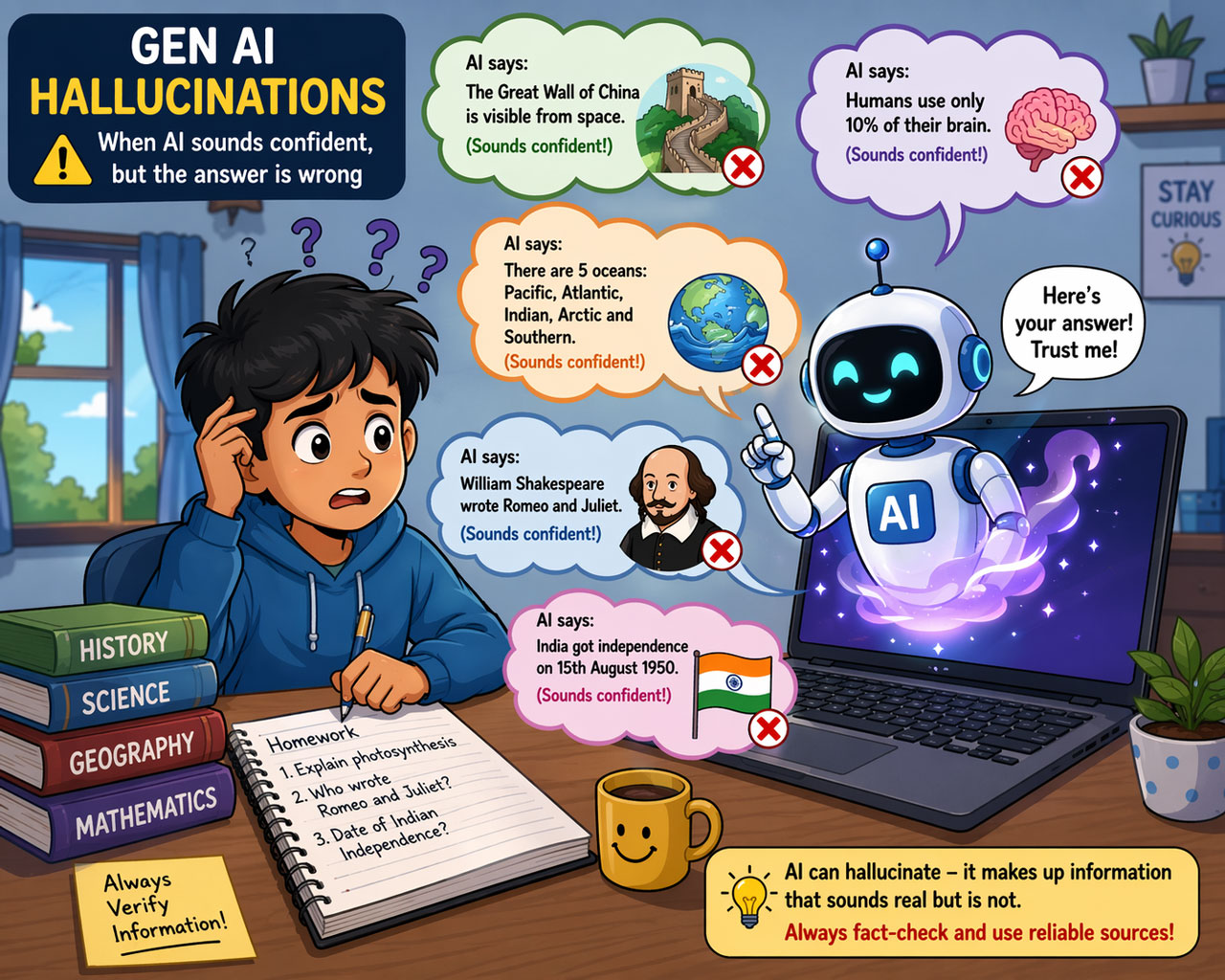
One of the tricky things about AI is that it doesn’t always know when it’s wrong. It’s not really “thinking” the way humans do. It’s predicting patterns. And because of that, it can sometimes give you an answer that sounds confident, polished, and totally believable… but is actually incorrect.
So, if we simply trust everything AI gives us, we’re not really learning. We’re just guessing.
This is especially important when AI gives you specific facts, like names, dates, statistics, quotes, website links, or sources. These are the places where hallucinations often happen.
Be extra careful when the topic is recent, very niche, or about a real person. AI can get those details badly wrong. And when it mentions a book, study, article, or website, don’t assume it actually exists. Sometimes, it has made the whole thing up.
A good way to think about AI is like a very confident friend. Most of the time, they might be helpful. But sometimes, they are confidently wrong.
So, use AI as a starting point, not the final word.
In practice, that means checking anything important. If you’re using AI for homework, a project, or anything that will be shared or marked, check the facts against a reliable source. That might be a textbook, Wikipedia, a trusted website, a news source, or your teacher. Often, a quick search is enough to catch a mistake.
You can also ask AI to provide sources, but don’t stop there. Check that the sources actually exist and that they really say what the AI claims they say.
AI is usually at its best when you use it for thinking, not just facts. It can be brilliant for brainstorming ideas, explaining tricky concepts in different ways, helping you plan an essay, or giving you a starting structure. But it’s less reliable when you need exact details.
And the more important the task, the more careful you need to be. If something is going to be marked, published, presented, or shared, the accuracy needs to be checked properly.
Learning to spot hallucinations is really just a modern version of an old skill: thinking critically about the information you consume.
You wouldn’t believe everything you saw on social media. You wouldn’t trust every random comment you heard from someone in the street. So don’t believe everything AI tells you either.
AI tools are incredibly powerful. But the people who get the most out of them are the ones who stay curious, stay sceptical, and do the final check themselves.
AI can generate answers. But you bring the judgement.
In a world full of powerful AI tools, your most important skill is not just knowing how to use them. It’s knowing how to question them.
AI might sound confident. But you are still responsible for what’s true.
 Dr Tim Kitchen