
After sorting through a number of non-legitimate and non-ANZ participants, over 200 teachers from throughout Australia & New Zealand contributed to a survey I designed in January 2026 to help provide more information about the way generative AI tools are being used in their classrooms.
So, this is a snapshot of what is happening in ANZ in regards to gen AI use in K-12 schools.
Over half (55%) of the participants were secondary teachers 39% were primary teachers and the rest a mix of Early Learning, corporate and admin support staff.
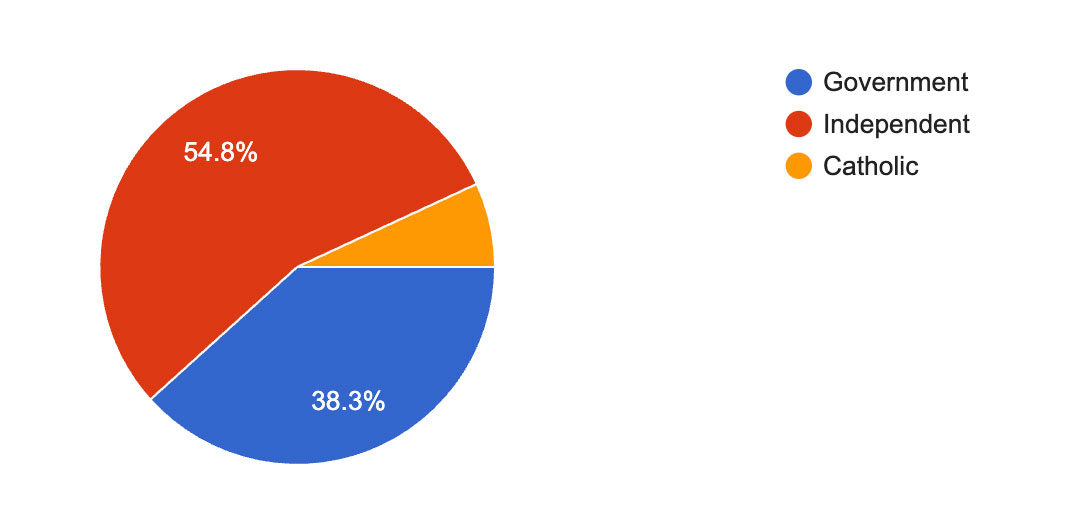
55% – Independent school teachers
38% – Government school teachers
7% – Catholic school teachers
Regions covered
- Victoria – 19%
- NZ – 17%
- NSW – 14%
- QLD – 15%
- WA – 15%
- NT – 5%
- ACT – 5%
- Tas – 5%
- SA – 5%

Preamble
As you’re reading through the survey results, it’s probably worth keeping a bit of context in mind. The survey was originally shared through my LinkedIn and Facebook networks, which means it largely reached teachers who are likely already EdTech advocates or who play a leadership role around ICT integration in their schools.
While participants were encouraged to pass the survey on to colleagues, it’s fair to say that the kind of teacher who is most likely to take the time to respond, is someone who already has an interest in education technologies. As a result, there’s likely a built-in bias towards more positive or open views on the use of generative AI in schools.
If you would like me to present the findings of this survey at your school as well as follow-up professional learning support, feel free to contact me via t.kitchen@me.com.
Dr Tim Kitchen
CTL – Creative Teaching & Learning
Top 10 gen AI tools in ANZ
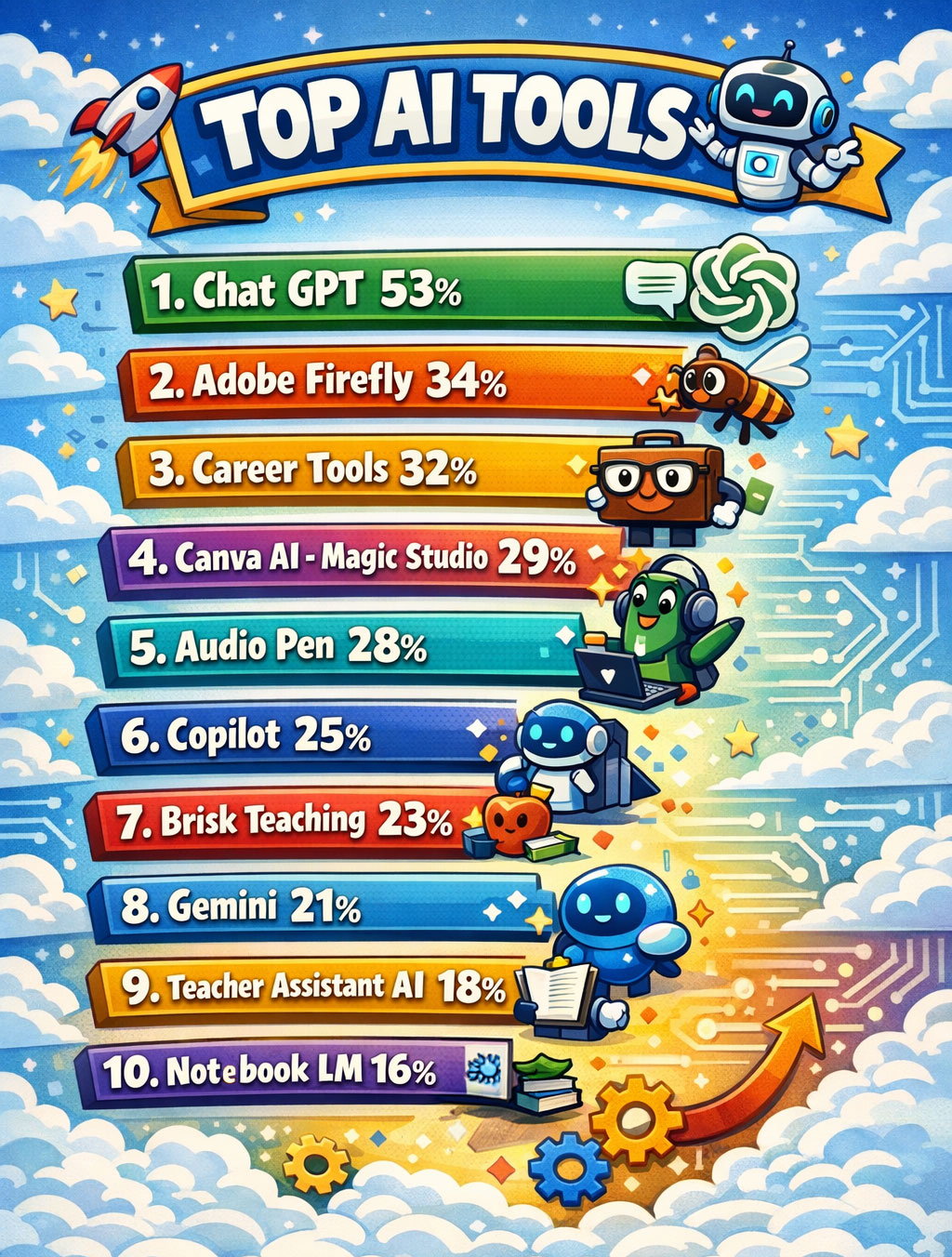
Unsurprisingly, ChatGPT came out on top as the most used generative AI tool, with 53% of participants saying they use it in their teaching. The next most used tool was Adobe Firefly, accessed through various Creative Cloud applications, including Adobe Express.
That result was a little unexpected, especially given the widespread popularity of tools like Canva. But when you factor in that most of the participants sit within my own network, and that I’ve been a long-time advocate for Adobe, it could explain the result.
Here are the top 10 …
- Chat GPT (53%)
- Adobe Firefly (34%)
- Career Tools (32%)
- Canva AI – Magic Studio (29%)
- Audio Pen (28%)
- Copilot (25%)
- Brisk Teaching (23%)
- Gemini (21%)
- Teacher Assistant AI (18%)
- Notebook LM (16%)
Click here to access the full list.
Note that 6% of the participants indicated that they did not use any gen AI tools.
Click here to see my site that provides information about what each of the above apps (and lots more) do, who makes them and information about privacy & security.
How gen AI tools are being used by ANZ teachers.
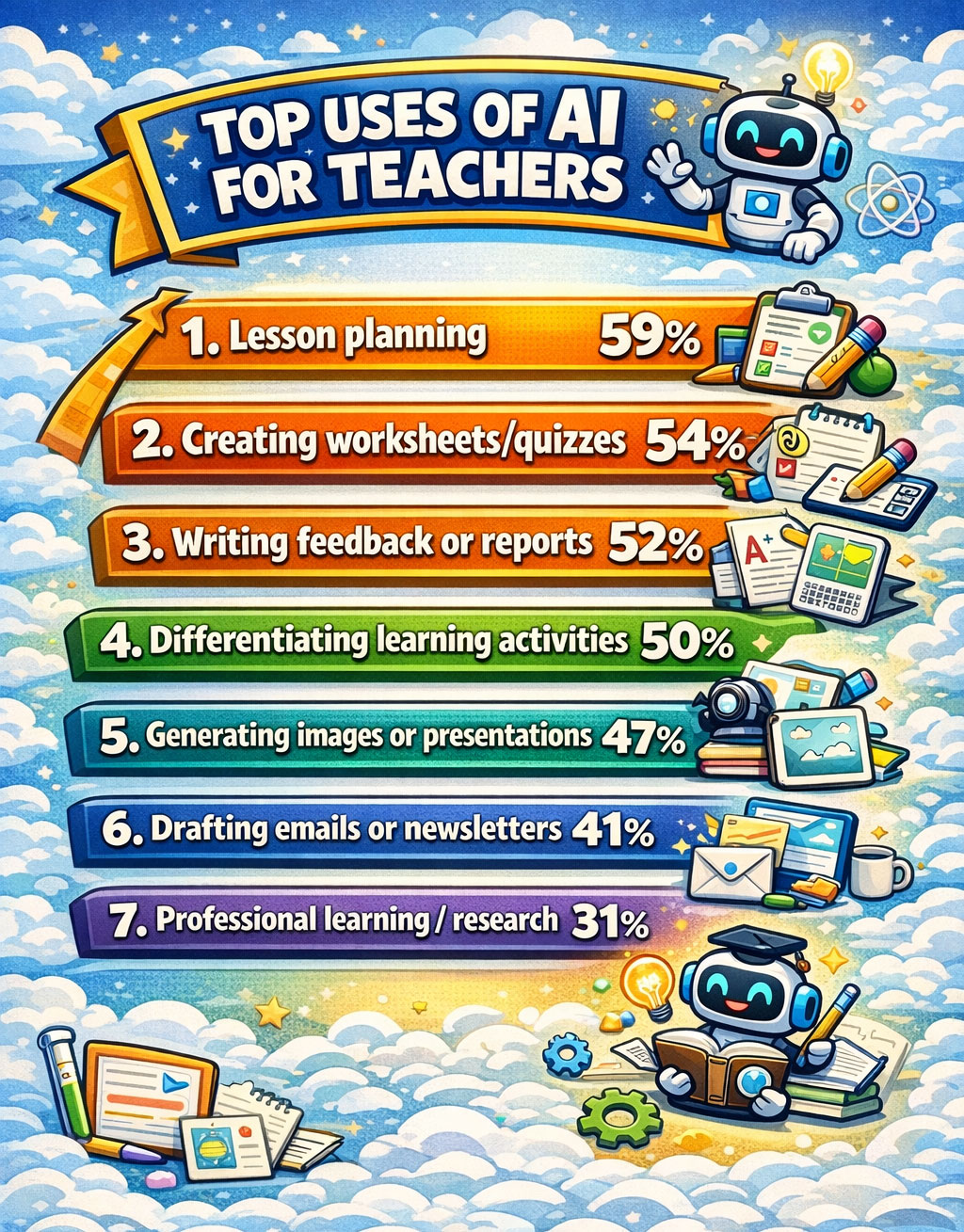
Participants were asked to select from a range of options the tasks they’ve used generative AI for. They were also given the opportunity to add any other uses that weren’t included in the list.
Most reported tasks:
- Lesson planning (59%)
- Creating worksheets/quizzes (54%)
- Writing feedback or reports (52%)
- Differentiating learning activities (50%)
- Generating images or presentations (47%)
- Drafting emails or newsletters (41%)
- Professional learning / research (31%)
Other tasks that participants listed included:
- Marking essays and peer reviews
- Teaching skills
- Deep research and audits.
- Vibe coding
- Creating digital interactive content
How often gen AI tools are being used by ANZ teachers
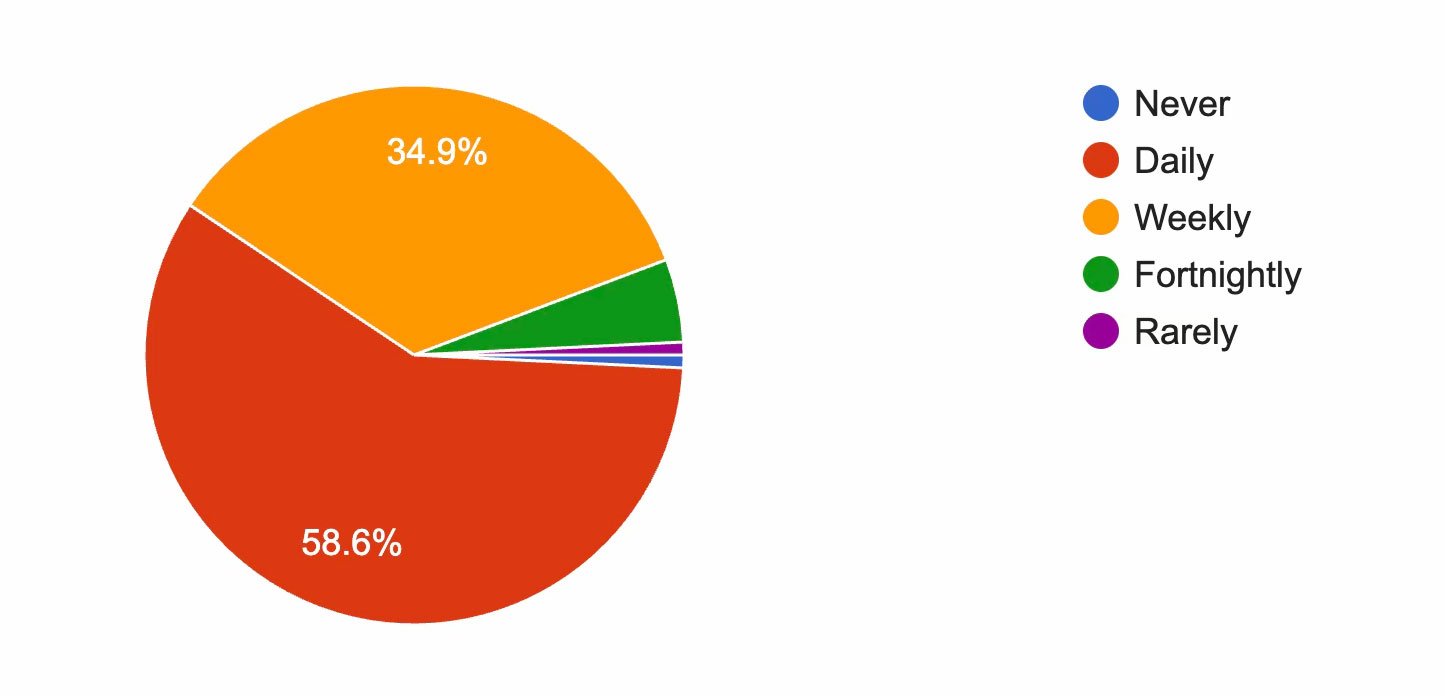
Almost 60% (59%) of participating teachers said that they used gen AI tools on a daily basis. 35% saiod they use then weekly, 5& fortnightly, 2% rarely with 0.8% never.
To what extent has gen AI helped reduce teachers workload?
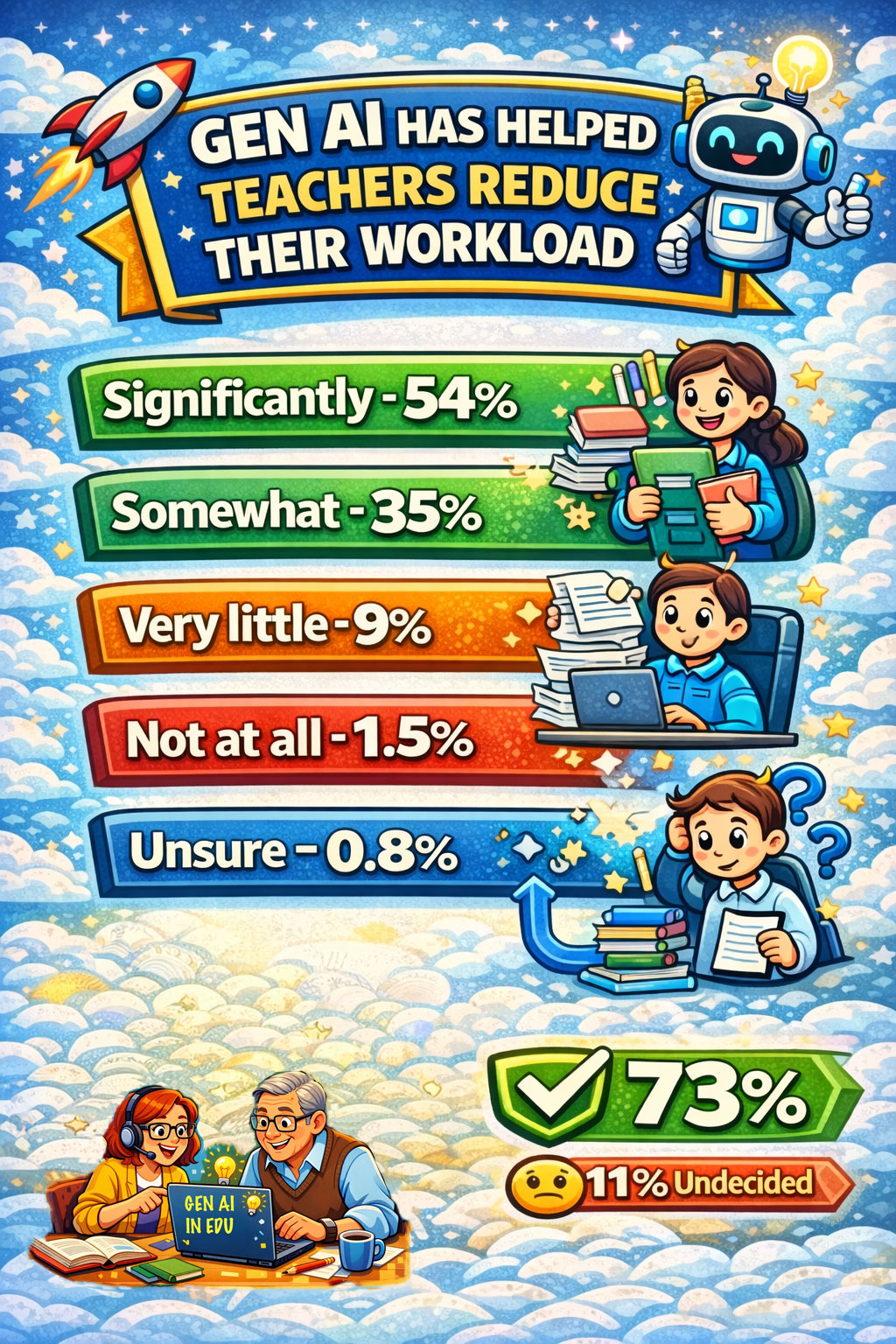
In terms of gen AI tools being used to help to reduce teacher workload, just over half (54%) of the participants have indicated that it has helped significantly. 35% said that it has somewhat helped, 9% said that gen AI had had very little influence, 1.5% said it had no influence with 0.8% unsure.
Are ANZ Teachers encouraged and supported by school leaders to use gen AI tools at work?
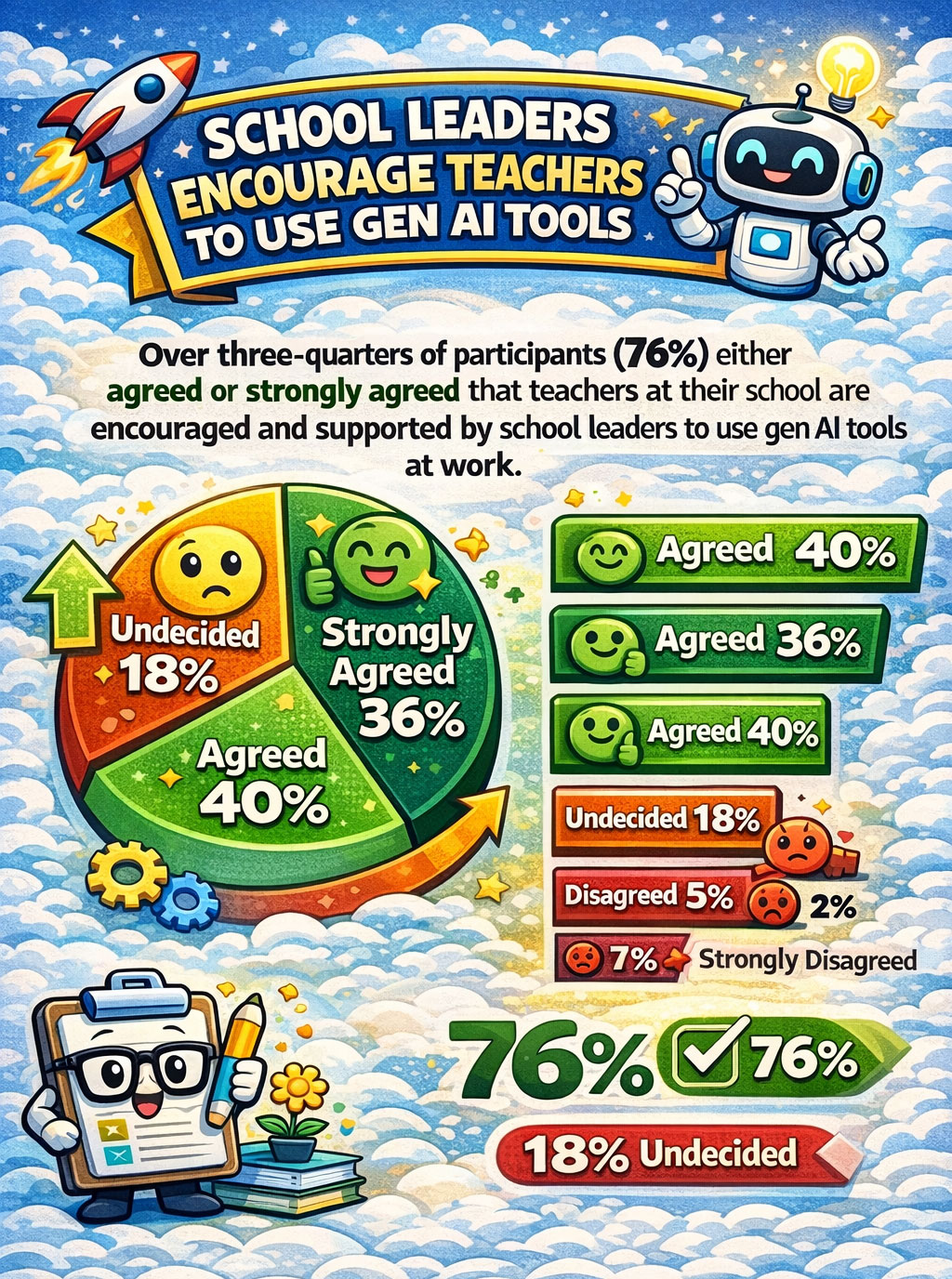
Over three-quarters of participants (76%) either of agreed or strongly agreed that teachers at their school are encouraged and supported by school leaders to use gen AI tools at work. Just under 36% strongly agreed and just just under 40% agreed.
Only 7% disagreed with 2% of those strongly disagreeing. 18% were undecided.
Are ANZ Students officially encouraged and supported by school leaders to use gen AI tools in the learning process?
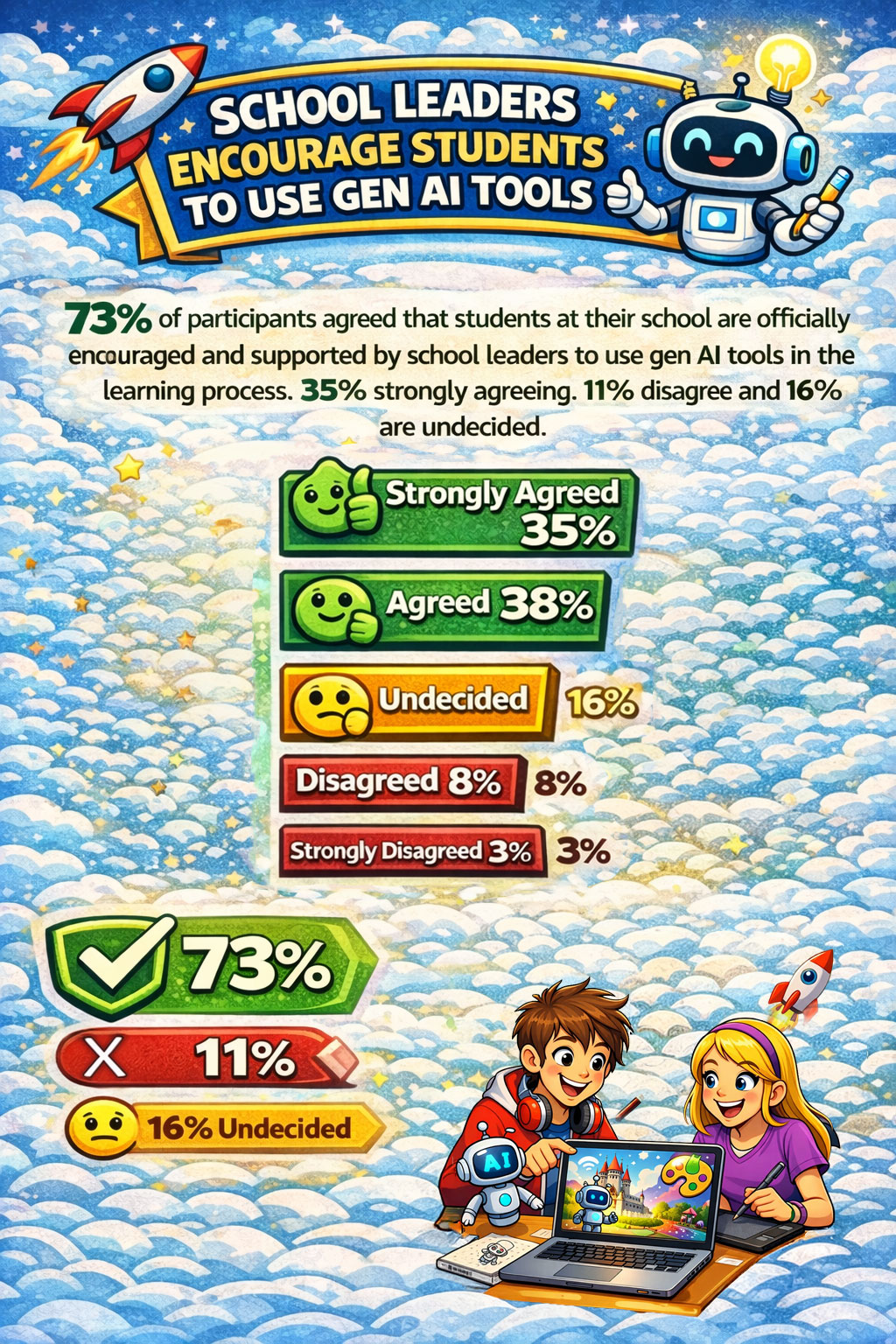
73% of participants agree (38%) or strongly agree (35%) that students at their school are officially encouraged and supported by school leaders to use gen AI tools in the learning process.
11% disagree (8%) or strongly disagree (3%) that students are officially encouraged and supported by school leaders to use gen AI tools in the learning process. 16% are undecided
Concerns ANZ teachers have about working with gen AI in schools
- Over-reliance by students – 58%
- Data privacy and safety – 48%
- Academic integrity / plagiarism – 45%
- Reduced critical thinking – 37%
- Equity of access – 37%
- Accuracy – 37%
- Lack of clear policy – 30%
- Environmental – 13%
- no major concern – 6%
Other concerns
- Ethical use of inputs by the providers
- Deceased emotional responses
Are current school policies adequately addressing these concerns?
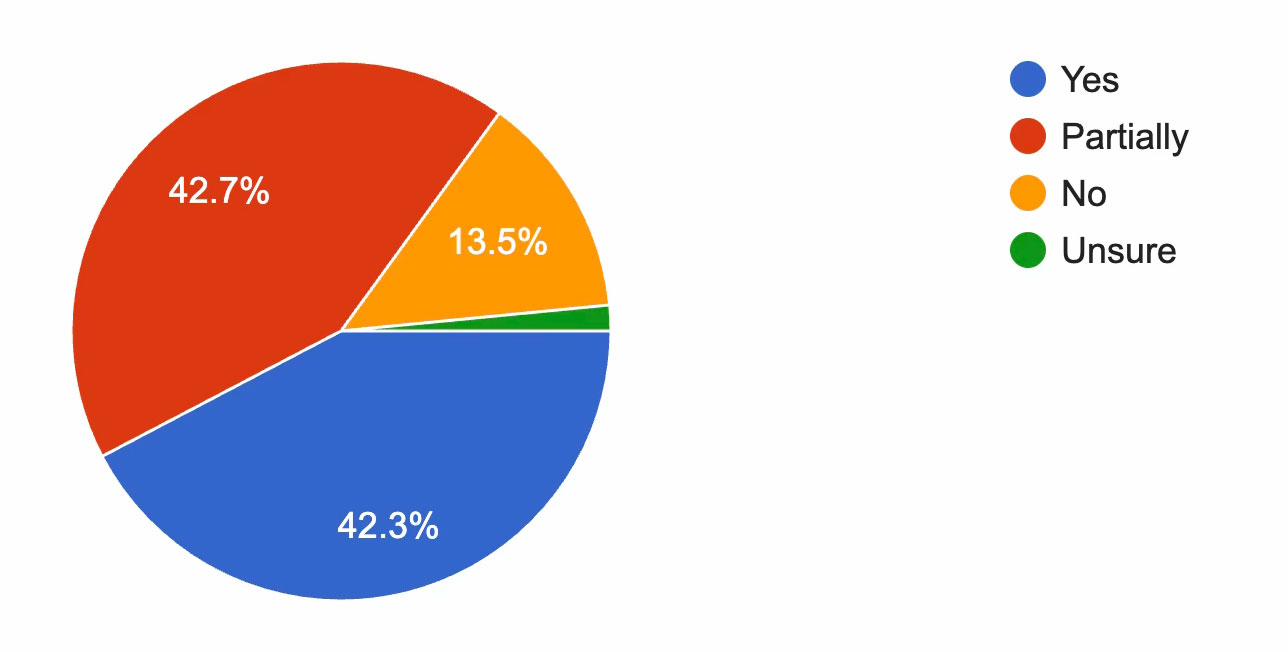
42% of participants feel that current School policies adequately address the above concerns. 43% partially feel that current School policies adequately address these concerns. 14% do not feel that current School policies adequately address these concerns and 1.5% are unsure.
Survey question – Do you feel current school polices adequately address these concerns
Are ANZ schools providing guidance or policy around gen AI use?
60% of school or school systems currently provide clear and practical guidance or policy around gen AI use. 27% provide guidance but it us unclear. 10% are in development of police & guidance and 3% are not aware of any guidance or policy.
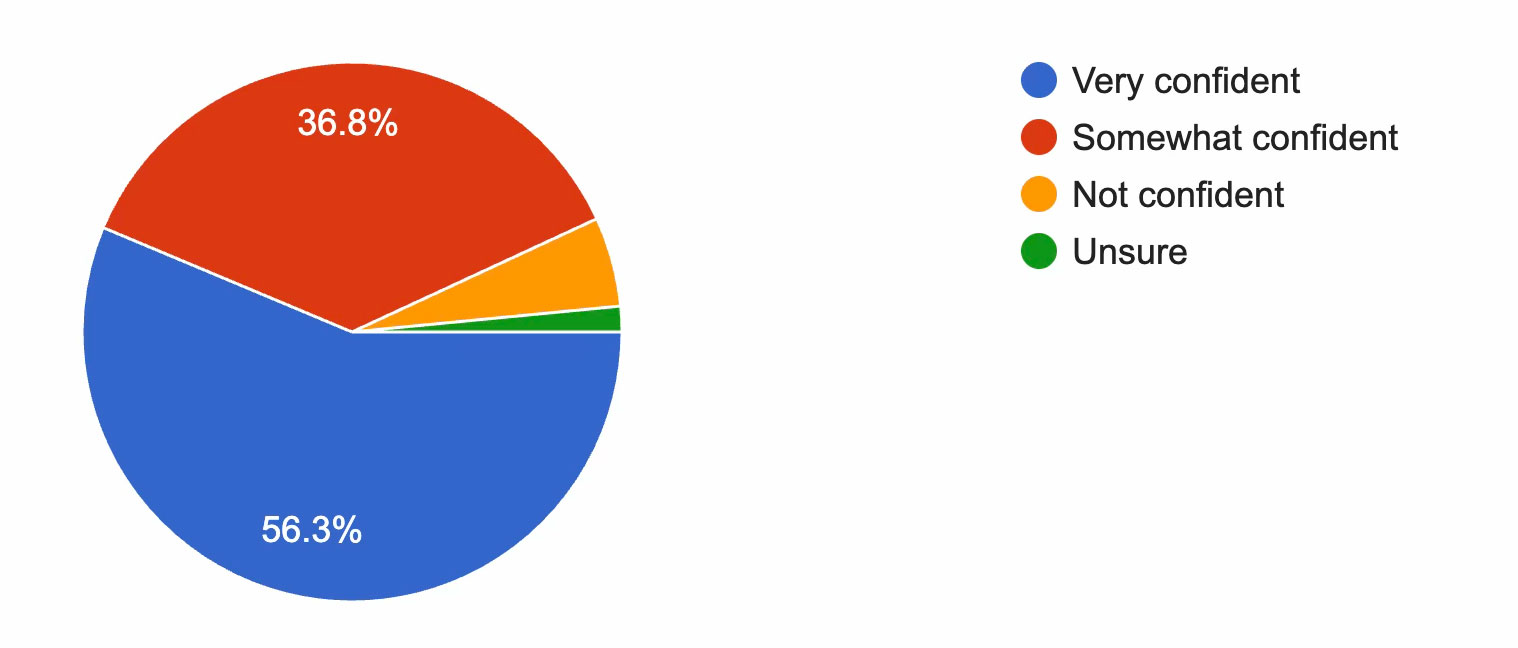
How confident are teachers feeling about guiding students to use gen AI ethically and effectively?
Over half (56%) feel very confident about guiding students to use gen AI ethically and effectively. 37% are somewhat confident, with only 5% not confident. 1.5% are unsure.
Types of support that would help ANZ teachers use gen AI more confidently
58% – Clear school guidelines
56% – Practical classroom examples
48% – Approved / safe tools list
40% – Time to experiment
32% – Ongoing coaching or mentoring
Professional Learning preferences
39% – Online self-paced modules
21% – Full-day workshop
17% – In-class modelling
15% – Short staff meeting sessions
8% – Faculty-specific training
Summary of comments
Overall, respondents see generative AI as a valuable and increasingly embedded part of teaching practice, particularly for saving time on lesson preparation, creating differentiated and student-friendly materials, providing feedback, and enabling more data-informed, personalised instruction. Many believe AI will continue to improve and make innovative contributions to instructional design, freeing teachers to focus more on students’ learning, well-being, and individual needs.
At the same time, there are consistent calls for clearer policies, stronger leadership understanding, targeted professional learning, and better integration with existing curricula—especially to ensure equitable access for rural schools. Concerns remain around data privacy, ethics, network security, content accuracy, and the risk of students becoming overly reliant on AI in ways that could weaken independent thinking. As a result, respondents emphasise the need to shift from debating whether to use AI to learning how to use it wisely, ethically, and critically, with teachers evolving into learning designers and guides who actively model and teach responsible AI use.
Samples of optional anonymous comments
Generative AI has become a useful auxiliary tool in my daily teaching, helping to streamline tasks like lesson planning and creating learning materials. I hope schools can continue to refine relevant policies and provide more targeted professional learning, so that both teachers and students can use gen AI in a more standardized and effective way.
Artificial intelligence has been deeply integrated into the entire teaching process.We are using AI to adapt lesson plans and courseware, and it will achieve even greater outcomes in the field of education in the future.
AI aids teaching smoothly, freeing up time to focus on students while I keep an eye on content accuracy and students’ usage habits.
I think cultivating artificial intelligence from a young age is very good, and I also hope to promote it vigorously. This is another progress of human civilization!
I have been spending a considerable amount of time researching and experimenting with AI. It will be integrated into our curriculum if it will enhance the student learning
AI has saved the time for lesson preparation, but further training is needed.
Using AI in teaching is no longer a novelty; what need to consider is how to make the most of this tool.
Although I personally believe that artificial intelligence is a trend, I am concerned that my students may overly rely on intelligence, which is what I am worried about.
Data Privacy and Ethics: The collection and use of learning data must be strictly regulated to prevent abuse.
More guidance on AI education policies is needed.
Rural schools lack AI resources and network support.
AI is providing a wealth of teaching support for schools and will be more deeply integrated into teaching tasks in the future.
It is difficult to integrate AI tools with existing courses.
AI will make more innovative contributions to instructional design in the future.
Data privacy and AI ethics are cause for concern.
We have some policies in place, but not all that are needed to best support all staff, however, this will be an area of significant focus in 2026
Transformation of the Teacher’s Role: Teachers need to shift from being knowledge transmitters to becoming learning designers, guides, and emotional mentors, which demands new professional skills and mindsets.
AI tools efficiently assist with lesson preparation, differentiated teaching, and assignment feedback, saving time to focus on students’ development. They are well-suited for New Zealand’s multicultural teaching scenarios, though attention should be paid to content verification and guiding students to use them appropriately.
Artificial intelligence is worth promoting, but necessary security measures should also be taken into account, such as network security and the need for excessive dependency testing.
Schools have long grown accustomed to using AI tools; what we need to do now is figure out how to make better use of them.
I am still somewhat concerned because artificial intelligence is not yet as advanced as it seems.
Students’ reliance on AI for writing weakens their ability to think independently.
I have been thinking about a question, if humans overly rely on intelligence, will it lead to the overall cognitive degradation of us humans? If that’s the case, then it’s really a big trouble.
We should think about how to use AI to create more instructional designs, rather than pushing it away out of fear.
AI will only keep performing better and better in teaching practice.
I truly believe that our administration at all levels has no deep understanding of the ‘need’ in this space!
Practice has proven that artificial intelligence does more good than harm to teaching.
Our school leaders are too conservative, and I can understand that. Perhaps the principal is concerned that children may rely too much on artificial intelligence and lose their ability to think for themselves. Oh my god, if that’s the case, it will cause great social trouble.
In traditional teaching, teachers often rely on their experience to guess where students might struggle, and it’s hard to take every student’s individual differences into account. But AI‑powered learning analytics tools — like adaptive assessment systems or classroom behavior trackers — can collect real‑time data from students: things like answer records, how often they interact, types of mistakes they make, and so on. Then they generate visual reports on each student’s learning situation.
For example, a math teacher using AI might find that a particular student keeps making three typical errors in the “quadratic function applications” unit — mixing up formulas, misreading graphs, and having trouble turning real‑world problems into math models. The system can then automatically suggest tiered practice exercises for that student. In Chinese class, teachers can use NLP technology to spot logical gaps or weak emotional expression in an essay, and then design focused mini‑lessons to target those issues.
This shifts teaching from “rough observation” to “data‑backed precise intervention,” so teachers can truly achieve personalized instruction — one plan for each student.
Artificial intelligence may be the future direction of development, and I think I should learn it as soon as possible.
I think artificial intelligence can make my teaching work easier in many aspects, and I will use more intelligent tools in the future.
AI helps reduce teaching burden, allowing more focus on students while prioritizing content accuracy and proper student AI usage.
Education on the critical use of AI by students should be enhanced.
AI has already played a tremendous role in practical teaching work, and it will evolve into an even more excellent teaching tool.
AI is widely used in our school; it helps me make kid-friendly materials, saving time for students. I check content accuracy and teach proper AI use.
 Dr Tim Kitchen