

The generative AI evolution is giving K-12 education the revolution it has needed for many years.
As published on LinkedIn on 3 January 2026
Dr Tim Kitchen
The 30th of November, 2022 became a landmark moment for both education and modern society. That was the day OpenAI released ChatGPT to the public as a free, large language model (LLM) and almost overnight, everything shifted.
LLMs had been around for a number of years prior to the launch of Chat GPT. They slowly grew out of decades of work in linguistics, statistics, and artificial intelligence. The big breakthrough came in 2017 with a new approach called Transformer architecture. Instead of looking at words one at a time, it allowed computers to understand how words relate to each other across whole sentences and paragraphs. This made it possible to train AI on huge amounts of text and helped it recognise patterns in meaning, grammar, and intent in ways that had never been possible before (Tucudean et al, 2024).
The secret behind the success of ChatGPT was that it was free and easily available via a browser. Teachers and students alike were drawn to what felt like the next big thing in technology. Suddenly, this new tool was being explored for writing and refining assessment tasks, generating lesson plans, images, songs, videos, quizzes, and streamlining everyday teaching work. What had once felt experimental or futuristic quickly became part of daily conversations in staff rooms and classrooms, signalling that something genuinely different, and potentially transformative, had arrived in education.
Almost overnight, ‘gen AI’ became a buzzword, but for many, it also felt like the latest threat to traditional approaches to schooling. What began as uncertainty and concern quickly turned into widespread curiosity and experimentation. Just over three years on, it’s not unusual to find dozens of gen AI tools being used regularly by both teachers and students to support learning, enhance assessment, help with planning, solve the creativity blank page issue, and problem-solve.
From COVID lock-downs to Gen AI
Those of us who were early adopters of computers in the classroom in the 1990s and advocates for 1:1 laptop programs were constantly fighting against a very traditional, slow to change, system. Even though digital technologies had been in schools since the mid 1980s, there was still a strong reluctance to change. It seemed as though just about every aspect of society (such as banking, shopping, communicating and being entertained) was centred around a digital device but education was still predominantly face to face with a focus on handwritten assessments. The interruptions to traditional classroom experiences caused by COVID lock-downs in 2020 & 2021 forced some quick changes when most teachers and students had to work digitally (many for the first time).
When schools finally emerged from COVID lock-downs, there was a sense of hope that teachers would keep building on the increased access to digital technologies that had become part of their everyday work practice. Instead, almost the opposite happened. Many teachers, understandably exhausted by months of remote learning, were keen to step away from screens altogether, eager to return to familiar, face-to-face practices after being forced to rely so heavily on digital tools during lock-down.
For many teachers, the sudden and sustained shift to remote learning was exhausting, with studies describing heightened stress, increased workload, and a sense of having to “start teaching all over again” in unfamiliar digital environments. Prolonged screen time, constant videoconferencing, and what researchers describe as ‘technostress’ contributed to widespread digital fatigue and burnout. As a result, when face-to-face teaching resumed, many educators were eager to step away from screens altogether, not because they rejected technology outright, but because it had become so closely associated with crisis teaching, emotional strain, and survival rather than thoughtful, creative pedagogy (Bond, 2020).
Then Chat GPT happened and adoption of technology across most of the K-12 curriculum dramatically increased. Researchers have observed that “AI tools are flooding K-12 classrooms,” with solutions like ChatGPT widely adopted despite ongoing evaluation of their effects (Loeb, 2025). These trends suggest that Chat GPT’s emergence has coincided with (and arguably accelerated) a dramatic increase in technology adoption across the K-12 curriculum and a broader rethinking of schooling practice far greater than the adoption forced by COVID lock downs.
A change to teaching & learning
The rapid shift towards the use of a range of gen AI solutions has exposed a long-standing tension in education. For decades, schooling has largely centred on the final product, the exam paper, the test, the essay, or the polished project handed in at the end of a unit. But when gen AI tools can now produce highly convincing end products with very little student input, the spotlight has inevitably moved.
Increasingly, the real value lies not just in what students submit, but in how they got there, the thinking, decision-making, drafts, feedback, reflection, and growth that happened along the way. In many ways, gen AI has forced educators to pay closer attention to the learning process itself. A need in education that has been well over due.
Linking back to Benjamin Bloom
The rapid rise of gen AI tools in schools has quietly pushed educators back to something that had been sitting there all along: Bloom’s Taxonomy and its focus on how learning actually happens. Back in 1956, American educational psychologist Benjamin Bloom mapped out a series of learning stages that moved well beyond memorising facts for a test. Then, in 2001, those ideas were refreshed to better reflect a progression toward deeper thinking and creativity, rather than just recall (Kitchen, 2024).
Now, with gen AI able to produce polished essays, images, code, or presentations in seconds, the final product on its own tells us far less than it once did. As a result, teachers are paying much closer attention to the processes Bloom highlighted such as questioning, analysing, evaluating, creating, reflecting, and revising. The real value lies in how students plan their work, test ideas, make decisions, explain their thinking, and respond to feedback, not just in what they hand in at the end.
Used transparently and ethically, gen AI can actually strengthen this shift. It can support brainstorming, help students refine drafts, and encourage reflection on their thinking, making the learning journey more visible. In many ways, gen AI hasn’t made Bloom’s work outdated; it has reinforced its relevance. It is a timely reminder that deep learning isn’t best measured by a finished product, but by the growth, thinking, and decision-making that happen along the way.
Rethinking assessment
Well before gen AI entered classrooms, research on formative assessment and visible learning emphasised the importance of drafts, feedback, and reflection in supporting student growth. The landmark work of Paul Black and Dylan Wiliam demonstrated that formative practices such as peer feedback, iterative drafts, and metacognitive reflection have a significant impact on learning outcomes (Black & Wiliam, 1998). Similarly, the OECD has consistently argued that modern assessment must value problem-solving, reasoning, and learning progression, not just task completion, particularly in complex, real-world contexts where answers are rarely linear or fixed (OECD, 2023).
In practical terms, schools are responding by redesigning assessment tasks requiring annotated drafts, design journals, digital portfolios, version histories, reflective commentaries, reflective podcasts, oral explanations of thinking and video reflections. Many teachers now also ask students to document how AI tools were used, what prompts were tried, what outputs were rejected, and how ideas were refined, turning AI from a shortcut into a thinking partner. This aligns with guidance from Education Services Australia (ESA), which encourages schools to focus on transparency, ethical use, and student reflection when integrating gen AI into assessment design (Australian Framework for Generative Artificial Intelligence (AI) in Schools, 2023).
The gen AI evolution has exposed an over-reliance on the end product in traditional schooling. It has accelerated a necessary correction, pushing educators to value growth, judgement, and decision-making as core learning outcomes. Both the Australian Curriculum, Assessment and Reporting Authority and the OECD note that future-ready learners must be able to explain how they think, adapt feedback, and justify choices, skills that cannot be meaningfully assessed through a single artifact alone (Australian Curriculum, Assessment and Reporting Authority, 2022).
Gen AI has forced education systems to confront a truth long overdue: authentic assessment has always been about the journey, not just the destination.
Invite Tim Kitchen to your school …
With more than three decades in education, including 23 years in the classroom and 13 years as Adobe’s Senior Education Specialist for Australia, New Zealand & South East Asia, Dr Tim Kitchen now runs CTL – Creative Teaching & Learning, an education consultancy supporting schools to implement safe, ethical, and creative AI practices that strengthen teaching and learning.
Find out more via – https://timkitchen.net/ctl/
Contact Tim via – t.kitchen@me.com

References
Anderson, L. W., & Krathwohl, D. R. (Eds.). (2001). A taxonomy for learning, teaching, and assessing: A revision of Bloom’s taxonomy of educational objectives. Longman.
Australian Curriculum, Assessment and Reporting Authority. (2022). Australian curriculum: General capabilities. Online available (January 2026) https://www.australiancurriculum.edu.au/curriculum-information/understand-this-general-capability/critical-and-creative-thinking?utm_source=chatgpt.com
Australian Framework for Generative Artificial Intelligence (AI) in Schools. (2023). Developed by the National AI in Schools Taskforce (including Educational Services Australia, ACARA, AITSL, and AERO). Australian Government, Department of Education. Online available (January 2026) https://www.education.gov.au/schooling/announcements/australian-framework-generative-artificial-intelligence-ai-schools?utm_source=chatgpt.com
Black, P., & Wiliam, D. (1998). Assessment and classroom learning. Assessment in Education: Principles, Policy & Practice, 5(1), 7–74. Online available (January 2026) https://www.tandfonline.com/doi/abs/10.1080/0969595980050102
Bond, M. (2020). Schools and emergency remote education during the COVID-19 pandemic: A living rapid systematic review. Asian Journal of Distance Education, 15(2), 191–247. Online available (January 2026) https://zenodo.org/records/4425683
Kitchen, T. (2024). The Best Way to Learn is to Make – Creativity in a Gen AI World. Mammoth Learning
Loeb, S. (2025). How ChatGPT and generative AI are affecting learning, teaching, and schools. Stanford Graduate School of Education News. Online available (January 2026) https://news.stanford.edu/stories/2025/07/chatgpt-open-ai-impact-schools-education-learning-data-research?utm_source=chatgpt.com
OECD. (2023). Student assessment. Organisation for Economic Co-operation and Development. Online available (January 2026) https://www.oecd.org/en/topics/sub-issues/student-assessment.html?utm_source=chatgpt.com
Tucudean G, Bucos M, Dragulescu B, Caleanu CD. 2024. Natural language processing with transformers: a review. PeerJ Computer Science 10:e2222. online available (January 2026) https://doi.org/10.7717/peerj-cs.2222
Tim’s book
The Best Way to Learn is to Make – Creativity in a Gen AI World
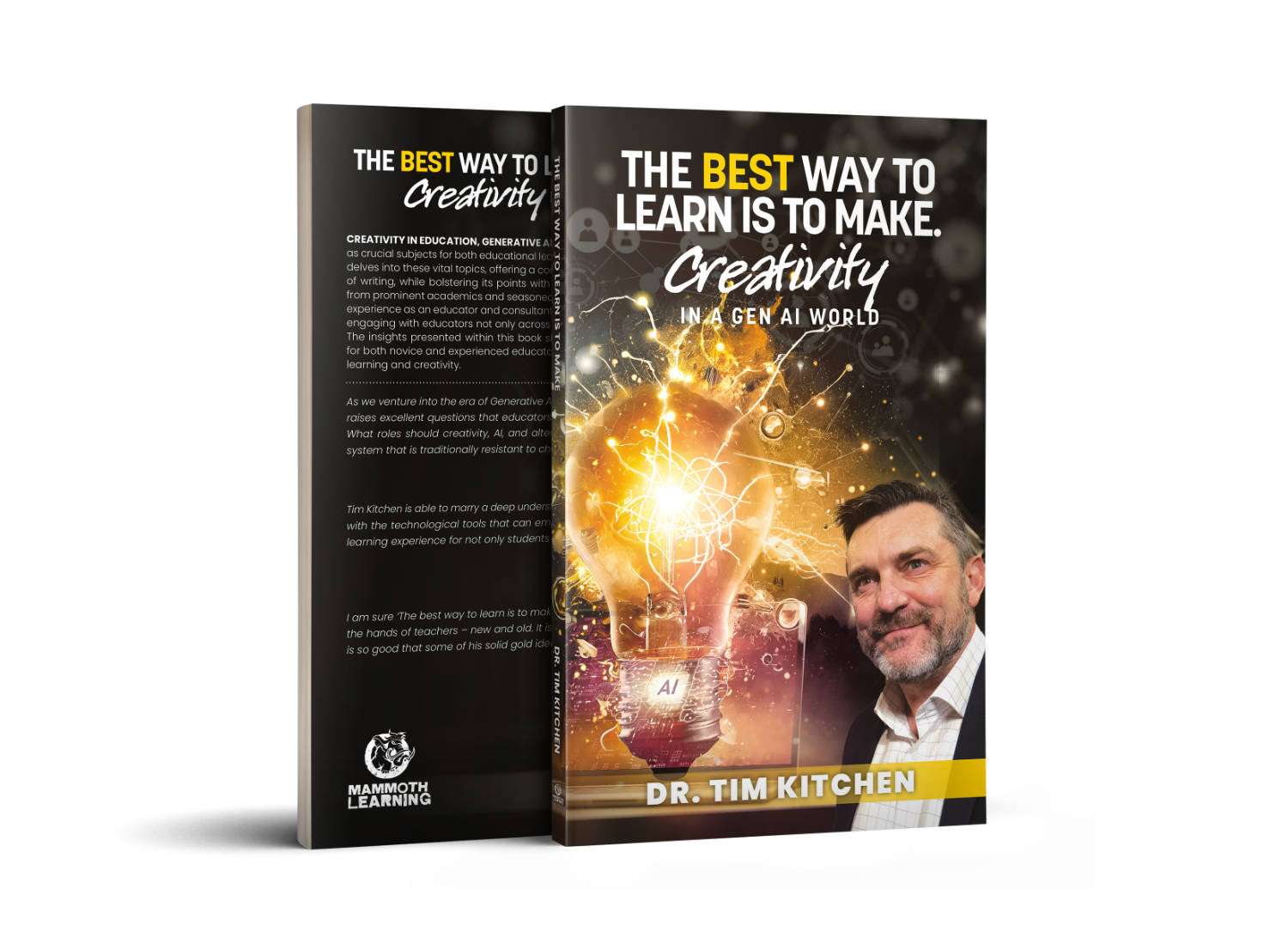
This book draws together Tim’s understanding of future directions in technology as well as his deep understanding of what students need in our classrooms. It is essential reading for all teachers (Dr Helen Hughes).
Click here
 Dr Tim Kitchen's Journal (CTL - Creative Teaching & Learning)