

As published on LinkedIn on 13 February, 2026
Creativity isn’t just about making something that looks impressive. It’s not reserved for artists, designers or musicians. At its heart, creativity is deeply human. It’s our ability to make meaning, notice patterns, connect ideas, ask better questions, imagine alternatives and respond thoughtfully to what’s happening around us.
Generative AI (gen AI) can absolutely support creative work. But it doesn’t have creativity. It can produce outputs that look creative. It can remix, recombine and generate at astonishing speed. But true creativity itself? That’s still a human capability.
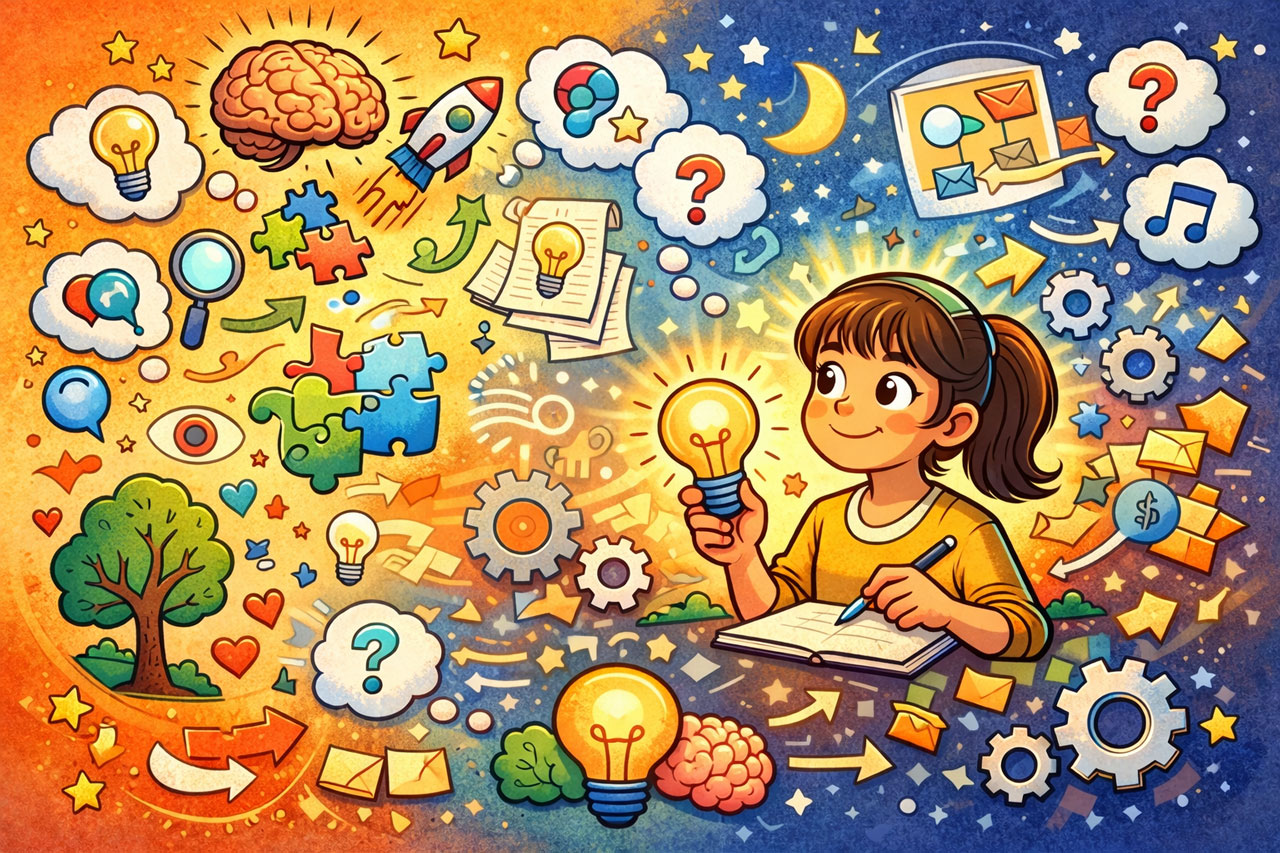
In Chapter 2 of my book, The Best Way to Learn is to Make – Creativity in a Gen AI World (available through Amazon), I explore a range of definitions from world-leading experts and classroom teachers. One of those experts is Dr Ellis Paul Torrance from the University of Georgia. He describes creativity as including uniqueness, fluency, flexibility, elaboration, humour and the avoidance of premature closure. He also talks about creativity as becoming sensitive to problems, gaps in knowledge, missing elements and disharmonies.
I really like that definition. Partly because it includes humour. And partly because it highlights persistence. In my years as a classroom teacher (and now in workshops and keynotes) I’ve seen how humour helps people relax even if my jokes don’t quite land (which of course is very rare 😉). When people feel safe and relaxed, they’re more willing to try, to experiment, to risk being wrong and be more open to the learning process (Edmondson, 2018).
I’m also drawn to that idea of avoiding premature closure. Real creativity isn’t about rushing to the first acceptable answer. It’s about staying with the problem. Sitting in the uncertainty. Letting ideas evolve. That takes effort. It takes resilience. It takes time.
Sir Ken Robinson framed creativity as the process of having original ideas that have value. I love the clarity of that. Creativity isn’t just originality for its own sake. It has to matter. It has to connect. It has to be useful, meaningful, or transformative in some way.
Sir Ken consistently argued that creativity isn’t a niche talent reserved for the arts. It’s a universal human capacity. In his famous 2006 TED Talk, Do Schools Kill Creativity?, he challenged schools for prioritising standardisation and conformity over imagination. His point wasn’t that schools are the enemy. It was that systems can unintentionally narrow human potential if we’re not careful.
In his 2009 book The Element, he explored how people flourish when passion intersects with opportunity. And in Creative Schools (2015), he called for learning environments that nurture curiosity, innovation and human potential more intentionally.
The thread running through all of his work is simple: creativity is human. It’s rooted in imagination, judgement and meaning-making. And when you unpack it, creativity usually involves things like:
- Intent – choosing why you’re creating something
- Judgement – deciding what’s meaningful, ethical or appropriate
- Context – understanding audience, culture and consequence
- Risk – stepping into uncertainty without a guaranteed answer
- Meaning-making – expressing identity, values or purpose
Now compare that with generative AI.
Generative AI doesn’t intend anything. It analyses enormous datasets of human work. It learns statistical patterns across language, images, sound or code. It produces outputs by predicting what is most likely to come next.
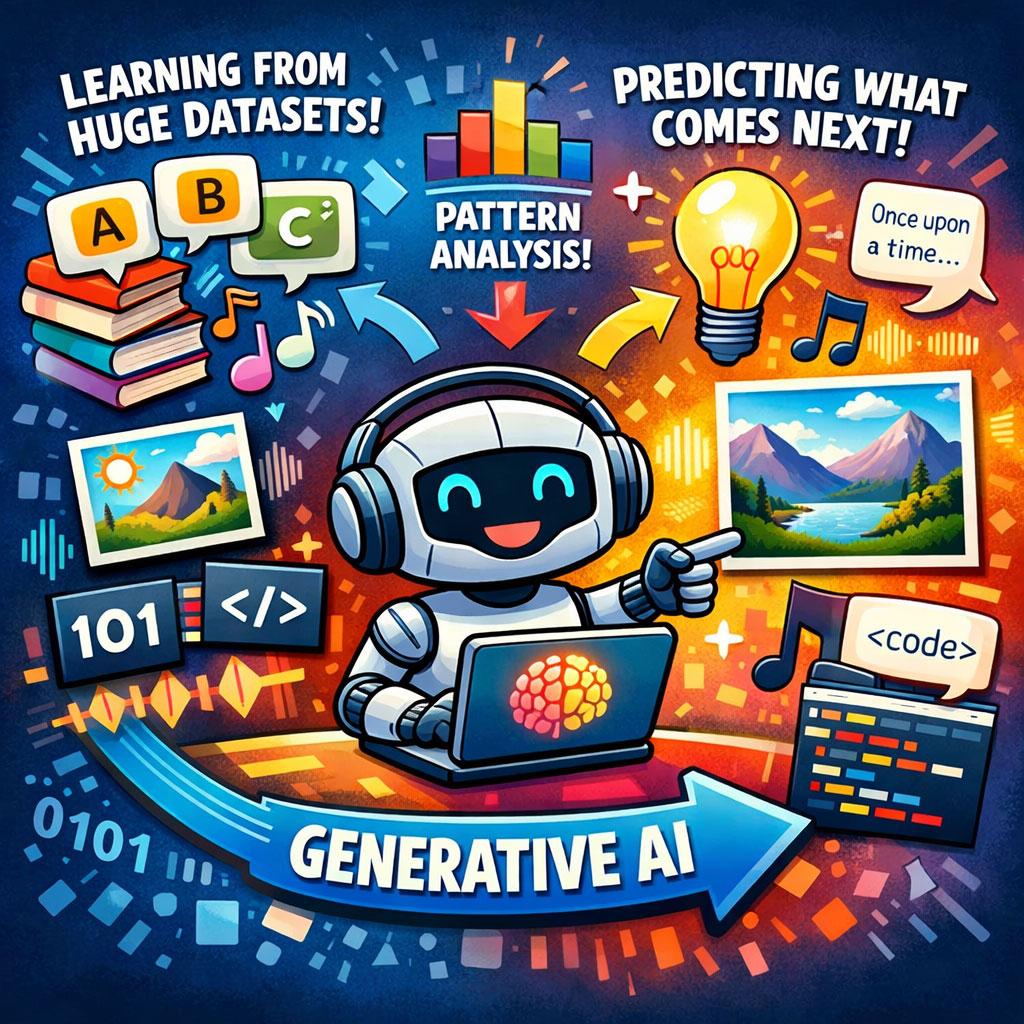
It’s very good at mimicry. It’s very good at variation. It’s very good at speed. It’s very good at filling in gaps. But it doesn’t care if something matters. It doesn’t understand truth, beauty or value. It doesn’t experience curiosity, doubt or emotion. It doesn’t know why an idea is worth pursuing.
When gen AI “creates”, it isn’t expressing insight. It’s executing probability. That doesn’t make it useless. Far from it. Gen AI lowers the friction of making. It helps people get started. It handles drafts and variations. It removes some technical barriers. It can expand what students feel capable of trying. It can solve that intimidating “blank page” problem that so many learners struggle with.
But deciding what matters? Judging quality? Revising with purpose? Connecting ideas to lived experience? That’s still human work.
Real creativity is messy. It involves uncertainty, false starts, failure, emotional judgement and context. It’s shaped by who we are and what we care about. A scientist forming a new hypothesis. A teacher redesigning a lesson because students are disengaged. A student finding a new way to explain an idea when the first attempt doesn’t land.
That’s creativity.
Gen AI can generate amazing looking images, it can write poems, generate songs and remix ideas at lightning speed. But it doesn’t care, it doesn’t understand meaning, it doesn’t feel tension, curiosity, or purpose. It doesn’t wrestle with doubt or make value-based decisions. AI predicts patterns, humans make judgements.
Gen AI can assist creativity. It can amplify it. It can spark it. But it can’t own it.
That’s why creativity matters more than ever in education. Not as an optional extra. But as a core human capability embedded across the curriculum.
The future won’t belong to those who produce the fastest answer. It will belong to those who can frame better problems, question assumptions, adapt when things change and bring human insight into complex situations.
Those are creative acts. And they are deeply human.
Creativity isn’t disappearing because of AI. If anything, it’s being clarified. It’s not about competing with machines. It’s about doing what machines can’t.
And that feels like something worth protecting and designing learning around.
Invite Dr Tim Kitchen to your school …
With more than three decades in education, including 23 years in the classroom and 13 years as Adobe’s Senior Education Specialist for Australia, New Zealand & South East Asia, Tim now runs CTL – Creative Teaching & Learning, an education consultancy supporting schools to implement safe, ethical, and creative AI practices that strengthen teaching and learning.
Find out more via – https://timkitchen.net/ctl/
Contact Tim via – t.kitchen@me.com
References
Edmondson, A. C. (2018). The fearless organization: Creating psychological safety in the workplace for learning, innovation, and growth. John Wiley & Sons.
Floridi, L., & Chiriatti, M. (2020). GPT-3: Its nature, scope, limits, and consequences. Minds and Machines, 30, 681–694. Online available (Feb 2026 – https://link.springer.com/article/10.1007/s11023-020-09548-1)
Kitchen, T. (2024). The Best Way to Learn is to Make – Creativity in a Gen AI World, Mammoth Learning (available through Amazon see – https://timkitchen.net/book1/
Robinson, K. (2006, February). Do schools kill creativity? [Video]. TED Conferences, Online available February 2026 at https://www.ted.com/talks/sir_ken_robinson_do_schools_kill_creativity
Robinson, K. (2009). The element: How finding your passion changes everything. Viking.
Robinson, K. (2015). Creative schools: The grassroots revolution that’s transforming education. Viking.
 Dr Tim Kitchen