

As published in LinkedIn on 8 May, 2026
Generative AI has changed the game for what students need to succeed, not just at school, but in work and everyday life. Tools like ChatGPT, Claude, Gemini, and Copilot can now generate essays, write code, analyse complex information, and create impressive content in a matter of seconds.
But there’s another side to that speed and convenience. These same tools can also produce convincing inaccuracies (hallucinations), biased perspectives, made-up references, and misinformation that sound credible on the surface. That’s why, in this new AI-rich landscape, one skill matters more than ever for the next generation of learners: critical thinking.
A Long-Standing Capability, Often Overlooked
Critical and Creative Thinking has been part of the Australian Curriculum’s General Capabilities since 2010 (ACARA, 2010). Alongside Literacy, Numeracy, Digital Literacy (and other capabilities) schools have long been expected to develop these skills across all learning areas.
In reality, though, critical thinking has often sat on the edges of classroom practice. It’s usually been assumed that students would “pick it up” through good teaching, rather than having it explicitly taught, modelled, assessed, and intentionally prioritised. Schools have concentrated on curriculum coverage and a range of standardised assessment requirements, while critical thinking has frequently been treated as a secondary outcome rather than a central one.
That approach is becoming increasingly difficult to justify. With generative AI now woven into classrooms, workplaces, and everyday digital tools, students need far more than the ability to recall information or produce polished answers. They need the capacity to question, evaluate, interpret, and challenge what AI systems generate. Critical thinking is no longer an optional extra sitting alongside the curriculum; it is quickly becoming one of the most essential capabilities students can develop.
From Producing Answers to Evaluating Them
When students can generate an essay draft or solve a mathematics problem with a single prompt, the role of the teacher is no longer simply to help students produce answers, but to help them question, evaluate, refine, and challenge those answers.
That means schools need to place far greater emphasis on explicitly teaching skills such as:
- interrogating the credibility of sources;
- recognising bias;
- testing claims against evidence;
- constructing reasoned, evidence-based arguments; and
- creatively connecting ideas in ways AI cannot easily replicate.
These are no longer “nice-to-have” capabilities sitting at the edges of the curriculum. They are becoming the new foundations of literacy in an AI-rich world.
Beyond these capabilities, students also need regular opportunities to analyse evidence, reflect on differing perspectives, and understand that AI should support human judgement rather than replace it. In many ways, generative AI has made critical thinking one of the most important forms of digital literacy.
This shift is reflected globally. The OECD’s Future of Education and Skills 2030 framework identifies critical thinking as one of the key “transformative competencies” students will need to navigate uncertainty and shape the future (OECD, 2019). The 2025 World Economic Forum Future of Jobs Report identified analytical thinking as the number one core skill sought by employers, with seven out of 10 companies considering it as essential (World Economic Forum, 2025). UNESCO’s Guidance for Generative AI in Education and Research makes a similar point, arguing that human judgement, ethical reasoning, and critical evaluation must sit at the centre of any meaningful use of AI in learning (UNESCO, 2023).
In other words, the rise of generative AI does not reduce the importance of human thinking, it amplifies it.
Embedding Critical Thinking Across the Curriculum
For educators, the implication is clear: critical thinking can no longer sit on the margins of a unit plan. It must be visible in every classroom experience, every subject, and throughout every course. A science teacher might ask students to fact-check an AI-generated explanation of climate models. A humanities teacher might invite students to deconstruct the assumptions in an AI-written historical narrative. A mathematics teacher might require students to identify and correct errors in AI-generated worked examples. A primary teacher might use AI-generated picture books as a springboard for questions about authorship, truth, and bias.
Teachers can foster critical thinking through inquiry-based learning, ethical discussions, project-based tasks, collaborative problem solving, media analysis, and regular opportunities for students to justify their thinking. The use of generative AI itself can become a powerful teaching tool when students are encouraged to critique outputs, identify inaccuracies, improve prompts and reflect on the strengths and limitations of AI-generated content.
Ultimately, the rise of generative AI is reminding educators of something deeply important. Education is not simply about producing polished answers. It is about developing thoughtful, capable and adaptable human beings who can navigate complexity, uncertainty and rapid technological change.

Preparing Students for the Future of Work
This shift also re-frames student preparation for future employment. Many predictable tasks will be automated, but employers will continue to value workers who can ask better questions, verify information, weigh competing evidence, and apply uniquely human judgement within AI-augmented workflows. Critical thinking is not a defence against AI, it is the skill that allows young people to use it wisely, ethically, and creatively across their working lives.
Importantly, critical thinking is not simply about identifying problems or criticising ideas. It also involves curiosity, reflection, creativity and adaptability. In fact, creativity and critical thinking are increasingly interconnected in modern learning and future employment. As AI takes over more routine production tasks, the uniquely human ability to imagine new possibilities, innovate, collaborate and apply judgement becomes increasingly valuable.
The Australian Curriculum has named critical and creative thinking as essential for sixteen years. The arrival of generative AI has, at last, made it impossible to ignore. For educators, the message is now unmistakable: critical thinking is no longer optional, it is an urgent priority.
In a world increasingly shaped by artificial intelligence, teaching students what to think is no longer enough. Helping students learn how to think may be the most important responsibility education now has.
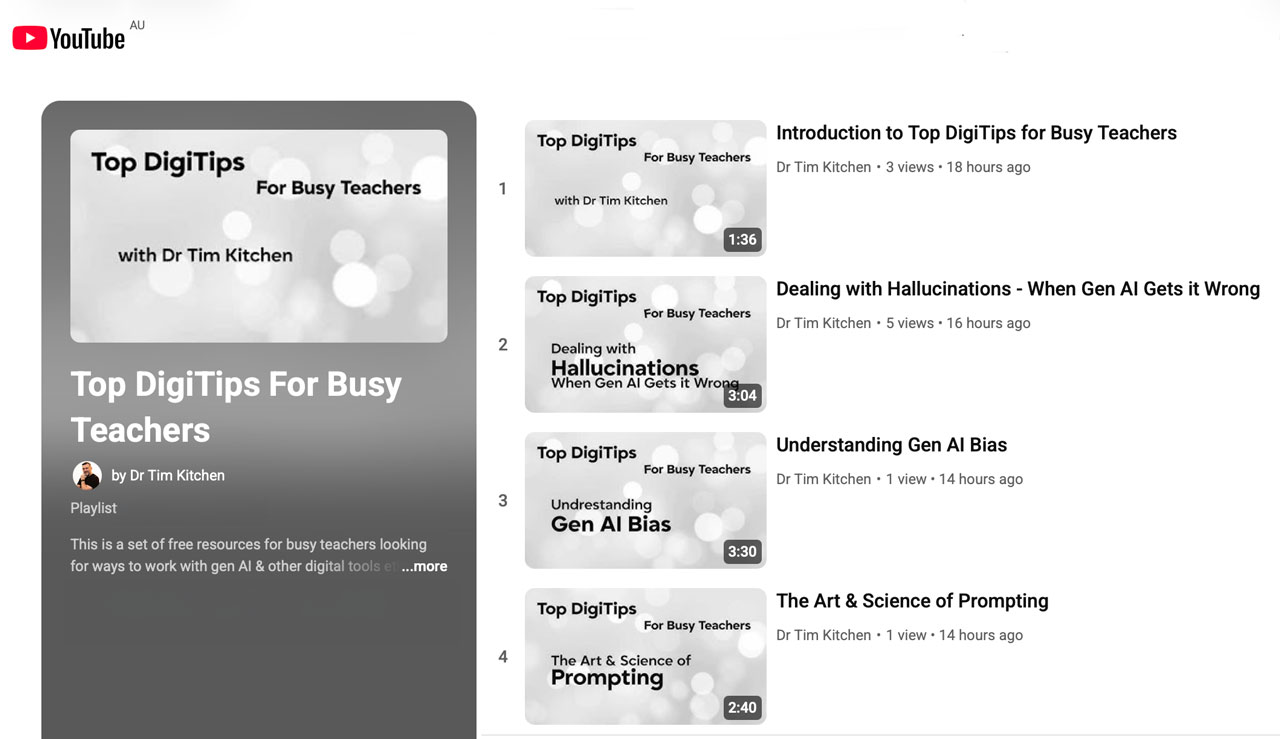
If you are looking for practical ways to apply what is covered in this article in your classroom, have a look at my new Top DigiTips for Busy Teachers playlist on YouTube.
If you would like me to visit your school, contact me via – https://timkitchen.net/ctl/
References
Australian Curriculum, Assessment and Reporting Authority (ACARA). (2010). Australian Curriculum: General Capabilities — Critical and Creative Thinking. Retrieved from https://www.australiancurriculum.edu.au
OECD. (2019). Future of Education and Skills 2030: Conceptual Learning Framework. Paris: OECD Publishing.
UNESCO. (2023). Guidance for Generative AI in Education and Research. Paris: UNESCO.
World Economic Forum. (2025). Future of Jobs Report 2025. Geneva: WEF. Retrieved from https://www.weforum.org/publications/the-future-of-jobs-report-2025/
Special thank you to Claude and ChatGPT for being my sparing partners in the production of this article.