

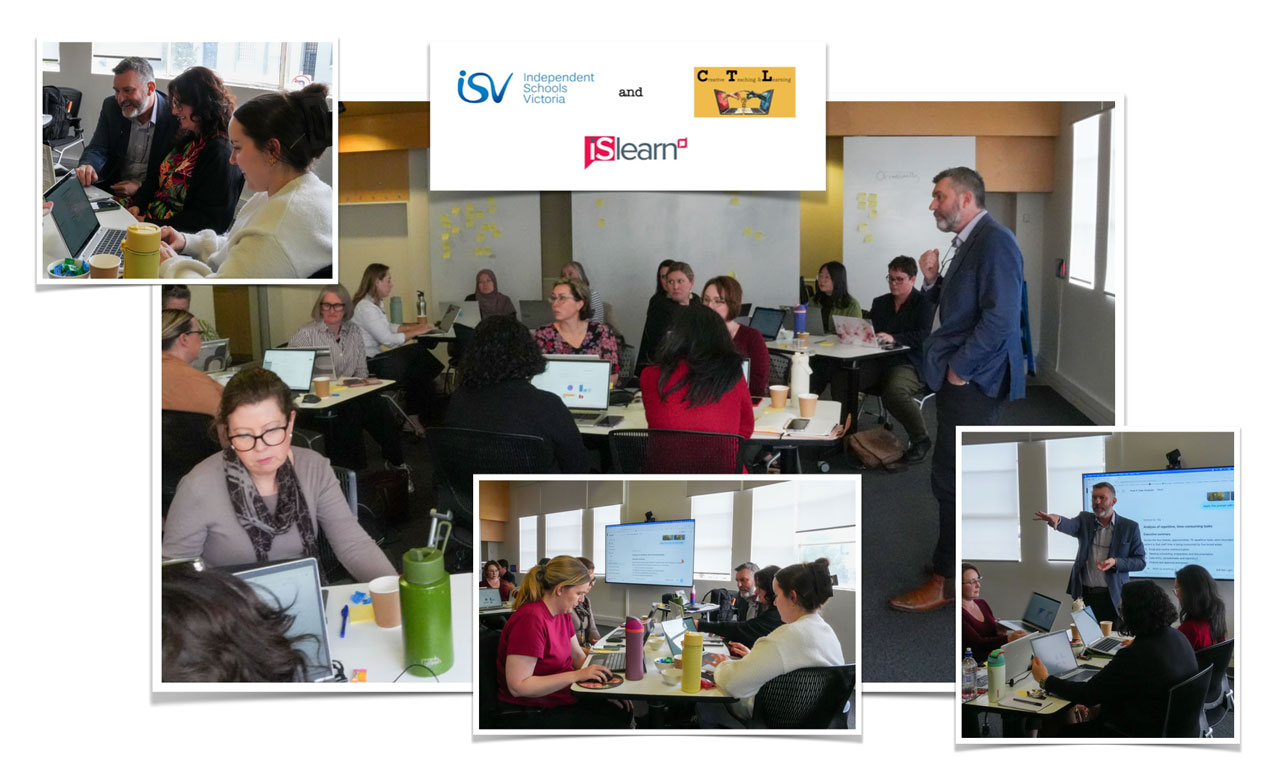
On Tuesday 1st September, I had the pleasure of facilitating a practical workshop titled Time-Saving Automation with AI for 19 non-teaching staff representing approximately 12 Victorian independent schools.
Designed specifically for school administrative and office staff, the workshop explored practical ways AI tools can help reduce repetitive work, streamline everyday processes and give staff more time to focus on the people and responsibilities that require human judgement and care.
It was great to see a number of participants who returned for more after attending my workshop titled – Generative AI Basics for School Administration on 11th August.

A poll conducted with the group revealed that generative AI is already becoming part of everyday administrative practice. Ten participants, or 53%, reported using generative AI daily, while another four, or 21%, said they use it several times a week. However, confidence has not necessarily kept pace with adoption. Fourteen participants, representing 74% of the group, described themselves as “still learning.” This included six of the ten daily users.
This was one of the most interesting findings from the workshop. Regular use does not automatically translate into confident, safe or effective practice. Staff may be experimenting frequently with AI while remaining uncertain about prompting, privacy, accuracy, appropriate use and the reliability of the information being generated.

Microsoft Copilot was the most widely used AI tool among the group, selected by 79% of respondents. Canva or Adobe Express AI features followed at 63%.
The most established applications were:
- Drafting emails — 84%
- Writing documents — 79%
- Preparing meeting notes — 58%
- Brainstorming ideas — 53%
These results reflect the immediate value that generative AI can offer administrative staff. Email and scheduling were also identified as the most time-consuming responsibilities, making them logical areas in which to explore safe and practical automation.

During the workshop, we examined how AI could assist with repetitive administrative tasks without removing human responsibility. The emphasis was not on handing entire roles over to AI, but on identifying small, recurring tasks where AI could provide a useful first draft, organise information, suggest a structure or accelerate an established process.
Participants were interested in applying AI to a broader range of practical tasks, including:
- Organising files
- Analysing spreadsheets
- Drafting meeting notes
- Creating standard letters and forms
- Summarising documents
- Responding to routine enquiries

The workshop highlighted the need for schools to establish clear guidance around approved AI tools, data privacy and human oversight.
Professional learning for non-teaching staff should be practical and closely connected to their roles. It should include opportunities to work with genuine administrative processes, learn how to check AI-generated outputs and understand how to handle confidential information safely.
The workshop reinforced that school administrative staff are not waiting for AI to arrive. Many are already using it regularly and are eager to develop more sophisticated workflows. The priority now is to ensure that adoption is supported by the confidence, guidance and safeguards needed to use these tools well.

When introduced thoughtfully, AI has the potential to take some repetitive work off the plates of busy school staff. However, the most effective approach will continue to combine the efficiency of AI with the experience, accountability and human judgement of the people who keep schools running.
Click here to find out more this series of events for non-teaching & teaching staff at ISV schools.
Click here to book Tim to work with your school (on-line or in-person)