

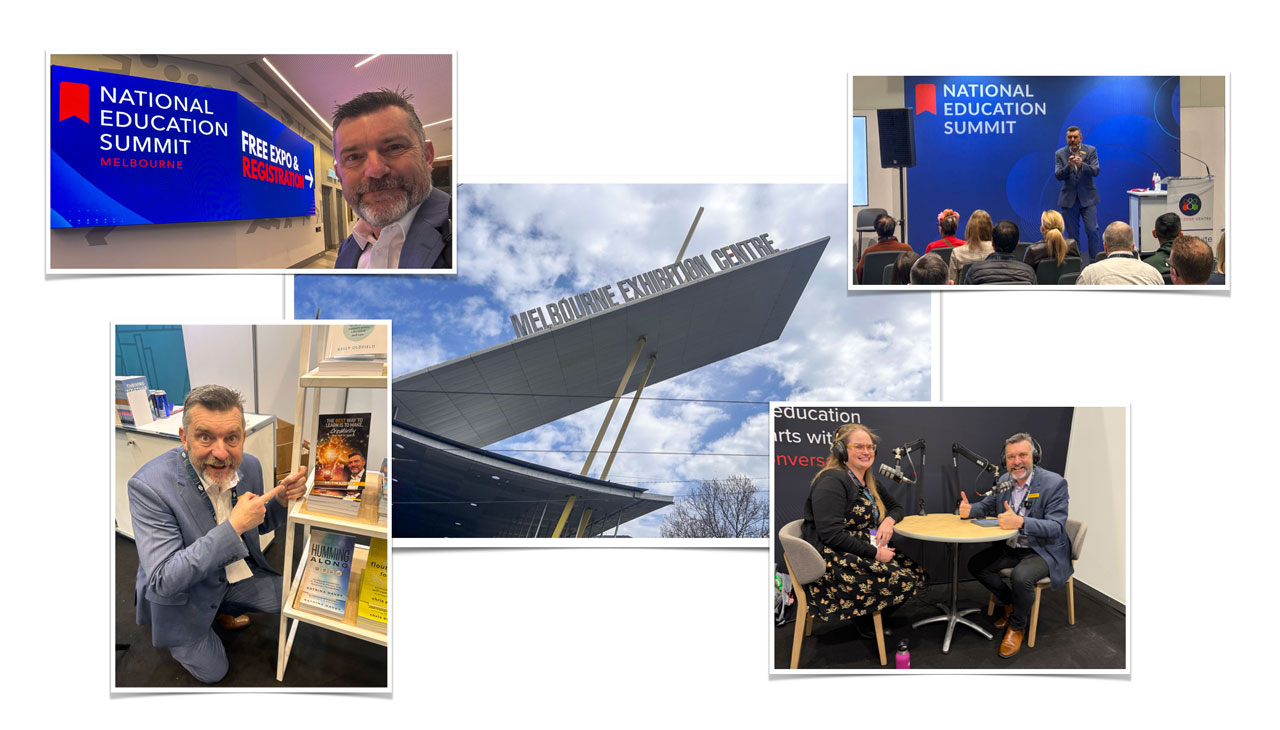
On 3 and 4 September, I had the great pleasure of being involved in the 2026 National Education Summit at the Melbourne Convention and Exhibition Centre.
This event brought together teachers, school leaders, education consultants, authors, researchers and industry partners for two days of professional learning, practical ideas and valuable conversations. With conference streams, free seminars and an extensive education exhibition, the Summit provides educators with many opportunities to learn, connect and be inspired.
My involvement across the two days included MCing, podcasting, presenting and book signing – four activities I thoroughly enjoy.
Day 1: Early Stages, podcasting and conversations with readers
My first role on Thursday was to MC the Early Stages Theatre. This free seminar program focused on early childhood and the early years of schooling, featuring a range of educators and specialists sharing practical insights and experiences.
One of the great privileges of being an MC is the opportunity to help create a welcoming environment for both presenters and audience members. It was a pleasure to introduce the speakers, learn from their work and help keep the program flowing throughout the day.

Director of Teaching and Learning,
Hume Anglican Grammar

Principal,
Tumut Public School
Between MC responsibilities, I moved across to the Summit’s Podcast Hub to record two special episodes of The Kitchen Think. My guests were Adrian Cotterell, Managing Director of Thinking Mode, and Tory Spicer-Stuart, Head of Teaching and Learning – Digital Practice at Beaconhills College. The Podcast Hub was located on the exhibition floor and hosted a curated series of live recordings featuring education podcasters, researchers, teachers and school leaders.


Adrian and I explored the increasingly complex relationship between assessment, generative AI and AI-detection software. We discussed why schools need to be cautious about relying too heavily on detection tools and why assessment practices must evolve to place greater emphasis on process, dialogue, reflection and evidence of learning. We also promoted his amazing assessment resource for schools called Thinking Mode.
Tory shared some of the thoughtful work taking place at Beaconhills College to integrate AI into teaching and learning. Our conversation also considered a much bigger question: what does it mean to be human in a world increasingly influenced by generative AI?
I also spent time signing books and meeting educators in the Amba Press Book Nook area. These sessions are about much more than simply adding a signature to a book. They provide an opportunity to speak directly with readers, hear about the challenges they are encountering in their schools and discuss the ideas that are most relevant to their work. This was an opportunity to promote my soon to come publication with Amba Press – The Human Advantage: Teaching, Learning and Leading in a Gen AI World.

For an author, there is something particularly rewarding about meeting the people who engage with your writing. Each conversation is a reminder that books can become the starting point for new thinking, professional dialogue and meaningful change.
Day 2: Exploring the Human Advantage
On Friday morning, I had the honour of opening the Knowledge Centre Theatre with my presentation:
The Human Advantage – how teaching and learning is changing in an AI-rich world

The session examined the rapid influence of generative AI on education and the need to reconsider some of our established approaches to teaching, learning and assessment.
AI can generate text, images, audio, video and computer code within seconds. It can help educators brainstorm ideas, differentiate resources, provide feedback and reduce time spent on repetitive administrative tasks. It can also support students as a creative partner, research assistant and thinking companion.

However, easy access to sophisticated AI-generated content also raises important questions. What does authentic student work now look like? How can teachers assess understanding rather than simply evaluate a polished final product? How do we help students use AI safely, ethically and transparently?
A key message from the presentation was that AI may change how we teach, learn and assess, but it does not diminish the importance of being human.
Our advantage lies in qualities such as curiosity, empathy, judgement, creativity, ethical reasoning and meaningful connection. These are not optional extras in education. They are central to the kind of people and communities we are trying to develop.
A highlight for me was seeing the work created by Marty from Sketch Group, a talented artist who visually captured the key ideas from my presentation as I spoke.


A valuable two days
Across both days, the strongest feature of the Summit was the opportunity to connect.
Whether I was MCing a theatre, recording a podcast, presenting to educators or signing books, the most valuable moments came through conversations with people who care deeply about education and the future of young people.


Events such as the National Education Summit remind us that educators do not need to navigate rapid technological and social change alone. By sharing our experiences, asking difficult questions and learning from one another, we can develop more thoughtful and human-centred responses.
Thank you to the National Education Summit team, the presenters, exhibitors, podcast guests, Amba Press and everyone who attended my session or stopped by for a conversation.
It was a busy, energising and inspiring two days, and a wonderful opportunity to celebrate the human advantage at the heart of education.
