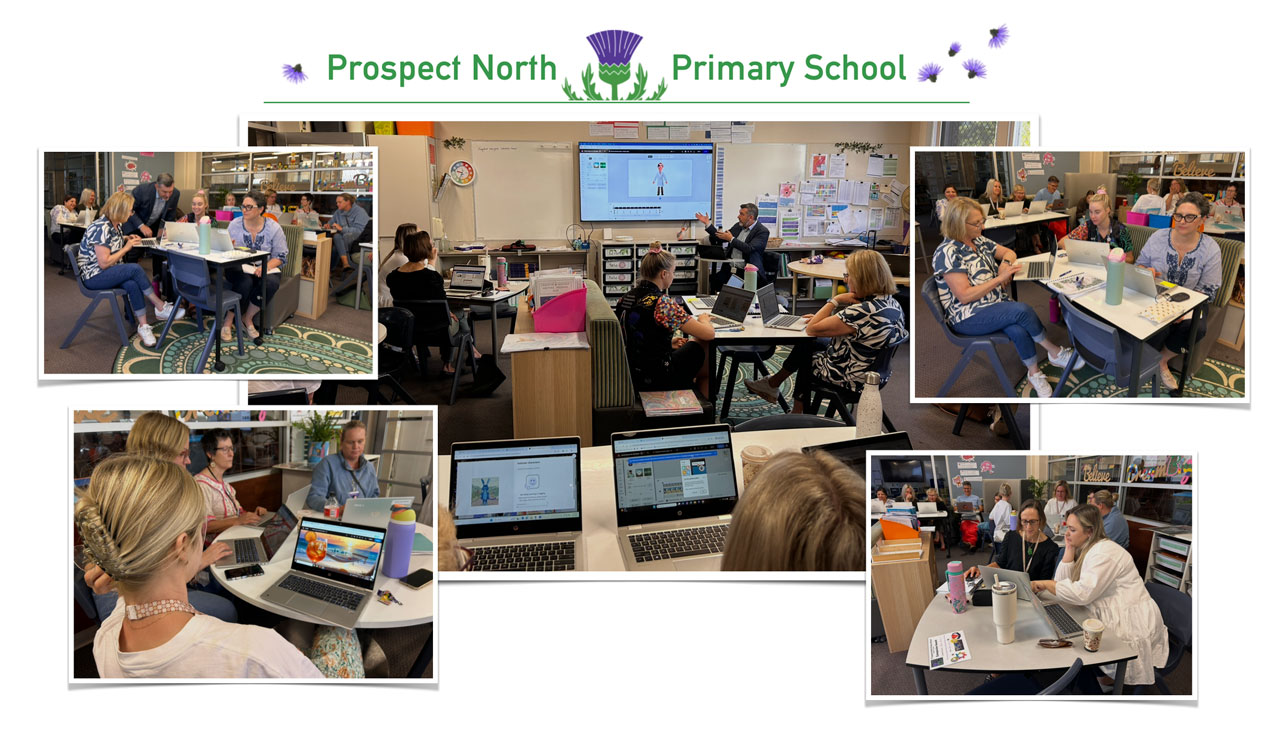
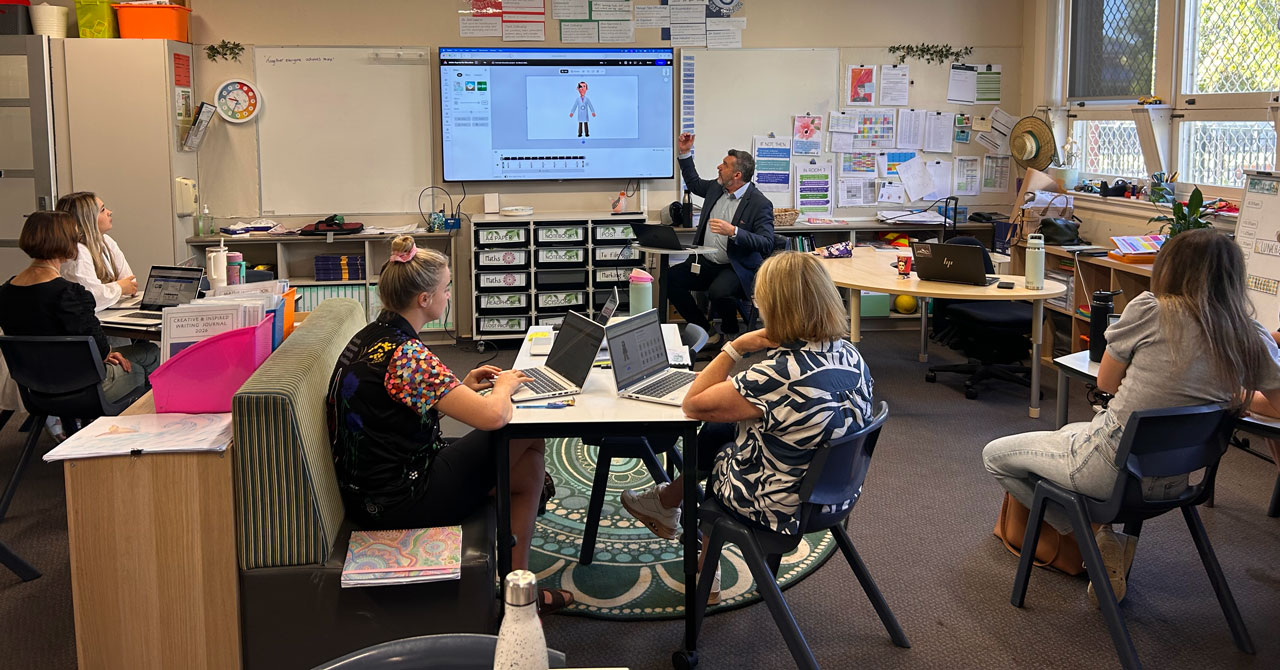
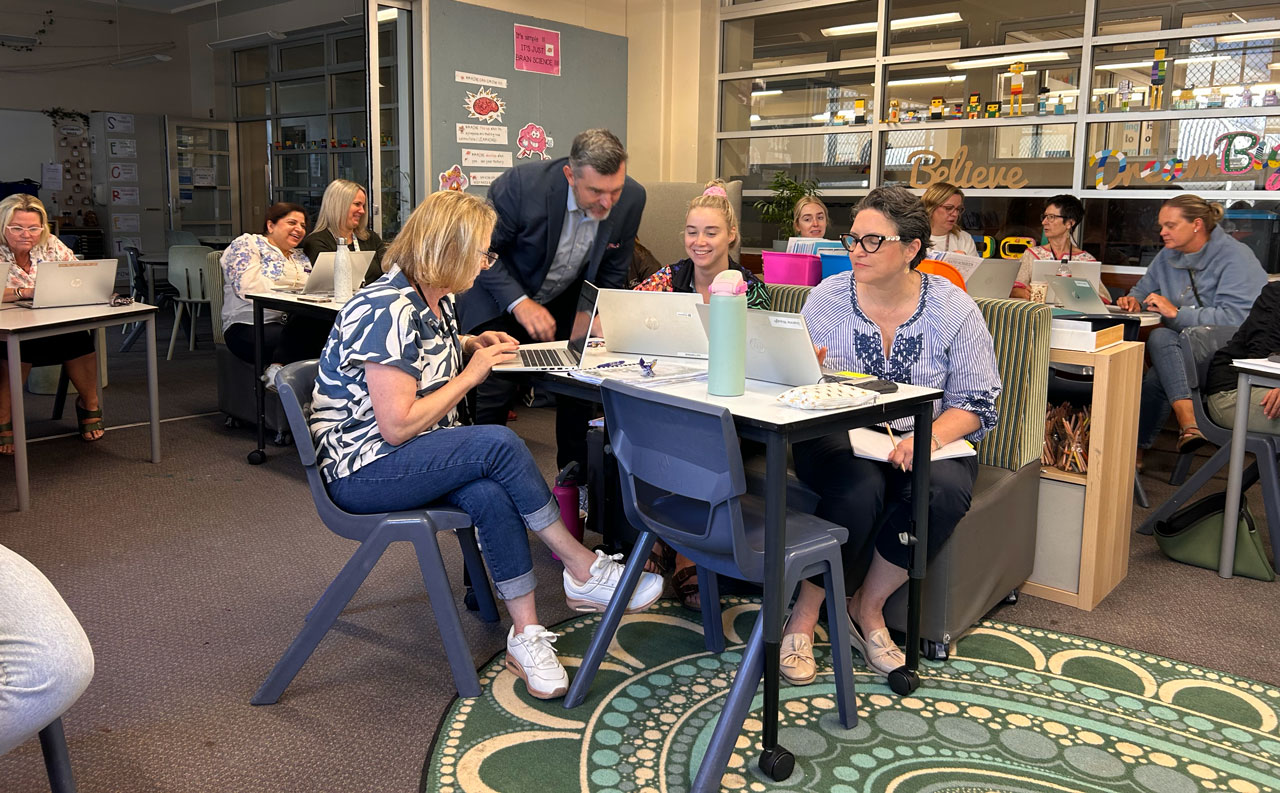
On Friday, 6 March 2026, I had the pleasure of running a workshop with the teaching staff at Prospect North Primary School in Adelaide. Our focus for the session was the safe and effective use of Generative AI in education.
This school is located in the inner-northern suburb of Prospect, about 5 km from the centre of Adelaide, South Australia. The school serves a diverse and multicultural community, with many students coming from a range of cultural and language backgrounds. With around 380 students enrolled, the school emphasises student agency, inquiry learning, and real-world problem solving, helping students develop skills such as communication, collaboration, digital literacy, and resilience.
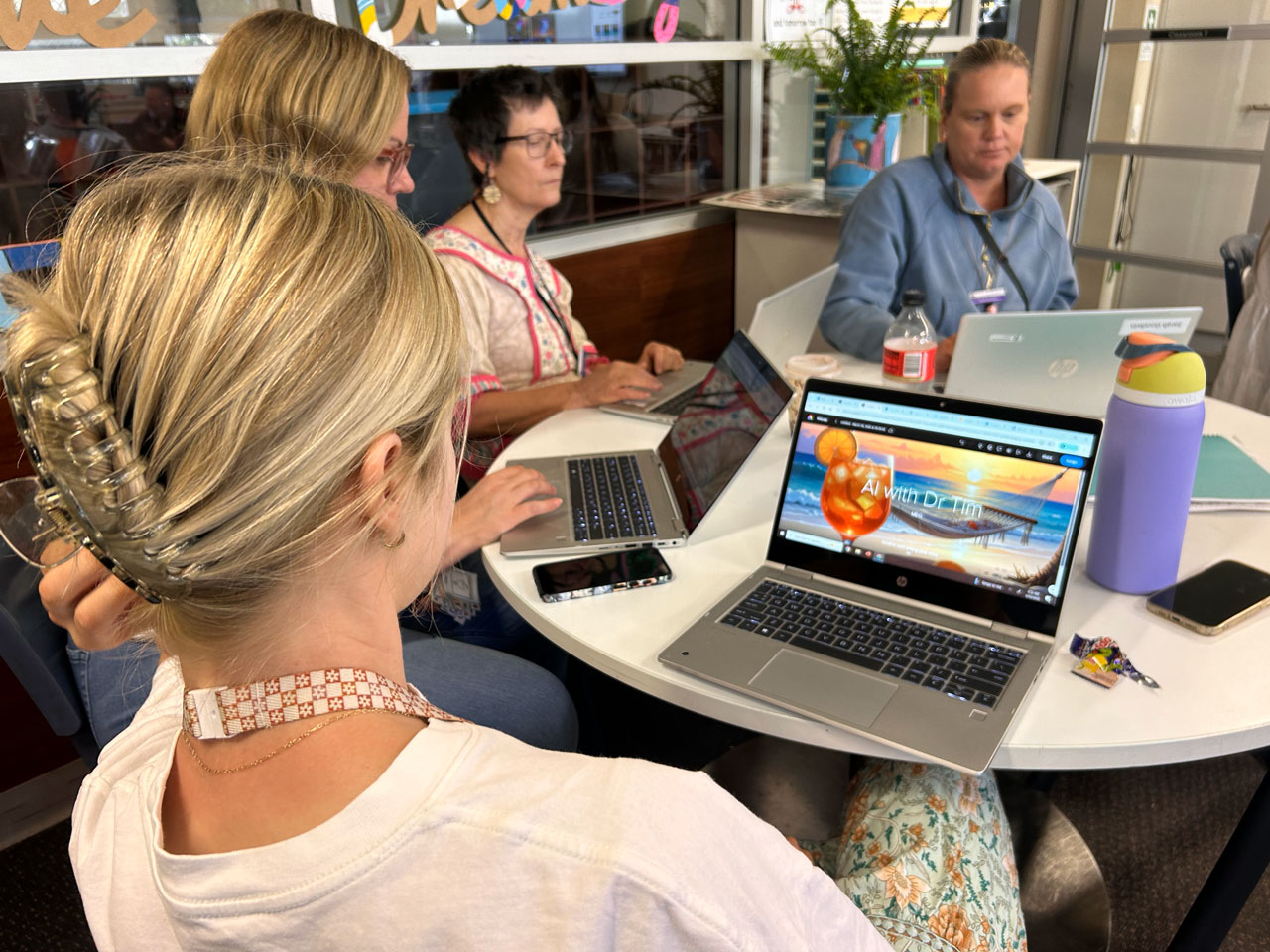
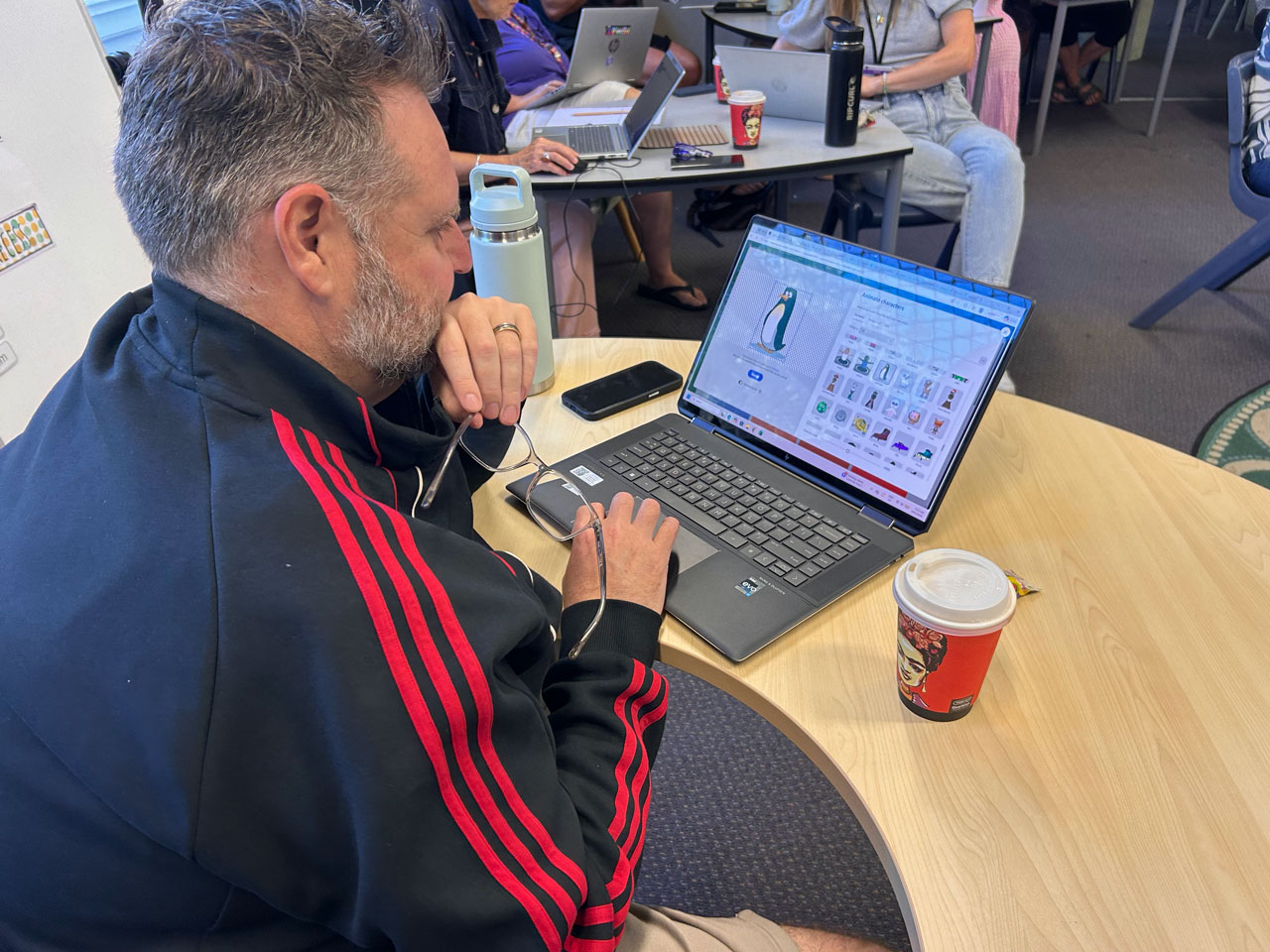
Throughout the workshop, teachers were encouraged to capture their key takeaways and reflections by creating a digital portfolio using Adobe Express which has been provided to them centrally by the South Australian Department for Education. It was a great way to document their learning as we went.
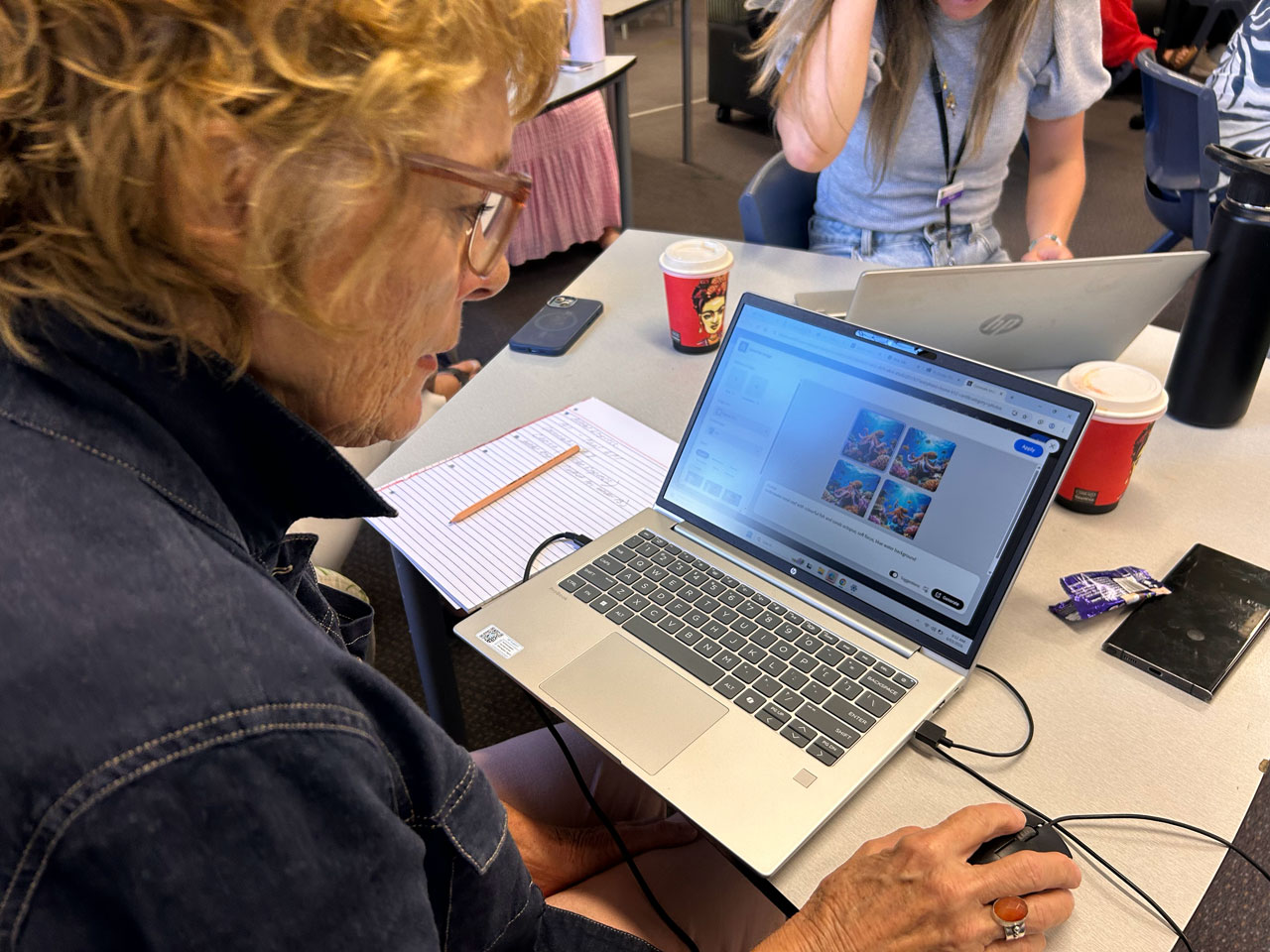
I also showed them how to use some of the AI features within Adobe Express to make short animated video content.
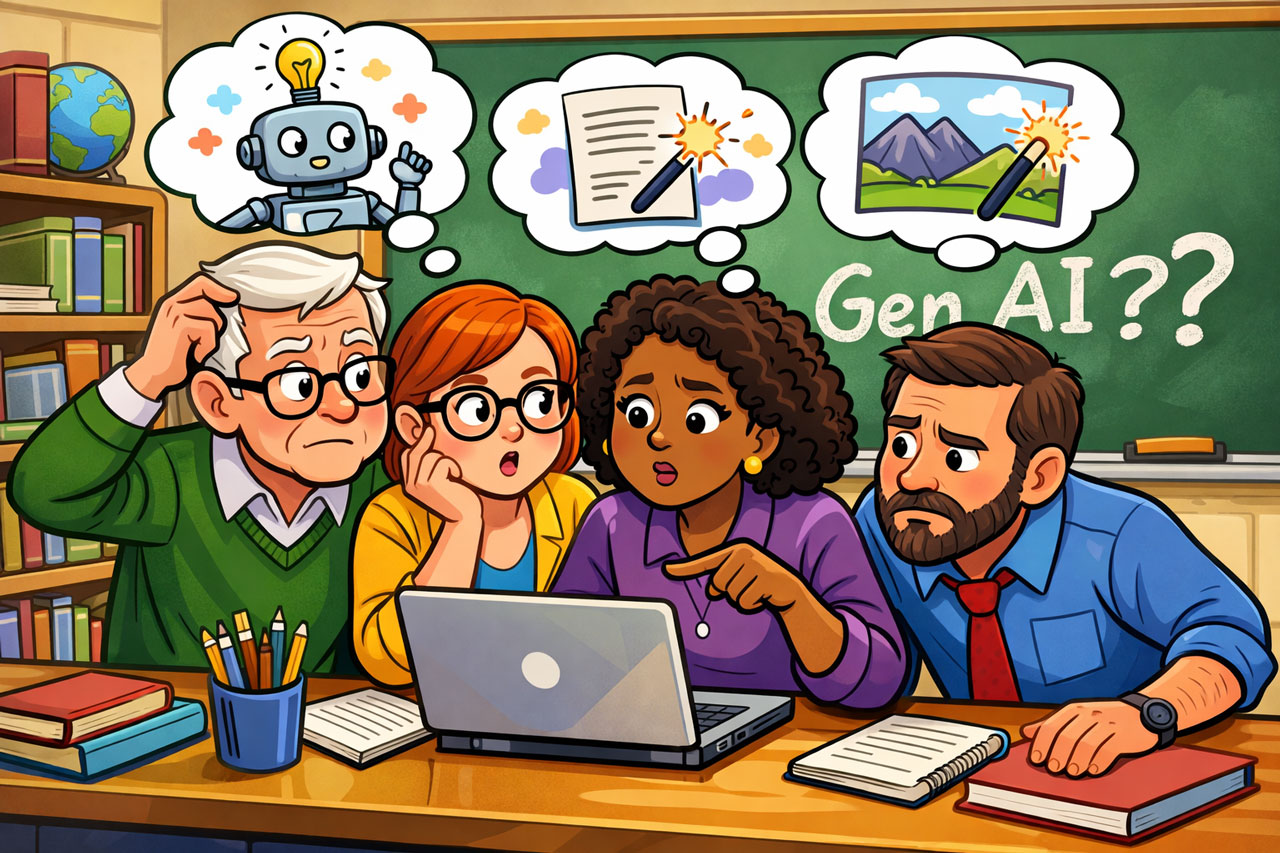
We explored the difference between AI and Generative AI, unpacking what these terms actually mean in practice. From there, we had some really thoughtful discussions about the opportunities AI presents in a primary school setting, as well as some of the challenges and considerations that come with using these tools responsibly.
We worked through a Gen AI use survey to help understand gen AI use by the teaching staff over the past 6 months and compared some of the results with the national study I did earlier this year.
We looked at
ways that gen AI tools are being used by the teachers
the effect of gen AI tools to help reduce their overall workload
concerns that teachers have about the use of gen AI
I introduced the teachers to a range of resources such as:
Leon Furze and I have collaborated on this new course that responds to the growing anxiety among educators that generative AI tools may replace creative thinking, originality, and student effort. Rather than positioning AI as a threat, the course re-frames creativity as the essential human capability that gives learning meaning, relevance, and integrity in an AI-rich world.
This course is now available to purchase for AUD $80 via Leon’s site …
Share the course with your colleagues, discuss the ideas in faculty meetings, and use it as a springboard for deeper reflection about what truly makes learning human. In a time of rapid change, collective wisdom is powerful and this is a chance to lead it.
Enterprise rates are available for schools wanting groups of staff to do the course.
I also run a 1-hour after-school in-person version of the course which is often part of an (whole day or half-day) incursion with students focused on safe & ethical AI use.
A free practical starting point for schools navigating the AI shift
It seem like just about every week there’s a new tool, a new headline and a new promise about how AI will transform learning & teaching.
In most places I visit, whether I’m working with primary teachers, secondary school, TAFE/Uni educators, school leaders or students, I hear the same questions:
Which tools are actually safe for students?
Which ones are genuinely useful for teaching and learning?
Which platforms are appropriate within Australian school contexts?
And how do we integrate AI responsibly without getting caught up in hype?
This is why I created Generative AI Tools Used by Teachers, a free practical, educator-focused web resource designed to bring clarity to a rapidly changing landscape.
Over the past few years, I’ve worked closely with schools across Australia and New Zealand supporting safe and ethical AI integration. What’s become clear is this:
Teachers don’t need more noise. They need trustworthy information.
They need to know:
What a tool actually does (beyond the marketing)
Who built it
Whether it aligns with school policies and system requirements
What the risks and limitations are
And how it might realistically support learning
This resource was built with those needs front and centre.
The site features a growing collection of generative AI tools that are already being used in schools.
When you click on any tool, you’ll see:
What it is – A clear explanation in plain language
Who built it – So you understand the organisation behind the platform
Its ST4S (Safer Technologies 4 Schools) status in ANZ – Critical for compliance and procurement decisions
Key pros and cons – The strengths and limitations
What teachers need to know before using it – Practical considerations around privacy, age-appropriateness, implementation and classroom impact
No hype. No exaggerated claims. No fear-based messaging.
For many schools, especially within government systems, ST4S badging is a crucial part of decision-making. It helps leaders evaluate privacy, security and data compliance in a structured way.
By including this information upfront, the aim is to remove uncertainty and save schools time in their due diligence process.
Please contact me if your school is looking for some extra support in this area.
Creativity isn’t just about making something that looks impressive. It’s not reserved for artists, designers or musicians. At its heart, creativity is deeply human. It’s our ability to make meaning, notice patterns, connect ideas, ask better questions, imagine alternatives and respond thoughtfully to what’s happening around us.
Generative AI (gen AI) can absolutely support creative work. But it doesn’t have creativity. It can produce outputs that look creative. It can remix, recombine and generate at astonishing speed. But true creativity itself? That’s still a human capability.
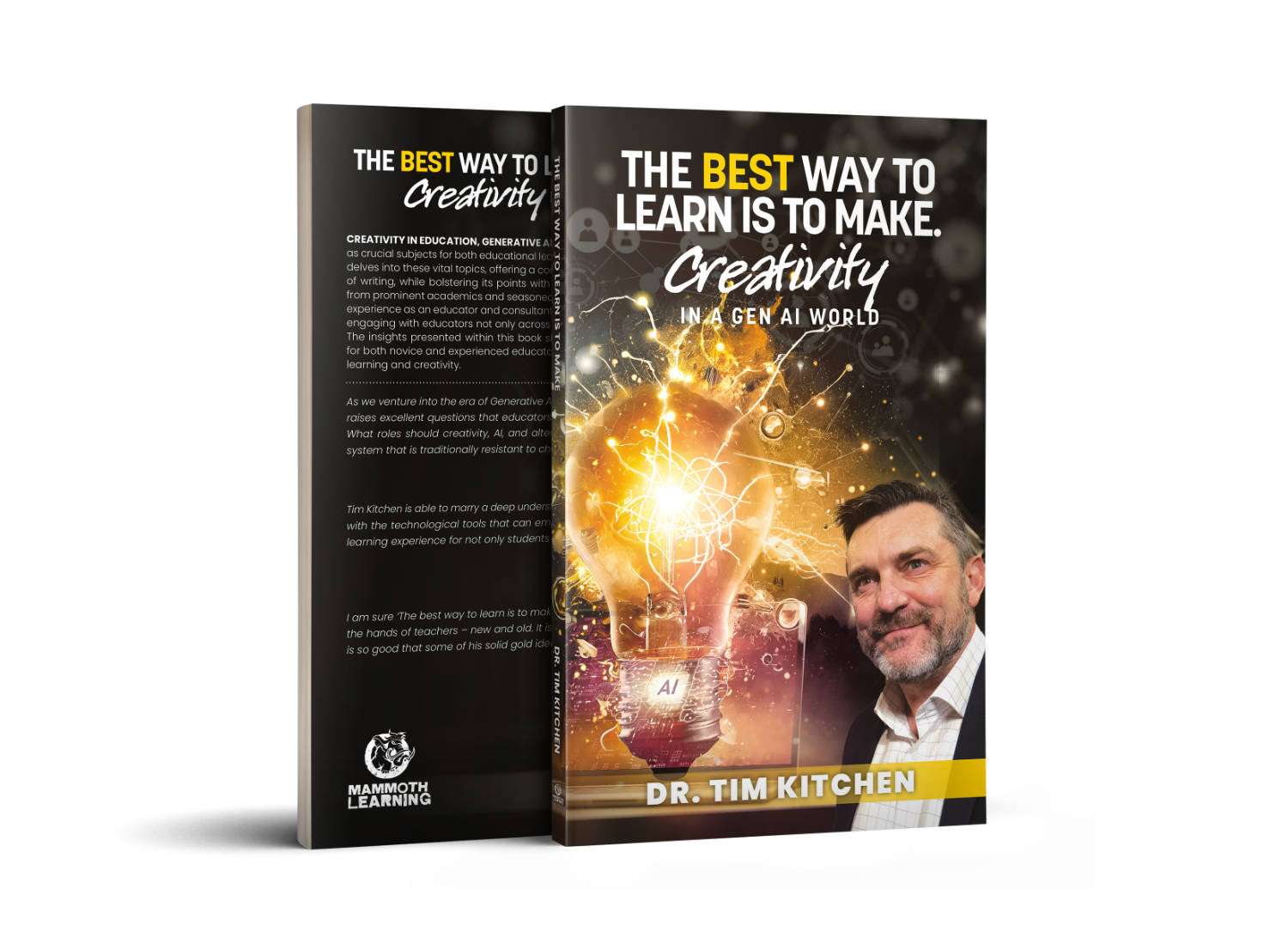
In Chapter 2 of my book, The Best Way to Learn is to Make – Creativity in a Gen AI World(available through Amazon), I explore a range of definitions from world-leading experts and classroom teachers. One of those experts is Dr Ellis Paul Torrance from the University of Georgia. He describes creativity as including uniqueness, fluency, flexibility, elaboration, humour and the avoidance of premature closure. He also talks about creativity as becoming sensitive to problems, gaps in knowledge, missing elements and disharmonies.
I really like that definition. Partly because it includes humour. And partly because it highlights persistence. In my years as a classroom teacher (and now in workshops and keynotes) I’ve seen how humour helps people relax even if my jokes don’t quite land (which of course is very rare 😉). When people feel safe and relaxed, they’re more willing to try, to experiment, to risk being wrong and be more open to the learning process (Edmondson, 2018).
I’m also drawn to that idea of avoiding premature closure. Real creativity isn’t about rushing to the first acceptable answer. It’s about staying with the problem. Sitting in the uncertainty. Letting ideas evolve. That takes effort. It takes resilience. It takes time.
Sir Ken Robinson framed creativity as the process of having original ideas that have value. I love the clarity of that. Creativity isn’t just originality for its own sake. It has to matter. It has to connect. It has to be useful, meaningful, or transformative in some way.
Sir Ken consistently argued that creativity isn’t a niche talent reserved for the arts. It’s a universal human capacity. In his famous 2006 TED Talk, Do Schools Kill Creativity?, he challenged schools for prioritising standardisation and conformity over imagination. His point wasn’t that schools are the enemy. It was that systems can unintentionally narrow human potential if we’re not careful.
In his 2009 book The Element, he explored how people flourish when passion intersects with opportunity. And in Creative Schools (2015), he called for learning environments that nurture curiosity, innovation and human potential more intentionally.
The thread running through all of his work is simple: creativity is human. It’s rooted in imagination, judgement and meaning-making. And when you unpack it, creativity usually involves things like:
Intent – choosing why you’re creating something
Judgement – deciding what’s meaningful, ethical or appropriate
Context – understanding audience, culture and consequence
Risk – stepping into uncertainty without a guaranteed answer
Meaning-making – expressing identity, values or purpose
Now compare that with generative AI.
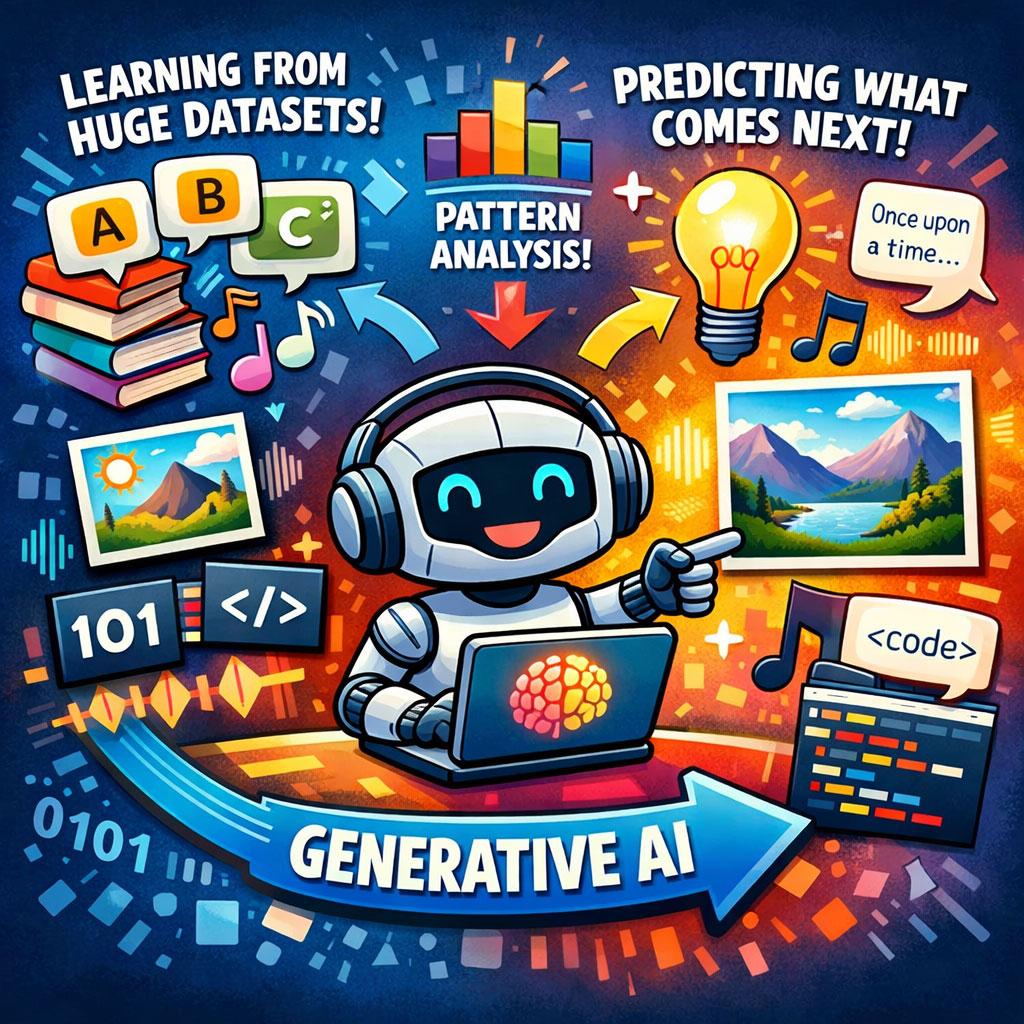
Generative AI doesn’t intend anything. It analyses enormous datasets of human work. It learns statistical patterns across language, images, sound or code. It produces outputs by predicting what is most likely to come next.
It’s very good at mimicry. It’s very good at variation. It’s very good at speed. It’s very good at filling in gaps. But it doesn’t care if something matters. It doesn’t understand truth, beauty or value. It doesn’t experience curiosity, doubt or emotion. It doesn’t know why an idea is worth pursuing.
When gen AI “creates”, it isn’t expressing insight. It’s executing probability. That doesn’t make it useless. Far from it. Gen AI lowers the friction of making. It helps people get started. It handles drafts and variations. It removes some technical barriers. It can expand what students feel capable of trying. It can solve that intimidating “blank page” problem that so many learners struggle with.
But deciding what matters? Judging quality? Revising with purpose? Connecting ideas to lived experience? That’s still human work.
Real creativity is messy. It involves uncertainty, false starts, failure, emotional judgement and context. It’s shaped by who we are and what we care about. A scientist forming a new hypothesis. A teacher redesigning a lesson because students are disengaged. A student finding a new way to explain an idea when the first attempt doesn’t land.
That’s creativity.
Gen AI can generate amazing looking images, it can write poems, generate songs and remix ideas at lightning speed. But it doesn’t care, it doesn’t understand meaning, it doesn’t feel tension, curiosity, or purpose. It doesn’t wrestle with doubt or make value-based decisions. AI predicts patterns, humans make judgements.
Gen AI can assist creativity. It can amplify it. It can spark it. But it can’t own it.
That’s why creativity matters more than ever in education. Not as an optional extra. But as a core human capability embedded across the curriculum.
The future won’t belong to those who produce the fastest answer. It will belong to those who can frame better problems, question assumptions, adapt when things change and bring human insight into complex situations.
Those are creative acts. And they are deeply human.
Creativity isn’t disappearing because of AI. If anything, it’s being clarified. It’s not about competing with machines. It’s about doing what machines can’t.
And that feels like something worth protecting and designing learning around.
Invite Dr Tim Kitchen to your school …
With more than three decades in education, including 23 years in the classroom and 13 years as Adobe’s Senior Education Specialist for Australia, New Zealand & South East Asia, Tim now runs CTL – Creative Teaching & Learning, an education consultancy supporting schools to implement safe, ethical, and creative AI practices that strengthen teaching and learning.
Edmondson, A. C. (2018). The fearless organization: Creating psychological safety in the workplace for learning, innovation, and growth. John Wiley & Sons.
Kitchen, T. (2024). The Best Way to Learn is to Make – Creativity in a Gen AI World, Mammoth Learning (available through Amazon see – https://timkitchen.net/book1/
I have a new book out but it’s not about EdTech. It’s called An Australian Manufacturing & Mission Success Story and it’s about the gradual rise of a successful manufacturing business that had it’s origins during the 1850s Gold Rush in Victoria. It also traces the growth of evangelical Christianity in Melbourne’s eastern suburbs and lots more.
At its heart, the book is about people. It’s about faith that lasts, love that’s handed down, a commitment to serving others, and the quiet strength of family across generations.
Click here to see the results of my recent gen AI in K-12 education survey.
Around 200 K–12 teachers from across Australia and New Zealand shared how they’re actually using generative AI in their day-to-day work. It makes for some genuinely interesting reading.
You’ll discover which generative AI tools they’re using most, how they’re using them, whether they’re saving time, the level of support they’re getting, and plenty more besides.
If you would like me to run a similar survey for your school as well as some practical workshops, feel free to contact me via – https://timkitchen.net/ctl/
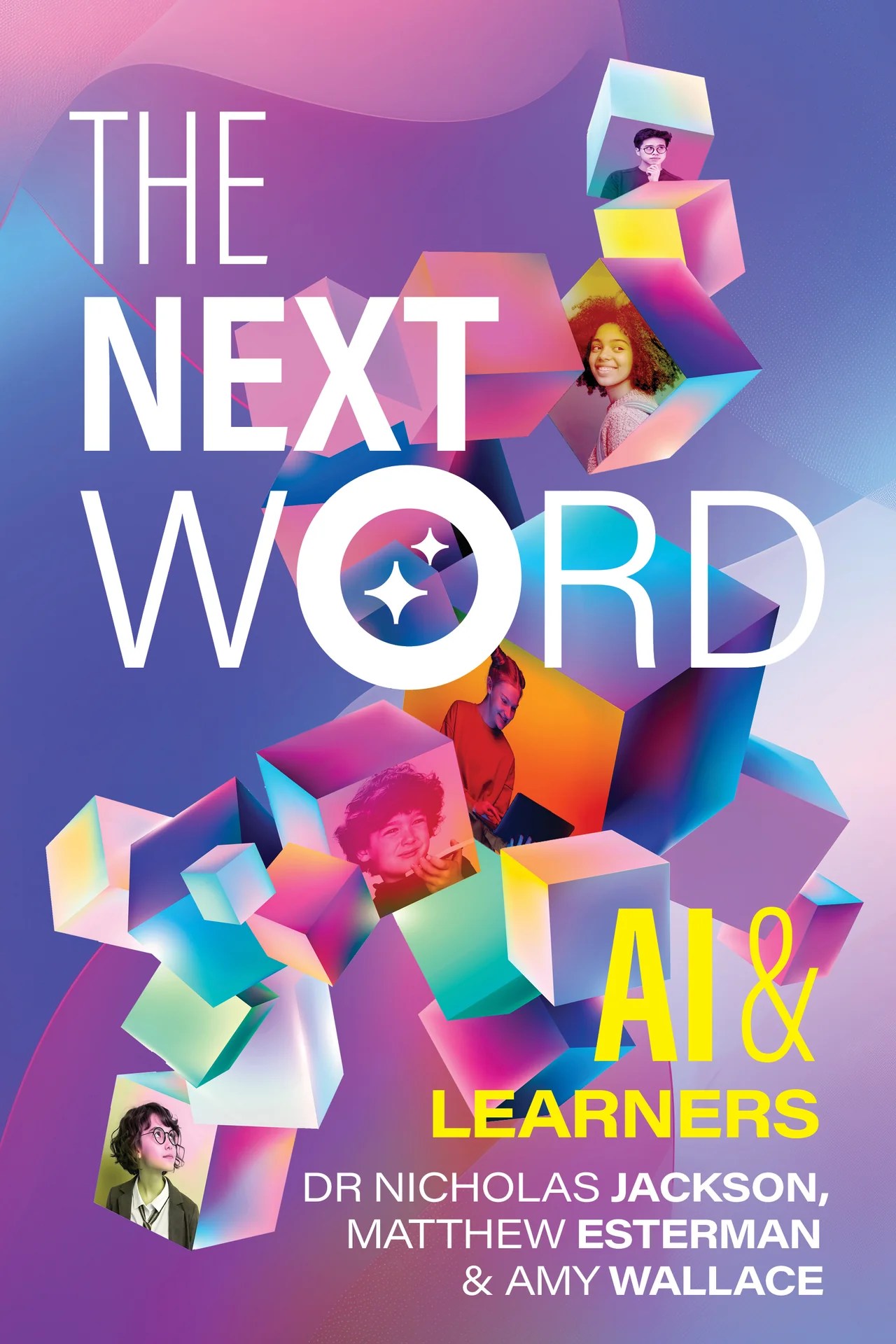
I recently finished reading The Next Word – AI & Learners, Dr Nick Jackson & Matt Esterman’s new book featuring the thoughts of student Amy Wallace on the effective use of gen AI tools in education.
The Next Word – AI & Learners challenges educators to stop asking whether AI should be allowed in schools and start asking what kind of learning really matters in a world where intelligent tools are everywhere. Drawing on research, classroom realities, and powerful student voice, the book re-frames AI not as a cheating threat or a passing trend, but as a learning partner that exposes long-standing cracks in assessment, curriculum design, and school structures.
One of favourite quotes from Amy …
So, here’s the challenge: instead of trying to catch students out, what if schools asked harder questions about the value of their assessments? What’s core and what’s fluff? What’s essential and what’s just tradition?
The book argues that AI hasn’t broken education, it has simply revealed how much schooling has prioritised compliance, performance, and busy work over deep thinking, creativity, and genuine understanding. For teachers and leaders, this is a call to shift focus from controlling learning to understanding how students learn, reflect, collaborate, and grow.
What makes this book especially compelling is its strong ethical lens and its inclusion of student perspectives, particularly through contributions from Amy. The book tackles hard questions around equity, bias, well-being, environmental impact, and the growing cultural disconnect between how students live and how schools operate. It urges schools to move beyond bans and surveillance, and instead prepare young people to use AI wisely, critically, and creatively as thinkers, problem-solvers, and ethical humans.
The Next Word – AI & Learners is not a “how-to” manual for tools; it is a deeply human guide for educators navigating the biggest shift in learning since the internet, reminding us that while AI may be the smartest presence in the room, wisdom, compassion, and courage still belong to us.
The 30th of November, 2022 became a landmark moment for both education and modern society. That was the day OpenAI released ChatGPT to the public as a free, large language model (LLM) and almost overnight, everything shifted.
LLMs had been around for a number of years prior to the launch of Chat GPT. They slowly grew out of decades of work in linguistics, statistics, and artificial intelligence. The big breakthrough came in 2017 with a new approach called Transformer architecture. Instead of looking at words one at a time, it allowed computers to understand how words relate to each other across whole sentences and paragraphs. This made it possible to train AI on huge amounts of text and helped it recognise patterns in meaning, grammar, and intent in ways that had never been possible before (Tucudean et al, 2024).
The secret behind the success of ChatGPT was that it was free and easily available via a browser. Teachers and students alike were drawn to what felt like the next big thing in technology. Suddenly, this new tool was being explored for writing and refining assessment tasks, generating lesson plans, images, songs, videos, quizzes, and streamlining everyday teaching work. What had once felt experimental or futuristic quickly became part of daily conversations in staff rooms and classrooms, signalling that something genuinely different, and potentially transformative, had arrived in education.
Almost overnight, ‘gen AI’ became a buzzword, but for many, it also felt like the latest threat to traditional approaches to schooling. What began as uncertainty and concern quickly turned into widespread curiosity and experimentation. Just over three years on, it’s not unusual to find dozens of gen AI tools being used regularly by both teachers and students to support learning, enhance assessment, help with planning, solve the creativity blank page issue, and problem-solve.
From COVID lock-downs to Gen AI
Those of us who were early adopters of computers in the classroom in the 1990s and advocates for 1:1 laptop programs were constantly fighting against a very traditional, slow to change, system. Even though digital technologies had been in schools since the mid 1980s, there was still a strong reluctance to change. It seemed as though just about every aspect of society (such as banking, shopping, communicating and being entertained) was centred around a digital device but education was still predominantly face to face with a focus on handwritten assessments. The interruptions to traditional classroom experiences caused by COVID lock-downs in 2020 & 2021 forced some quick changes when most teachers and students had to work digitally (many for the first time).
When schools finally emerged from COVID lock-downs, there was a sense of hope that teachers would keep building on the increased access to digital technologies that had become part of their everyday work practice. Instead, almost the opposite happened. Many teachers, understandably exhausted by months of remote learning, were keen to step away from screens altogether, eager to return to familiar, face-to-face practices after being forced to rely so heavily on digital tools during lock-down.
For many teachers, the sudden and sustained shift to remote learning was exhausting, with studies describing heightened stress, increased workload, and a sense of having to “start teaching all over again” in unfamiliar digital environments. Prolonged screen time, constant videoconferencing, and what researchers describe as ‘technostress’ contributed to widespread digital fatigue and burnout. As a result, when face-to-face teaching resumed, many educators were eager to step away from screens altogether, not because they rejected technology outright, but because it had become so closely associated with crisis teaching, emotional strain, and survival rather than thoughtful, creative pedagogy (Bond, 2020).
Then Chat GPT happened and adoption of technology across most of the K-12 curriculum dramatically increased. Researchers have observed that “AI tools are flooding K-12 classrooms,” with solutions like ChatGPT widely adopted despite ongoing evaluation of their effects (Loeb, 2025). These trends suggest that Chat GPT’s emergence has coincided with (and arguably accelerated) a dramatic increase in technology adoption across the K-12 curriculum and a broader rethinking of schooling practice far greater than the adoption forced by COVID lock downs.
A change to teaching & learning
The rapid shift towards the use of a range of gen AI solutions has exposed a long-standing tension in education. For decades, schooling has largely centred on the final product, the exam paper, the test, the essay, or the polished project handed in at the end of a unit. But when gen AI tools can now produce highly convincing end products with very little student input, the spotlight has inevitably moved.
Increasingly, the real value lies not just in what students submit, but in how they got there, the thinking, decision-making, drafts, feedback, reflection, and growth that happened along the way. In many ways, gen AI has forced educators to pay closer attention to the learning process itself. A need in education that has been well over due.
Linking back to Benjamin Bloom
The rapid rise of gen AI tools in schools has quietly pushed educators back to something that had been sitting there all along: Bloom’s Taxonomy and its focus on how learning actually happens. Back in 1956, American educational psychologist Benjamin Bloom mapped out a series of learning stages that moved well beyond memorising facts for a test. Then, in 2001, those ideas were refreshed to better reflect a progression toward deeper thinking and creativity, rather than just recall (Kitchen, 2024).
Now, with gen AI able to produce polished essays, images, code, or presentations in seconds, the final product on its own tells us far less than it once did. As a result, teachers are paying much closer attention to the processes Bloom highlighted such as questioning, analysing, evaluating, creating, reflecting, and revising. The real value lies in how students plan their work, test ideas, make decisions, explain their thinking, and respond to feedback, not just in what they hand in at the end.
Used transparently and ethically, gen AI can actually strengthen this shift. It can support brainstorming, help students refine drafts, and encourage reflection on their thinking, making the learning journey more visible. In many ways, gen AI hasn’t made Bloom’s work outdated; it has reinforced its relevance. It is a timely reminder that deep learning isn’t best measured by a finished product, but by the growth, thinking, and decision-making that happen along the way.
Rethinking assessment
Well before gen AI entered classrooms, research on formative assessment and visible learning emphasised the importance of drafts, feedback, and reflection in supporting student growth. The landmark work of Paul Black and Dylan Wiliam demonstrated that formative practices such as peer feedback, iterative drafts, and metacognitive reflection have a significant impact on learning outcomes (Black & Wiliam, 1998). Similarly, the OECD has consistently argued that modern assessment must value problem-solving, reasoning, and learning progression, not just task completion, particularly in complex, real-world contexts where answers are rarely linear or fixed (OECD, 2023).
In practical terms, schools are responding by redesigning assessment tasks requiring annotated drafts, design journals, digital portfolios, version histories, reflective commentaries, reflective podcasts, oral explanations of thinking and video reflections. Many teachers now also ask students to document how AI tools were used, what prompts were tried, what outputs were rejected, and how ideas were refined, turning AI from a shortcut into a thinking partner. This aligns with guidance from Education Services Australia (ESA), which encourages schools to focus on transparency, ethical use, and student reflection when integrating gen AI into assessment design (Australian Framework for Generative Artificial Intelligence (AI) in Schools, 2023).
The gen AI evolution has exposed an over-reliance on the end product in traditional schooling. It has accelerated a necessary correction, pushing educators to value growth, judgement, and decision-making as core learning outcomes. Both the Australian Curriculum, Assessment and Reporting Authority and the OECD note that future-ready learners must be able to explain how they think, adapt feedback, and justify choices, skills that cannot be meaningfully assessed through a single artifact alone (Australian Curriculum, Assessment and Reporting Authority, 2022).
Gen AI has forced education systems to confront a truth long overdue: authentic assessment has always been about the journey, not just the destination.
Invite Tim Kitchen to your school …
With more than three decades in education, including 23 years in the classroom and 13 years as Adobe’s Senior Education Specialist for Australia, New Zealand & South East Asia, Dr Tim Kitchen now runs CTL – Creative Teaching & Learning, an education consultancy supporting schools to implement safe, ethical, and creative AI practices that strengthen teaching and learning.
Anderson, L. W., & Krathwohl, D. R. (Eds.). (2001). A taxonomy for learning, teaching, and assessing: A revision of Bloom’s taxonomy of educational objectives. Longman.
Bond, M. (2020). Schools and emergency remote education during the COVID-19 pandemic: A living rapid systematic review. Asian Journal of Distance Education, 15(2), 191–247. Online available (January 2026) https://zenodo.org/records/4425683
Kitchen, T. (2024). The Best Way to Learn is to Make – Creativity in a Gen AI World. Mammoth Learning
Tucudean G, Bucos M, Dragulescu B, Caleanu CD. 2024. Natural language processing with transformers: a review. PeerJ Computer Science 10:e2222. online available (January 2026) https://doi.org/10.7717/peerj-cs.2222
Tim’s book
The Best Way to Learn is to Make – Creativity in a Gen AI World
This book draws together Tim’s understanding of future directions in technology as well as his deep understanding of what students need in our classrooms. It is essential reading for all teachers (Dr Helen Hughes).
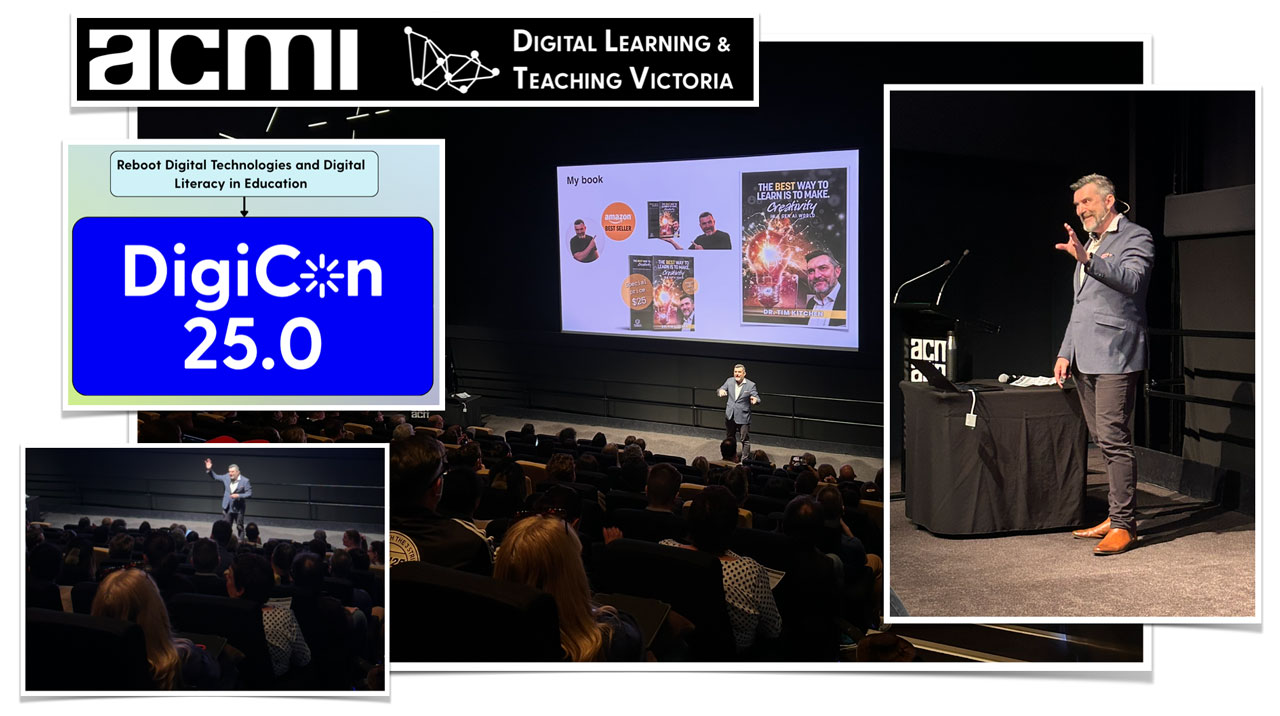
On Thursday 27 November 2025, I had the pleasure of doing the opening keynote address at DigiCon in Melbourne, a fantastic conference jointly run by ACMI and DLTV. It felt a bit like coming home. I bumped into so many familiar faces, people I’ve known since my days as the inaugural VP of DLTV and VP of VITTA.
At the same time, it was wonderful meeting a whole range of new educators, all buzzing with ideas and just as passionate as ever about strengthening digital literacy and creativity in their classrooms.
A real highlight was spending some time with the lovely Paula Christopherson, who was recognised as a Life Member of DLTV. Seeing her honoured for her dedication and contribution over so many years was truly special.
With Paula ChristophersonWith Catherine Newington from ACS
There was a lot of interest in my book and a number of teachers has purchased it previously and shared how much they enjoyed reading it.
I would like to thank the conference committee and especially Jacqueline Manison, the current President of DLTV for inviting me.
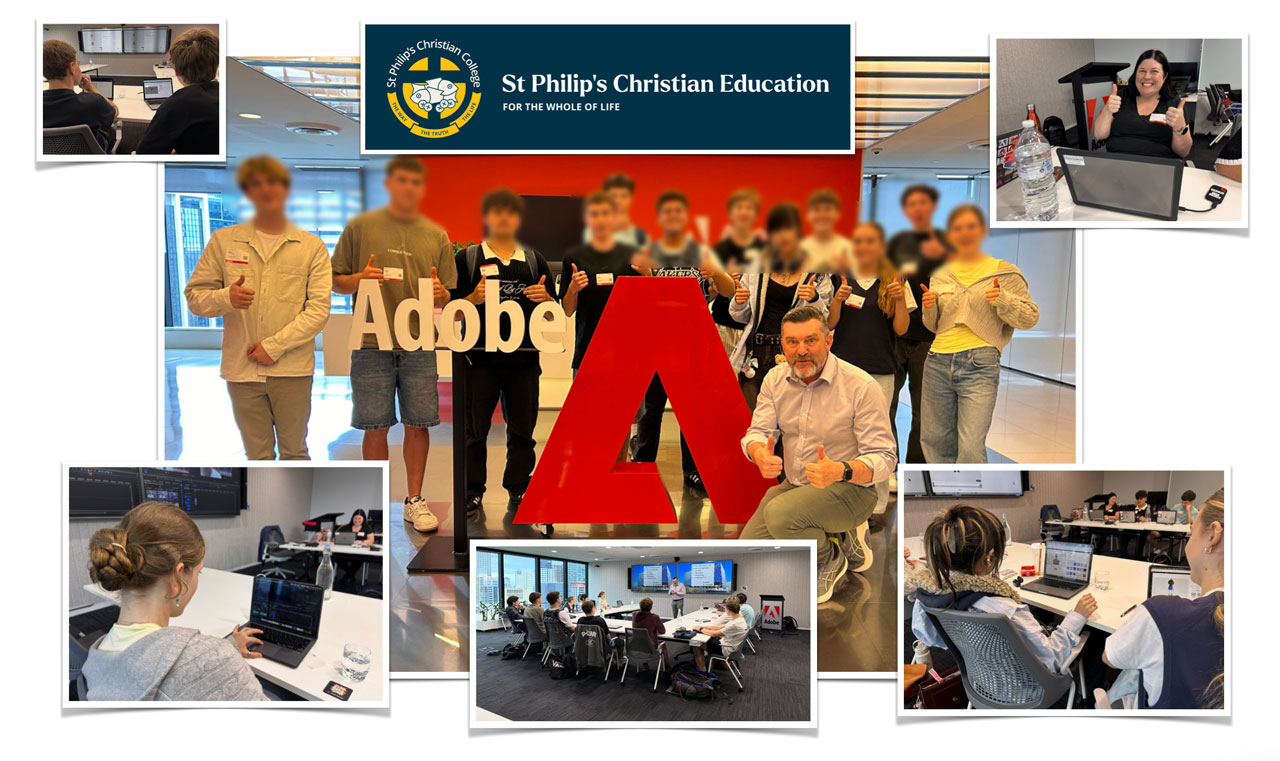
On Saturday 1st November, a wonderful group of media and arts students from St Philip’s Christian College in Newcastle visited the Adobe Sydney office as part of a city experience camp.
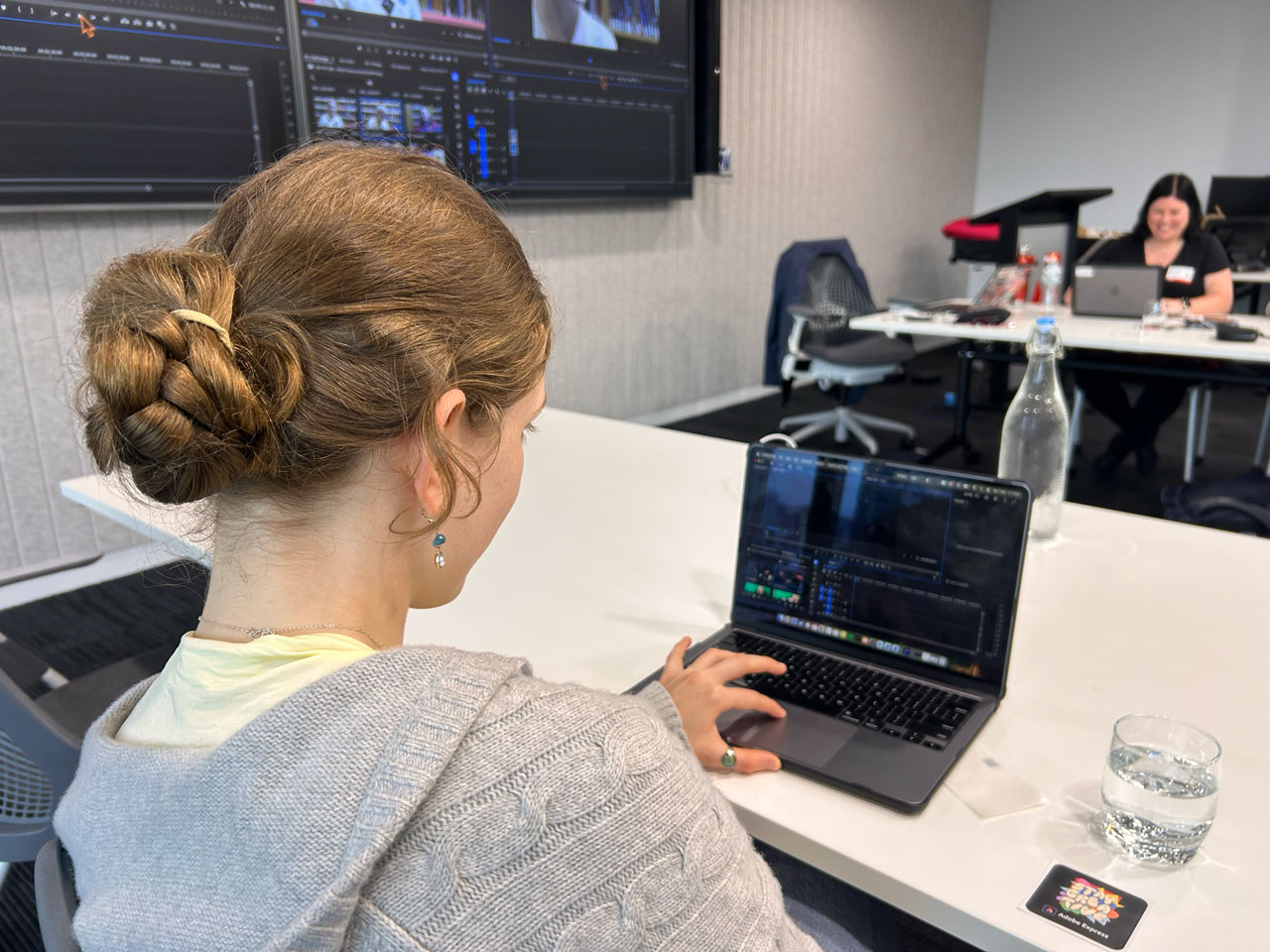
The aim of this event was to spend 4 hours getting to know more about Adobe Premiere Pro to help prepare the students for a range of media projects and for a future life of video communication.
Learning Adobe Premiere Pro is a great way for students to build powerful communication and video literacy skills. In today’s world, video is one of the most engaging ways to share ideas, tell stories, and make an impact — and Premiere Pro gives students the tools to do just that. As they plan, film, edit, and produce their own videos, they learn how to communicate clearly, think critically about visual storytelling, and collaborate creatively. These are skills that go far beyond the software — they’re essential for success in any modern career.
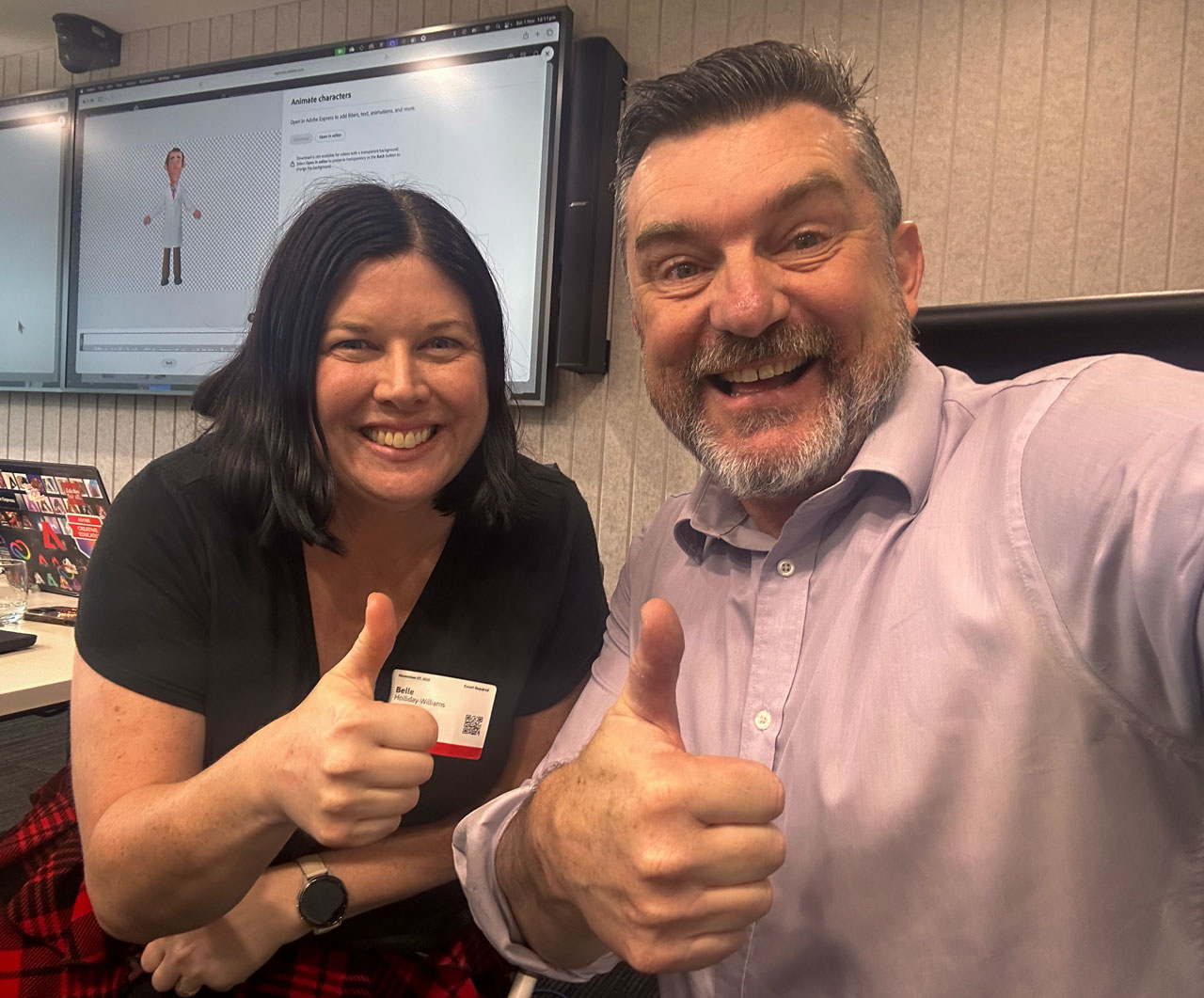
It was a pleasure to work with Adobe Creative Education (ACE) Belle Holliday-Williams (Leader of Student Media) at St Philips to make this experience possible for her students.










 Dr Tim Kitchen